


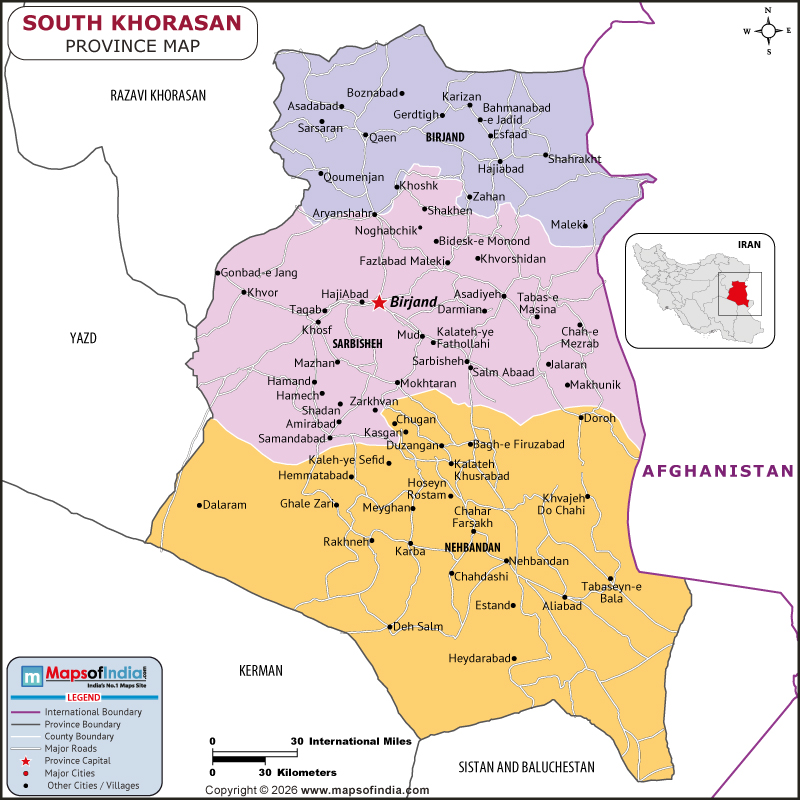



The South Khorasan Province is one of the richest yet the least densely populated provinces in Iran, lying in the easternmost areas of this country where the Persian plateau collides with the inhospitable deserts of the Central Asian region. South Khorasan was founded on 29 September 2004 as a result of the partitioning of the ancient Khorasan Province and includes the historic territory of Quhistan that means mountainous land. This vast territory has its administrative and business centre in the capital city of Birjand. Highly insular and inhospitable, South Khorasan has become an invaluable source of agricultural wealth in Iran, as the main source of over sixty per cent of the world's saffron, and practically all of the barberries in Iran.
History
The Land of South Khorasan Province has recorded an unprecedented history of dynasties and aesthetic changes in its history. The region was a part of the Achaemenian Empire between the sixth and the fourth centuries BCE and the Parthian Empire continued to exert influence over the region in the centuries. Under the Sassanid dynasty (p. 3rd century to 7th century CE) the larger Khorasan province came under military administration and the Sassanians officially designated the area Khorasan, meaning the land of the rising of the sun.
After the Arab conquest in 651 CE, Khorasan was partitioned into four large parts although the southern regions that were to become South Khorasan retained their links with the region of Quhistan. This land continued to be under the Abbasid until 820 and then Iranian rulers such as the Tahirids in 896 and the Samanids in 900. These native dynasties changed the region into a radiant hub of the Persian civilisation. This relative isolation of the area saved it some of the common attacks of invasions that afflicted other areas of Greater Khorasan regarding the preservation of language and ethnic identity.
Khorasan was conquered by Mahmud of Ghazni in 994 and by Toghrul, the first ruler of Seljuks in 1037. But none of the chapters was so much devastating as the one when Mongol invasion occurred in 1220 and the armies of Genghis Khan moved through Khorasan and inflicted the most dreadful devastation. In 1468, Tamerlane took over Khorasan. The Safavid dynasty that governed Iran between 1502 and 1736 could not hold up against the invasion of the Uzbeks. Uzbek tribes temporarily occupied Khorasan in 1507; and that after the death of Nader Shah, in 1747, some of the country was occupied momentarily by Afghanistan.
At these stormy centuries, Birjand was a small village in the more general Quhistan. The town developed substantially under the Qajar dynasty, and it started to have an increasing importance. This was a haven of several movements such as the Ismailis. The boundaries were delimited in the nineteenth century by a treaty with Russia in 1881, and the boundaries were outlined with Afghanistan in 1893. In 2004, the historical uniqueness of Quhistan region was recognised when the South Khorasan as an independent administrative unit was established. Later in years, the annexation of all the cities of the north and west such as the cities of Qaen, Ferdows and Tabas became a part of South Khorasan that is presently comprised of eleven counties.
Culture
The South Khorasan Province is a place where one can find the traditional Persian culture due to centuries of relative isolation that help to preserve the old customs and art. The cultural identity of the province reflects the survivability and innovativeness of communities that managed to survive in the dry deserts. This isolation promoted a culture that was marked with simplicity, peacefulness and strong adherence to the traditional values. The Cultural Heritage organisation identifies 1,179 historically significant sites in all the three Khorasan provinces, with many examples provided in South Khorasan such as Birjand Castle, the mysterious Dragon Cave, the ancient Ismaili Furg Citadel and unusual stepped villages such as Nayband.
The handicrafts of the province carry centuries of tradition of art. Carpet weaving has always been popular in Birjand and the rugs have been of high quality with characteristic regional designs. The craftsmen are good in traditional art like Barak weaving which is one of the oldest handicraft in the province during Seljuk period. Barak cloth which is made of camel wool or goat hair is known to be soft and durable. Other trades are felt making, traditional footwear, towel weaving, the Pateh needlework and traditional forging. The agriculture products in the province are well known internationally.
Over sixty per cent of the world production of saffron is done in South Khorasan and Qaen is the main and cultivation centre. Saffron of ravenswood province is valued because of its quality, high colour and superior aroma. The cultivation of barberry is more yet again more dominated with Qaen County producing about ninety-five per cent of the barberry in Iran. Barberries are called the red jewels of Khorasan, which give a tart flavor to many Persian dishes. Jujube production is another area in which the province is a leader in Iran with ninety-five per cent of the national cultivation.
The cultural traditions are still alive in the province. Especially its reverence is demonstrated regarding the celebration of Nowruz, the Persian New Year. There is one special rite known as Berat, which is done during the last Thursday of every year, and on this day, the individuals pay visits to the graves of the deceased family members. The elaborate celebration of the night of Yalda involves cooking of traditional dishes. The music of the province is easy going desert life as the plaintive notes of the Dowtar and the Maqam musical tradition gain worldwide fame. Local food presents the advanced utilisation of local materials, and the food items include kashk as a main ingredient to depict the unique flavours of South Khorasan.
Language
Farsi, or Persian as it is referred to in the area, is the regional language spoken in the whole of South Khorasan Province that was adopted as the administrative language in the area and the main language of communication in everyday life. The Persian language of South Khorasan is classified as the eastern group of dialect and it has its peculiarities that show its historical isolation of the area. The comparative isolation of the province to outside invasion has led to a very pure variety of Persian, the dialects of the province preserving ancient words of the Persian language used little by other parts of Iran and containing significantly fewer Arabic loanwords than that of Persian spoken elsewhere. Such linguistic conservatism renders the province especially useful to those who study the history of the Persian language. There are a few variations in the dialects of various regions of South Khorasan which depend on geographical isolation of people. Nevertheless, such variations are mutually intelligible. The fact that the archaic forms in Persian language still exist in the modern day language allows them to have a living access to the medieval forms of the language as well as giving knowledge on how Persian was spoken during the periods of literature.
Geography
The topography of the province is naturally decomposed in two parts, the mountainous regions to the north and northwest and the low, flat plains to the central and southern parts. The most high peaks are the Mount Kamarak and Mount Shah Kuh which trap valuable winter rains. Lut Desert which is among the hottest and driest regions on the earth borders its limits to the south. These extremes have middle zones of semi-desert, salt flats and intermittent valleys with allowance of water sources to permit cultivation.
The province has a mainly dry climate but major variations are experienced depending on the altitude. The climate is divided into broad categories of hot and dry in southern plains and mild and dry in areas of elevations in the north. Otherwise, cold weather (using mountainous areas) characterizes winter, and sometimes snow falls feeding seasonal rivers and groundwater. Most parts of the province are hot during summers. The amount of precipitation is severely low every year and this poses a chronic water shortage.
The rivers in the province are all seasonal and have no permanent watercourses. The absence of flowing rivers requires the excessive use of qanat system, underwater aqueducts used in the past. These clever irrigation systems are a great engineering wonder which is adjusted to the conditions of the area. Although arid, South Khorasan also harbors valuable agricultural areas that are mainly located in oases and in irrigated valleys. The agriculture of the province is based on advanced water management.
The intersection of the perfect climate to grow saffron has enabled the crop that has a high value to be the agricultural crown jewel in the province. Barberry bushes are common in most parts of the province and they have extensive root systems, hence they are well suited to the local conditions. The province is endowed with large amounts of mineral resources such as the sole magnesite deposits in Iran and the largest asbestos mine in the country, as well as with large deposits of copper and granite. It is a UNESCO World Heritage site which is the Lut Desert, which stretches to the southern extent of the province with its incredible geological structures that would challenge the researcher but offer a significant obstacle to development.
Quick Facts
| Country | Iran |
| Region | South Khorasan |
| Area | 151,913 km2 (58,654 sq mi) |
| Population | 768,898 |
FAQs
Q.1: Why is South Khorasan so sparsely populated despite its large size?
The province's extremely arid climate, lack of permanent water sources, and harsh desert conditions make most of the territory unsuitable for permanent settlement.
Q.2: What makes South Khorasan's saffron so valuable?
The province produces more than sixty per cent of global saffron using traditional cultivation methods, with ideal climatic conditions creating the world's highest-quality saffron.
Q.3: How does South Khorasan differ from the historical region of Quhistan?
South Khorasan essentially corresponds to the ancient region of Quhistan, though the modern province was only established in 2004 when Greater Khorasan was divided.
Q.4: When is the best time to visit South Khorasan?
Autumn is ideal, particularly in October and November when temperatures moderate and saffron harvest occurs in Qaen, allowing visitors to witness important agricultural traditions.
Last Updated on: April 15, 2026

