


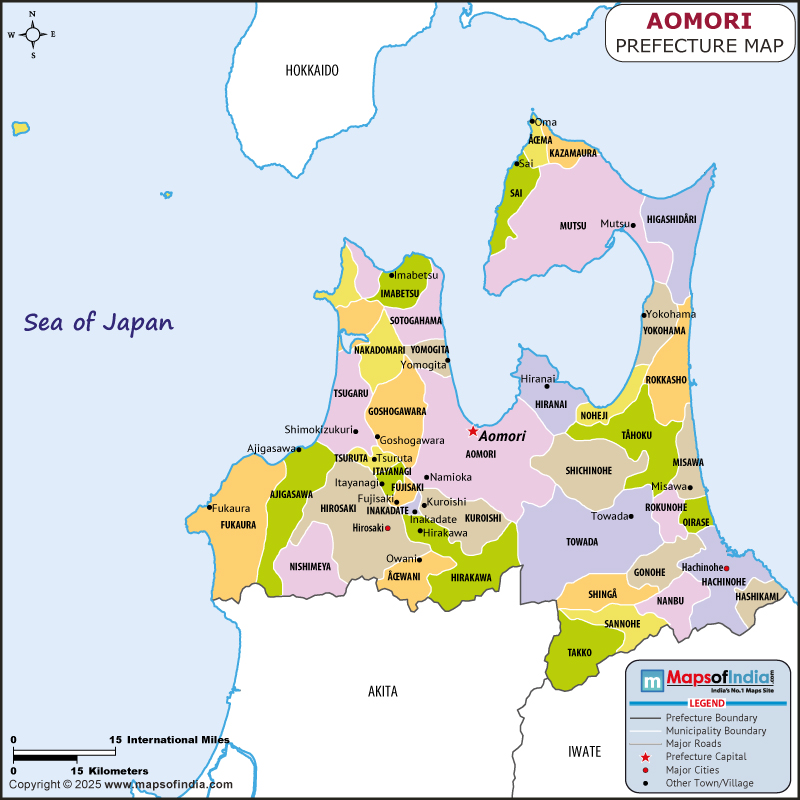



The city is located in the far north of Honshu, the largest island of Japan, and is its capital city. The current population (as of 1 August 2023) stands at 264,945 people on an area of 824.61 square kilometres, at a population density of about 321 people per square kilometre. The city is one of 62 core cities defined by the government in Japan, and is the main city in the Aomori metropolitan area. Aomori means probably Blue Forest, some say maybe Green Forest. The most reasonable one is that it fell out of a little wooded hill near the original village, which fishermen used as a check, although there is also a theory that it bears an Ainu origin. It is also known as the city of Nebuta Matsuri, the most glitzy summer festival in Japan, as a heavy producer of apples, due to snowy winters, and as a gateway to Hokkaido, the land of snow, once by ferry and currently by the Seikan Tunnel.
History
The area around Aomori has been inhabited since the Jomon period, 14,000 to 300 BCE. Large-scale, organised settlements in large, permanent structures with elaborate pottery, pit houses, and rite-structures are attested archaeologically at sites such as the Sannai-Maruyama Site (5500 to 4000 BCE) and the Komakino Site (4000 BCE). The results have changed the way scholars then viewed Jomon society as having been more complicated than they originally thought. During the Heian period, the former territories were put into the hands of the Northern Fujiwara clan, though the native Emishi still lived in the area. This area fell under Nambu control during the Kamakura period, when the Fujiwara had collapsed. The western side, including the successor Aomori City, was captured by the enemy clan Tsugaru during the Sengoku era.
In the early era of the Edo period, it was referred to as Uto-mura or a tiny port in the Hirosaki Domain. In 1626, Tsugaru Nobuhira, second lord of the Tsugaru clan, ordered the construction of a new port-town called Aomori, but the name did not actually come into common use until after 1783. Aomori developed as a local port, allowing trade and communications throughout the Mutsu Bay and also further to the east, and strategically positioned in maritime routes to Hokkaido.
When the Meiji Restoration of 1868 occurred, Japan erased the domain system. Its capital was first at Hirosaki, but, due to friction between the Tsugaru power and Nambu power, Aomori was moved to a centrally located Aomori in 1871. The city status and the town status were received by the municipality in 1898 and 1889, respectively. In 1872, the Hokkaido Colonisation Office inaugurated various boat services between Hakodate and Aomori, and the Tohoku Main Line served Aomori with trains to Tokyo in 1891. In 1894, its position as a transport centre was improved as the Ou Main Line opened along the coast of the Sea of Japan.
World War II also took its toll on Aomori, particularly the Aomori Air Raid of July 28, 1945, which reduced most of Aomori to rubble. It was rebuilt as an important port and administrative centre after reconstruction after the war. The diversion of much of the traffic between ships and trains, particularly by trains, was occasioned by the completion of the Seikan Tunnel in 1988, the world's longest underwater tunnel.
Culture
The cultural identity of Aomori is a full colour hand-weaving stylistic pattern of cultural background, season, and the toughness of the people facing the cold, snowy winter. Aomori Nebuta Matsuri is the most popular festival of the city and is not merely a summer festival but more a living, breathing manifestation of the pride of the people. Big lantern floats (some more than five meters high by nine meters long) are in the streets every August. The floats are superstitious warriors, monstrous creatures of many-coloured washi paper surrounding wooden frameworks.
This is a labour-intensive craft; months of design and construction go into each of the floats. Along with them, there are the haneto dancers, clad in multicoloured attire, with bells and sashes on their costumes and the traditional cry of the festival, "Rassera, rassera! One can feel the excitement created by the pounding of taiko drums, the cry of flutes, and the thwack of hand cymbals, which are simultaneously traditional.
Aomori Kitchen is thus also interconnected with its culture. Mutsu Bay affords the city a wide array of fresh seafood: scallops, squid, tuna and sea urchin are all regulars. The Nokke-don experience of Furukawa Fish Market provides an opportunity to build one’s own rice bowl by choosing the best toppings at numerous stalls and transforming a meal into a cultural experience. Winter meals such as the hearty kenoshiru, miso awayiri soup containing cut-up root vegetables, and ichigoni, the very delicate sea urchin and abalone soup, are testimonies to the resourcefulness of people whose ancestors long had to endure winter. Originally introduced in the late 19th century, apples have since become a symbol of Aomori Prefecture, and the city glorifies the products in both cider and apple pies, among other items.
Aomori people are known to be very hospitable and warm, and are often called omotenashi, a deep sense of receiving guests. This appears in not just festivals and markets but even in the trivial details of everyday communication, whether store owners give out samples or people passing acquaintances exchange small talk. A local language, the Tsugaru-ben, serves to identify the culture, and the expressions and accent are so different that the words can sound incomprehensible to other Japanese speakers. Although English in schools and the media is standard Japanese, Tsugaru-ben is still a valuable connection to the past season, and is commonly used in folk songs and other forms of storytelling, and in everyday conversation among locals.
Language
The language environment of Aomori is representative of its regional subdivisions. Tsugaru dialect or Tsugaru-ben is spoken on the west side of the prefecture (Aomori City) and has a distinguished vocabulary and tone, and is considerably incomprehensible to ordinary speakers of Standard Japanese. In the eastern areas, the dialect is Nanbu, and in the northern area of the Shimokita Peninsula, the dialect is the Shimokita. These developed due to geographical isolation by mountainous roads, intense winters. Despite the use of formal Japanese in schools, in the media and in the government, regional dialects form an effective source of identity.
Geography
Aomori City is located on the largest island of Honshu at its very corner, literally at the farthest end of the Mutsu Bay in the farthest northern part of Japan. On the south side, it is bordered by the Hakkoda Mountains, with volcanic peaks of 1,584 meters above sea level, and the calm waters of the bay on the north side. Such geography has determined the history of the city as a natural port and a gate to Hokkaido. Just off the bay is the Tsugaru Strait, which separates Honshu and the northernmost island of Japan and ferries that once chiefly serviced the Aomori to Hakodate have been operating across the seabed since the Seikan tunnel provided a rail access point.
Aomori has four distinct seasons; it is humid continental. There are ice-cold winters, long snowy winters, of which the city is famous as one of the snowiest in the world, which annually receives above seven meters of snowfall on average. This is due to this so-called effect of the sea-effect snow, where cold Siberian air escapes moisture in the middle of the sea and impresses it on the snow after it enters the mountains. The result is a winter picture as challenging as it is beautiful to host a snow festival, hot spring, and winter sports culture. Sumer has good warmth relative to most of Japan, the hottest month reaching a high of about 25 °C in August, and the city serves as an agreeable escape to the humid Tokyo and Osaka. Spring has the cherry blossoms, autumn has the mountains flushed with smouldering reds and golds.
The natural environment is extremely diverse. On the West lies the Tsugaru Peninsula with its rugged shore and windswept capes like Tappizaki, where the Sea of Japan meets the Tsugaru Strait. The surreal Shimokita Peninsula juts into the Pacific on the east, with its volcanic massif of Mount Osore, though Japan has three holy sites. The city itself is bordered to the south by the Shirakama-Sanchi mountain range, a UNESCO World Heritage site, which retains one of the largest virgin beech forests in the world with untouched hiking trails and hidden waterfalls.
The redevelopment of the seafront that is within the city limit includes A- Factory market, where local products and hand-crafts are put on display, and Seikan Ferry Memorial Ship Hakkoda Maru, a preserved ferry ship that used to carry passengers and trains across the strait. The more eastern side of the city, on the Asamushi location, merges seascapes with restorative hot springs, a remembrance of the volcanic action that created the site.
Quick Facts
| Official Name | Aomori City |
| Area | 824.61 km² |
| Population | 264,945 (As of 2023) |
| Religion | Shinto and Buddhism |
| Language | Japanese |
FAQs
Q1: What is Aomori most famous for?
Aomori is best known for its vibrant Nebuta Festival, delicious apples, and breathtaking seasonal scenery.
Q2: Where is Aomori located in Japan?
It’s at the northernmost tip of Honshu Island, bordered by both the Sea of Japan and the Pacific Ocean.
Q3: How can travellers reach Aomori from Tokyo?
One can get there in under four hours by Shinkansen, about 80 minutes by plane, or via long‑distance buses.
Q4: What unique food experience can one try in Aomori?
At the Aomori Gyosai Centre, one can create their own seafood rice bowl called Nokkedon.
Q5: Why is Aomori considered a hidden gem?
It offers rich culture and natural beauty without the heavy crowds of Japan’s major tourist cities.
Last Updated on: June 22, 2026

