


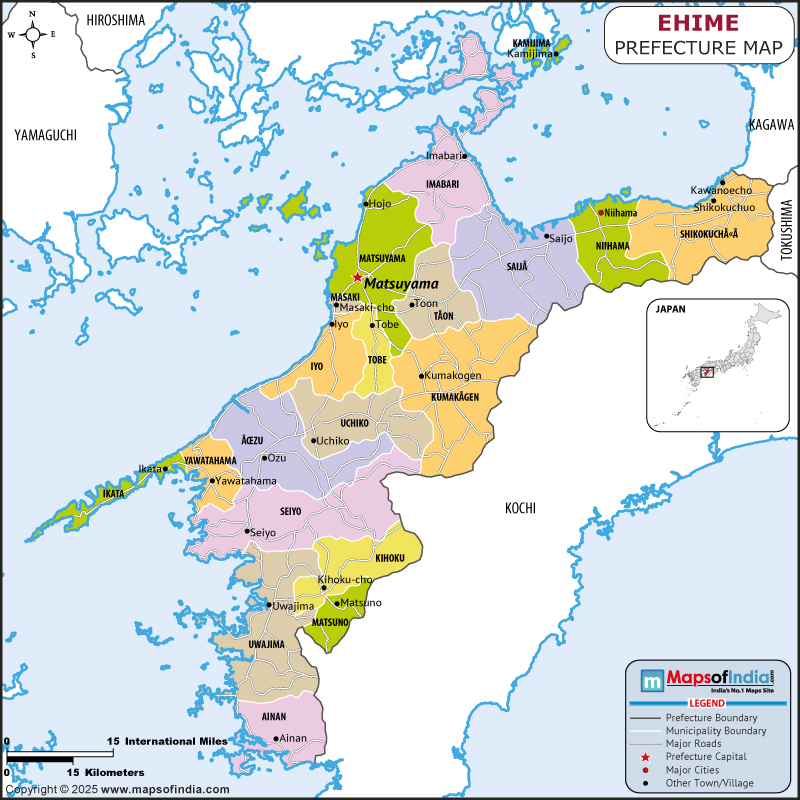



Ehime is a lovely Japanese prefecture on Shikoku Island. It is renowned for its peaceful lifestyle, welcoming locals, hot springs, castles, and oranges, particularly mikan (mandarins). Several travellers come to Ehime to relax in its nature, culture, and traditional past. The capital of Ehime is Matsuyama, and it is renowned due to its castle and Dogo Onsen, which is one of Japan's oldest hot spring spas.
Ehime is a combination of ocean, mountains, and peaceful towns. Visitors here get a relaxed lifestyle as well as hospitality. The Seto Inland Sea is a bonus, and ferries provide a link to the rest of Japan. Now, Ehime is not only a travel destination but also a major cultural and historical site.
History
The history of Ehime in Japan is colourful, rich, and abounds with significant events. In history, this area used to be referred to as Iyo Province, and the residents remember this name in a lot of traditions and places. The inhabitants of Ehime are elated to possess a history associated with samurai heritage, celebrated authors, and natural hot springs that have impacted daily life for hundreds of years.
Ehime was a small but dynamic part of Japan. Located close to the Seto Inland Sea, it was a vital connection for trade and visiting reasons. There were farmers, fishermen, and traders who resided there and utilised the sea and rich soil to earn a living for their families. Shrines and temples were constructed early on, so religion and culture were vital to the inhabitants.
During the Edo period, between the early 1600s and mid 1800s, Ehime's history was closely linked with Matsuyama Castle. It was constructed by the influential warlord Kato Yoshiaki. He needed a castle from which he could govern the area, and the castle became not just a military outpost but also the city hub. Even today, Matsuyama Castle remains one of Ehime's landmarks and among the most popular. Its stone walls and wood ceilings and towers remind us of samurai days.
Ehime became famous for Dogo Onsen, which is one of Japan's oldest hot springs. It has been referred to in some of Japan's most ancient literature, including the Nihon Shoki. Emperors and members of aristocratic families bathed there, as well as regular people throughout the centuries. The onsen later became a site where culture and everyday life converged and thereby became an immeasurably large portion of Ehime's history.
During the Meiji period (late 1800s), Japan started modernising, and Ehime was a part of this transformation. Matsuyama became a centre of education and literature. Natsume Soseki, a famous writer, was here for a short while and went on to write about his time in the novel Botchan. This made Matsuyama and Ehime nationally famous. Schools and industries were opened, and the area saw development.
The 20th century was a time of both hardship and development. During the wars, numerous residents in Ehime suffered from hardship, and certain areas of the prefecture were hit with air raids. After the war, though, Ehime thrived. Shipbuilding businesses, paper manufacturing, and citrus farm enterprises developed. Ehime oranges, particularly the mikan, brought fame throughout Japan. Industry and agriculture improved the livelihoods of individuals in the area and sustained the economy.
Along with this, there were traditions that survived with caution as well. Ceramic artefacts, festivals, and traditional theatre remained a part of life. The blend of ancient culture and contemporaneity provided Ehime with an additional identity.
These days, Ehime's history is all around. Impressive Matsuyama Castle testifies to the might of the times of the samurai. Dogo Onsen continues to receive visitors as it did centuries ago. Written texts, tillage, and craftsmanship carry stories from previous generations into contemporary life. Ehime's history is not merely wars and monarchs but also the ordinary day to day routines of farmers, fishermen, writers, and common families who constructed this hospitable and embracing corner of Japan.
Culture
Ehime culture in Japan is influenced by history, customs, and natural scenery. The inhabitants enjoy neighbourliness, respect for nature, and a simple lifestyle. The culture is expressed in ceremonies, food, handicrafts, hot springs, and welcoming visitors.
One of the most prevailing aspects of Ehime culture is the festivals. The various towns celebrate each year with festivals that unite families and neighbours. The Matsuyama Autumn Festival is particularly well-known. During the festival, men take heavy wooden shrines, or mikoshi, down the streets. They are decorated with gold and bright colours. There are drums, music, and cries of encouragement filling the air, and the entire city is full of carnival spirit. Festivals such as this demonstrate strong community spirit and pride in Ehime and the traditional culture that people have.
Food is another integral aspect of Ehime culture. Ehime has earned the title of being the "citrus kingdom" due to the extensive variety of oranges and mandarins, particularly the mikan. Citrus fruits are utilised in juices, sweets, and even in bath goods. Citrus fruits symbolise the interaction between farm culture and everyday life in Ehime. Local residents also consume Jakoten, which is a deep fried fish cake made of small fish from the Seto Inland Sea. This simple food shows to what degree people depend on the sea for their livelihood. Seafood, rice, and vegetables according to the season all play important roles in meals.
Ehime is also renowned for crafts and arts. Tobe-yaki pottery is one of the most sought after traditional crafts found here. It is typically white with blue patterns, plain but beautiful. The ceramic goods are utilitarian, sometimes used for regular meals, but also have aesthetic value. Tourists visiting Ehime can participate in workshops where they may attempt their own pottery, thereby keeping the craft alive.
Art and literature also have their place in Ehime society. Well known author Natsume Soseki resided and taught in Matsuyama, and his book Botchan was a renowned novel that established the city's popularity throughout all of Japan. The Botchan train and other cultural icons continue to remind people of him. Poetry, traditional theatre, and indigenous storytelling also continue to bring culture to the region and vary it.
Hospitality is the second most important aspect of Ehime culture. Guests are usually welcoming of the hospitality of the locals. People in small cities or big cities like Matsuyama greet guests with open arms. This hospitable nature greets guests easily and contributes to the beauty of the area.
As a whole, Ehime culture is a blend of traditions, cuisine, arts, and everyday life. From its vibrant celebrations to its soothing hot springs, the culture reflects the essence of the people who inhabit this unique corner of Japan.
Language
Japanese is the predominant language spoken in Ehime. The natives, though, have their own dialect called Iyo-ben. This is their indigenous language, with words and phrases peculiar to it and differing from formal Japanese. For example, some of the words spoken are milder or shorter and thus give the language a friendly sound.
The elderly speak the dialect more, but the younger ones employ the standard Japanese, particularly in schools or the workplace. The dialect is a significant part of belonging to the region. It expresses pride in having been born in Ehime and keeps the region's spirit alive.
Foreigners might not know Iyo-ben, but people at home are polite and tolerant when communicating with foreigners. Some residents who are employed in tourism or business can also speak simple English, so tourists can communicate more comfortably.
Language in Ehime is not just words but also the warmth of communication. The prefecture is famous for having friendly residents, so communication comes as a natural and friendly act.
Geography
The Ehime landscape in Japan is special in that it includes sea, mountains, rivers, and islands simultaneously. The proportionate combination of land to water determines the way of life, agriculture, and the inhabitants' culture in this region. Ehime is situated on Shikoku Island's northwestern edge, one of the four large Japanese islands itself. It is bounded by the Seto Inland Sea to the east and the Shikoku Mountains to the west. This provides the area with a mix of sea and mountainous land.
The northern boundary of the Seto Inland Sea belonging to Ehime embraces it. It is a peaceful sea scattered with plenty of small islands that interrupt the line, so it is something lovely to behold. The Shimanami Kaido is a chain of highways and bridges linking Ehime with Hiroshima on Honshu's largest island and crossing the islands. Today, the highway has been renamed a cycling highway, as it guides the guests through sea breezes, island villages, and open watershore landscapes. Fishing continued to be an important activity on this seacoast, and seafood is still the centre of life in Ehime.
The southern part of Ehime is totally different in that the Shikoku Mountains cover it. These are lush and serene and full of natural resources. Here, Mount Ishizuchi, the highest mountain in western Japan, exists. Some climbers come to climb the mountain but also to witness its religious significance. Temples and shrines in between the mountains exist, and they are part of the Shikoku Pilgrimage, a path trodden by Buddhist pilgrims. The mountains are also sources of clean water that feed rivers flowing over the land, nourishing agriculture as well as domestic consumption.
Ehime's rural area is filled with citrus orchards. Ehime's warm climate and gently sloping hills offer the optimal conditions for mikan growth, and for this reason, Ehime is referred to as the "citrus kingdom". Green orchards and orange coloured fruit in autumn, a sight that has become synonymous with this province. Agriculture is not only significant in the economy but also contributes to the beautiful landscape.
There are numerous rivers in Ehime, like the Oda River. The rivers enable people to cultivate rice, fruits, and vegetables, as well as form peaceful valleys. With coastlines, rivers, and mountains, residents in Ehime always live near nature.
The weather in Ehime is temperate. It is hot but not excessively hot in summer compared to the rest of Japan and cold but not bitterly cold in winter. Very little snow falls in the northern parts, although there is occasional snowfall in the southern mountains in winter. The climate is conducive to agriculture and tourism throughout most of the year.
Its sea route and land route access are another geographical characteristic of Ehime. The Seto Inland Sea provides ferries with routes to link Ehime to surrounding regions, with natural boundaries created by mountains within Shikoku. This has been the bridge linking various regions of Japan for centuries.
The Ehime landscape portrays a deep link between nature and human beings. The ocean provides food and commerce, the mountains provide religious significance and excitement, and the orchards drape the hillsides in colour. Together, this combination makes Ehime not just beautiful to see but also a region where nature and everyday life are deeply intertwined.
Quick Facts
| Official Name | Ehime Prefecture |
| Area | 5,676 km² |
| Population | Approximately 1,300,000 |
| Currency | Japanese Yen (JPY) |
| Religion | Shinto and Buddhism (major), Christianity and others (minor) |
| Language | Japanese (official), local dialects also spoken |
FAQs
Q1: Where is Ehime in Japan?
Ehime is situated on Shikoku Island, western Japan. It has the Seto Inland Sea in front of it and is bounded by the Shikoku Mountains.
Q2: What is Ehime famous for?
Ehime is also famous for its sweet mikan oranges, Dogo Onsen hot spring, and western Japan's highest mountain, Mount Ishizuchi.
Q3: Does Ehime have islands?
Yes, there are lots of small islands in Ehime too within the Seto Inland Sea. They are joined by the Shimanami Kaido, a road that is renowned for being cycled around.
Q4: Is Mount Ishizuchi worth visiting?
Yes, Mount Ishizuchi is a favourite hiking spot and a holy mountain. It has a fantastic view and is cherished by nature enthusiasts as well as mountaineers.
Last Updated on: April 15, 2026

