


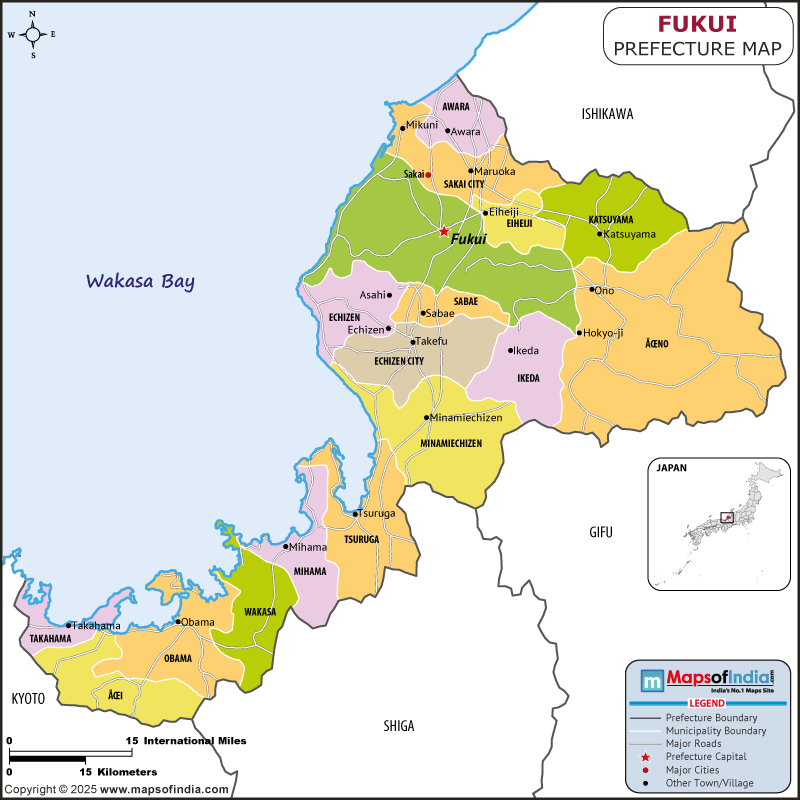



Fukui, prefecture, on the shores of the Sea of Japan in the Chubu region of Honshu, is one of those neighbourhoods where the beats of nature and the heritage of history can be combined. Frequently disregarded by tourists in favour of the more well-known travel destinations in Japan, Fukui is a reward to people by offering spectacular scenery bordering the coastline, as well as its calm temples and a rich history that has been well-maintained in its original state for centuries. The prefecture, with an estimated population of 737,000 people, covering an area of 4,190 square kilometres, shares its borders with Ishikawa to the north, Gifu to the east, Shiga to the south and finally Kyoto to the southwest. Fukui City is its capital and is also its administrative and economic centre, though other cities like Sabae, Echizen, and Tsuruga add their own unique flavour.
History
The history of Fukui dates back to the ancient systems in the region of Japan, namely Echizen and Wakasa, which were split apart by the provincial system. The area is Wakasa or Miketsukuni, or the Land of Food, since it provided the imperial court in Kyoto with seafood and other delicacies. Echizen made himself a reputation for good craftsmanship, especially in lacquerware and handmade washi papers, and until now, the art has continued.
Disrupting the Ashikaga period, during the Sengoku period, the Asakura clan of their fortress at Ichijodani ruled Echizen. Ichijodani had three hundred years of longevity that served as a political, cultural and economic capital, having a castle town that was as elegant as Kyoto. This was short-lived as invasions by the forces of Oda Nobunaga destroyed the city in 1573. The Ichijodani Asakura Clan Ruins is now regarded as a nationally-designated historic site, with the healing of streets, gardens and artefacts providing the modern observer with a clear picture of what life was like in the Warring States period.
Shibata Katsutoyo built the Maruoka Castle in the late 16th century. Being among twelve original castle keeps in Japan, it is characterised by a simple and impressive design and declared as the oldest tenshu (main keep) that has ever been made in Japan. There was stability in the Edo period since the Matsudaira clan, which affected quotas of Tokugawa Ieyasu, were the rulers in the Echizen domain centred on the Fukui Castle. Constructed in 1606, Fukui Castle was a great site, once enclosed by moats and stone walls. Even after the destruction by fire in 1669 destroyed its main keep, the ruins of the castle remain, including the "Well of Good Luck" (Fuku-no-I), as reminders of the city's past. It is thought that this well inspired the name Fukui, the desire to have a good and wealthy life.
The Meiji restoration of 1868 came with a wave of changes that dominated, among which was the abolition of the feudal domain system. Echizen and Wakasa became Fukui Prefecture in 1871. The modern period did not pass without struggle: the prefecture received air strikes that turned out devastating during World War II, and an earthquake that destroyed most of the Fukui City buildings took place in the year 1948. In spite of these failures, the region has recovered in a way that it has harmonised modernisation and conservation of cultural and historical treasures.
Fukui has also received worldwide fame, particularly in the past decades, in connection with the paleontological discoveries. Kulkitadani Dinosaur Quarry in Katsuyama has produced major fossils, including such species as Fukuiraptor kitadaniensis and Fukuisaurus tetoriensis. Fukui Prefectural Dinosaur Museum, which was known to be one of the biggest Dinosaur Museums in the world, now emerges as a measure of scientific input and the prehistoric era experienced by the region.
Culture
The cultural identity of Fukui is formed based on the spiritual tradition, craft associations, and the cuisine. Among its most sanctified is the Eiheiji Temple, first established by the Zen guru Dogen in the year 1244. Eiheiji is one of the main temples of the Soto school of Zen Buddhism and is still an active monastic structure, with a strict order of meditation, labour, and reading (Van de Kooning 2014). The tourists will be able to enjoy a serene state of the temple, engage in zazen (sitting preparation), and observe how Zen philosophy has been perpetuated in Japanese society.
Traditional craftsmanship is also centred on the prefecture. With a further history of more than 1,500 years, Echizen washi is a handmade paper valued by its strength, nature and beauty. Its applications include official documents, calligraphy and even present-day art. Echizen lacquerware, characterised by its great longevity and dense lustre, is still being manufactured in the same technology as in the past. Another speciality of this area is Echizen forged knives, which are appreciated by professional cooks because of their sharpness, accuracy and precision. The Sabae eyewear market is very successful, with this city having most of the domestically made eyeglass frames in Japan, as well as introducing lightweight titanium materials.
Fukui cuisine reflects its location on the shore and is abundant in agricultural production. Echizen Gani is known in the prefecture, and it is a snow crab which is caught in the Sea of Japan and regarded as a winter speciality. Other specialities are Oroshi Soba, buckwheat noodles topped with grated daikon radish, as well as Sauce Katsudon, breaded pork cutlet served on rice, topped with a tangy Sauce. Laconic fresh like seafood includes sweet shrimp, mackerel, and yellowtail (as well). This tradition of feeding the imperial court has become a modern image of great gastronomy.
Festivals and events are seasonal activities that make communities bond and glorify local traditions. The Echizen Fish Festival is known to represent the abundance of the sea, and the Sabae Glasses Festival celebrates the eyewear industry in the city. The EchizenDuring the season of dark winter, daffodils are blooming on the Echizen coast, and this would greatly contrast with the snow-covered environment. During the summer, there are fireworks and vibrant matsuri, which are full of music, dance and food stalls along the streets.
Language
Japanese is the native language that is used in Fukui, with the locals speaking a variant of the Hokuriku dialect. This local dialect has similarities to Isikawa and Toyama and peculiar wording and intonation. Although standard Japanese is employed in education, media, and formal communication, the local language is a significant identity according to all local and rural regions; the latter is so full of traditional patterns of speech.
In the case of non native speakers, there are chances in learning Japanese which are offered by institutions like the Fukui Language Academy, also the only school of the Japanese language in the prefecture, with the recognised accreditation of the Ministry of Education and the Ministry of Justice. The school welcomes students from all over the world, and it provides immersion programs where students study languages and their experiences related to the culture. Language classes and aid societies also exist in the local communities where language is taught, and this helps the locals and the increasing international population to connect.
At school, English is taught, and in tourism-related issues, this is the most common language used, but to different degrees. There are multilingual signs and information posted in some communal amenities, museums, and cultural sites, which help guide the tourists. Another set of languages that are brought in by the presence of the international students, technical trainees, and foreign residents includes Chinese, Vietnamese, and Portuguese languages in the local soundscape.
Geography
The position along the Sea of Japan and the diverse terrain form the geography of Fukui as it incorporates malarial lands, river valleys and mountain ranges. The north of Echin lies above the Fukui Plain, on which the capital city was built, and which is intersected by the Kuzuryu River, an important agribusiness and hydropower river. The southern region of Wakasa is thinner with mountains approaching the sea and creating the Euro-pleasing Wakasa Bay, characterised by clear water, peninsulas and inlets.
The coastline in the prefecture is characterised by biting natural features, of which the Tojinbo Cliffs are the most recognised. These are basalt rugged columns, which were formed due to erosion of waves over millions of years and are considered a natural monument. Further inland, one can find forest-covered slopes and other ranges of the Ryohaku Mountains and enjoy periods of hiking, skiing and nature watching.
The climate of Fukui is hot and semi-humid and has clear seasonal variations. During the warm summer seasons, with little rain usually occurs, and the winter seasons are cold and snowy, particularly in inland and mountainous regions. Precipitation yearly is very high and ranges between 2,300 and 2,500 millimetres annually in most parts of the region, whereby a large portion of this is precipitated as snow during the winter months. This large snow cover adds to the green cover of this area and provides plenty of water supplies to feed agriculture and other traditional industries like papermaking.
The natural environment is biodiverse. The waters of the coast are full of fish, and the inland forests are home to deer, bears and varieties of birds. There is an ongoing trend in conservation to be able to preserve these ecosystems, at the same time rate tourism and growing development to be more sustainable. There is an emphasis on the ecological diversity and beauty of the prefecture, which is featured by scenic places like Lake Kuzuryu, Mikata Five Lakes and the Echizen-Kaga Kaigan Quasi-National Park.
Quick Facts
| Official Name | Fukui Prefecture |
| Area | 4,190.49 km² |
| Population | 736,855 (As of 2025) |
| Religion | Shinto and Buddhism |
| Language | Japanese |
FAQs
Q1: What is Fukui Prefecture most famous for?
Fukui is best known for Eiheiji Temple, Echizen Gani snow crab, and the Fukui Prefectural Dinosaur Museum.
Q2: Are there any original castles left in Fukui?
Yes, Maruoka Castle in Sakai City is one of only twelve original castle keeps remaining in Japan.
Q3: What traditional crafts originate from Fukui?
Fukui is renowned for Echizen washi paper, Echizen lacquerware, and high-quality forged knives.
Q4: Does Fukui have any unique natural landmarks?
The Tōjinbō Cliffs are a striking basalt coastline formed by volcanic activity and sea erosion.
Q5: What is the climate like in Fukui?
Fukui has humid summers and snowy winters, with some of the heaviest snowfall in the Hokuriku region.
Last Updated on: April 15, 2026

