


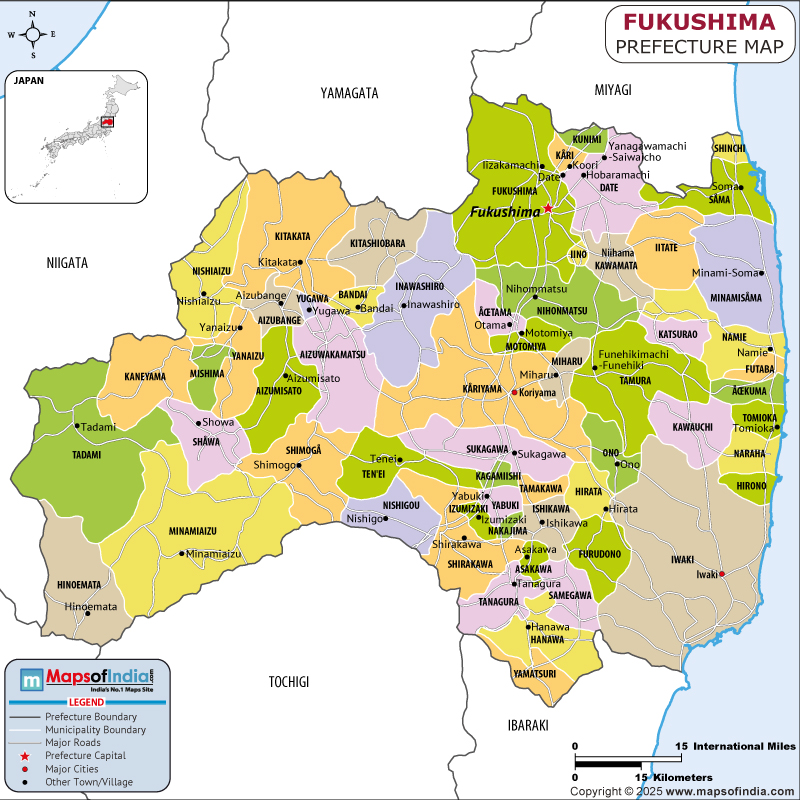



Fukushima Prefecture in the Tohoku region of southern Japan is a place of terrible contrasts and great strength. This is the third-largest prefecture in Japan by land area, spanning the mountainous interior to the eastern Pacific Ocean over a land area of about 13,780 square kilometres. It has a wide variety of landscapes, including rugged volcanic mountains and calm lakes, as well as fertile plains and stunning coasts. The area is divided into three different and distinct areas, namely the Hamadori, Nakadori and Aizu, which have their own climate, traditions and culture. Hamadori is situated along the Pacific coast, Nakadori is at the centre of the basin, while Aizu is located in the mountainous west.
The city of Fukushima is perhaps the best-known throughout the world due to the Great East Japan Earthquake in 2011 and the resultant nuclear accident of the Fukushima Daiichi Nuclear Power Plant. But to come up with the definition of the prefecture being that tragedy only would be doing it an injustice in terms of its history, its culture and its spirit. Fukushima was known long before 2011 to have a richly productive agricultural and hot springs heritage, a samurai culture, and a seasonal landscape. It remains nowadays a space between tradition and modernity, and where societies strive hard to recover and rethink their future.
History
It is impossible to write about Fukushima without writing more generally about the history of northern Japan. Archaeological remains indicate the area was occupied since the Jomon period (c. 14,000-300 BCE), and remains of pottery, tools and habitation sites have been unearthed. During the Kofun period (c. 300-538 CE), local chieftains are indicated by the introduction of burial mounds.
During feudal times, Fukushima found favour as it was an important place in terms of the trailways that passed through it and connected the Kanto area with northern Honshu. Aizu territory, in particular, turned into a nest of samurai culture. Another important crossroad of political and military influence was the Aizu-Wakamatsu Castle (Tsuruga Castle). Loyalty, discipline, as well as martial ability were characteristic features of the Aizu warriors and made them legendary within the Boshin War (1868-1869), a civil war between the soldiers who were loyal to the Tokugawa shogunate and those who joined the new Meiji government. The most observable in military history is the tragic tale of a group of young Aizu samurai called the Byakkotai, who committed suicide because they thought their castle had been destroyed, and therefore honour and sacrifice.
In the Meiji period (1868-1912), Fukushima ceased to be a feudal domain and became a modern prefecture, becoming part of the rapidly industrialising society of Japan. The economy was agrarian, and rice, fruits, and silk became primary economic products. The Fukushima area preserved its mining strength until the 20th century in the Joban coalfield in its southeast, and with roads and railways, the area was better linked to Tokyo and other cities.
The 1900s were a decade of development and struggle. Similar to most of Japan, Fukushima survived World War II and the postwar reconstruction period. Traditional farming was supplemented with manufacturing industries that developed during the second half of the century. But the Mar 11, 2011, events changed everything. On the northeastern coast, an earthquake of magnitude 9 occurred and caused a huge tsunami that destroyed communities near the coast. The natural disaster tsunami, also affected the Fukushima Daiichi Nuclear Power Plant in a disastrous way, causing the meltdown of the reactor and leaking radioactive material. There were massive evacuations, and exclusion zones were established in portions of the prefecture. The disaster produced severe social, economic, and environmental consequences, and recovery is still underway.
Fukushima has taken another giant step toward reconstruction despite these challenges. Rebuilding of infrastructure has taken place, decontamination has moved along, and lots of inhabitants have re-entered their houses. The prefecture has also tried to reinvent a new image, encouraging tourism, renewable energy and agricultural rejuvenation in memory of those lost.
Culture
The culture of Fukushima is a rich fabric of centuries of tradition, regional variety and seasons. The Aizu area, which is full of samurai traditions, does not lose most of the traditions of the Edo period. Martial arts shows, tea ceremonies and traditional crafts like lacquerware and kokeshi dolls can still be seen by visitors. Once a call on the Aizu Nishi Kaado trade route, the Ouchi-juku post town has preserved its thatched-roof structures dating to the Edo period and serves as a window into Japan of the past.
Fukushima is mainly cultural in its festival life. One of these, the Soma Nomaoi, which takes place every July in the city of Soma, on the coast, is a circumambulatory ceremony dating back in tradition over a thousand years. It includes the cavalry battle scenes of the samurai, with flag races and faux fights, and is equipped with cavalry armoured horsemen. The Aizu Autumn Festival in Aizu-Wakamatsu exposes the history of the area through parades, performances, and traditional music. There are also numerous seasonal festivals, such as cherry blossom sightseeing in the spring, or snow festivals in the winter.
Culinary traditions are also associated with Fukushima. Fruits grow in the fertile Nakadori basin, such as peaches and cherries, pears, grapes, and apples. One of the local delicacies is negi-soba, a noodle dish prepared with buckwheat, which is eaten alongside a long green onion as its garnish and also served as a utensil, and kozuyu, a clear soup made of dried scallops, vegetables, and konnyaku, served during New Year celebrations in Aizu. Kyoto city has been one of the major manufacturers of sake, and its pure mountain water and excellent rice make it achieve the award-winning sake brews.
Language
The primary Fukushima language is Japanese, although the dialects around it give colour to daily speech. The Fukushima dialects form part of the Tohoku dialect group, and are identified by certain phonetic and grammatical characteristics similar to those of standard Japanese, but dissimilar. There is a slight difference between the Aizu, Nakadori and Hamadori regions within the prefecture.
Could be an example, the Aizu dialect is differentiated by peculiar intonation use, words and by a fairly closed historical context of the dialect in the mountains that have left the dialect relatively isolated. Nakadori is a transport route, so its dialect is closer to standard Japanese; the dialect of Hamadori has been influenced by other coastal communities. Regional pride and identity are rooted in these linguistic differences, and even though younger generations are closer to the national code, the expressions related to the local dialect are significant elements of the Fukushima culture.
The native language of the country is Japanese, although in large urban areas and tourist destinations, a large number of people speak English or other languages to accommodate visitors. International programmes and exposure programmes in foreign languages have also gained more attention in some communities since the 2011 disaster.
Geography
Fukushima is a diverse land with a diverse culture. The three organs of the prefecture: Hamadori, Nakadori and Aizu are separated by mountain ranges, which characterise the climates and economies. On the Pacific coast, there is a place called Hamadori, which has a maritime climate, and winters are not very cold, and summers are also not very hot. It has a long coast where it is exercised in fishing. The central basin between the Abukuma and Ou mountains is known as Nakadori; the soils are fertile and can be used in agriculture, but the climate is dry with hot and humid summers and cold winters. The reason behind this is that Aizu in the mountainous west is also affected by the Sea of Japan, with lots of snowfall in winter and hotter days in the highlands.
The natural scenery of the prefecture is magnificent. Inawashiro Lake, a wintering area of swans and one of the largest lakes in Japan, lies in the middle of Fukushima. Mount Bandai and Mount Azuma are some of the lakes, marshes, forests, and mountains distributed across the slopes of the Bandai-Asahi National Park. In 1888, a volcanic eruption of Bandai resulted in new lakes being formed and the river course being altered. Hiking, skiing, and watching nature are common in the area.
The prefecture, rich in rivers such as the Abukuma and Aga, is blessed with nature so easy to enjoy, not to mention its usefulness in agriculture, but also its beauty. The varied topography also implies that Fukushima is a nation of great biodiversity whose fauna may extend along alpine and coastal wetlands.
It sits on the Pacific Ring of Fire geologically, and part of the explanation for the presence of so many hot springs in the region is volcanic activity. But that tectonic position also causes it to be prone to earthquakes, which unfortunately happened in 2011. The geography of the area has also contributed to the development of patterns of settlement since mountains, plains, and coasts have long been known to determine where towns and cities will flourish in the bottoms of valleys, river valleys and shores.
Quick Facts
| Official Name | Fukushima Prefecture |
| Area | 13,783.90 km² |
| Population | 1,771,100 (As of 2023) |
| Religion | Shinto and Buddhism |
| Language | Japanese |
FAQs
Q1: Is Fukushima safe to visit today?
Yes. Most areas of Fukushima Prefecture are completely safe for travel, with radiation levels comparable to other parts of Japan. The only exceptions are a few restricted zones near the Fukushima Daiichi Nuclear Power Plant, which remain off-limits. Tourism has been actively encouraged, and safety monitoring is ongoing to reassure visitors.
Q2: What is Fukushima best known for besides the 2011 disaster?
Fukushima is renowned for its natural beauty, including Mount Bandai, Inawashiro Lake, and the Bandai-Azuma Skyline. It’s also famous for award-winning sake, abundant fruit orchards—especially peaches—and historic samurai towns like Aizu-Wakamatsu.
Q3: What unique cultural experiences can visitors enjoy in Fukushima?
The Soma Nomaoi festival, where armoured horsemen reenact samurai cavalry battles, is one of the most spectacular events in Japan. Visitors can also explore preserved Edo-period post towns like Ouchi-juku, soak in historic hot springs, and learn traditional crafts such as Aizu lacquerware.
Q4: How is Fukushima working toward revitalisation?
The prefecture has invested heavily in infrastructure rebuilding, renewable energy projects, and tourism promotion. Efforts include restoring coastal communities, supporting returning residents, and showcasing Fukushima’s culture and nature to reshape its global image.
Last Updated on: April 15, 2026

