


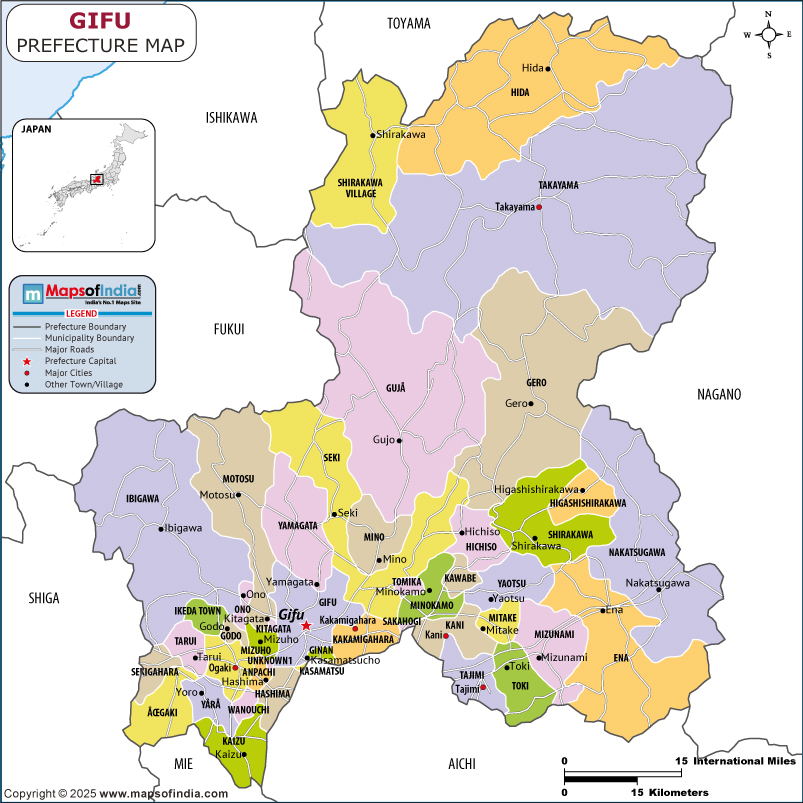



Gifu is a prefecture located in the Central region of Honshu. It is landlocked and has a wide history of great cultural heritage, and spectacular land legitimization. Gifu’s strategic location has positioned it as a connection point between eastern and western Japan. Hence it connects travelers with picturesque UNESCO thatched-roof villages such as Shirakawa-go and the time-honored mountain towns such as Takayama. It is also a location of forerunner trades still standard, the Mino ware pottery, the beautiful paper lanterns, the legendary swords of Seki are the main parts of the Gifu identity. History breathes through its landmarks, Gifu Castle on the top of the mountain Kinka, down on the Nagara River, the ancient ritual of cormorant-fishing. In Gero Onsen, one of the most popular hot-springs towns in Japan, people have an opportunity to have a bath in the medical water and enjoy a leisurely lifestyle and the real Japanese hospitality of the prefecture.
History
Gifu’s history traces back to early Japan when the prefecture present- day Gifu became a member of Yamato Court during the mid-4th century. Thanks to the prime position it enjoys on the Honshu island, Gifu has always served as the focal point in all wars including the Jinshin War of 672 that saw Emperor Tenmu assuming the throne.
Formerly covered by the old provinces of Hida and Mino (and Echizen and Shinano), the area was not officially referred to as Gifu until 1567. The same year, Oda Nobunaga invaded and acquired the Inabayama Castle renaming it and the surrounding region of the territory Gifu-inspired by the Chinese location symbolizing epitome and togetherness. The castle town turned out to be a colorful center as a result of his ambitions. The castle was made again through highly sophisticated methods of the time by Nobunaga and surrounded by gardens and classy buildings that were compared by the contemporary viewer as paradise on earth.
The first frames of the future Gifu Castle were the works of the Nikaido clan in the previous period of Kamakura (1201-1204). These were extended subsequently under the Muromachi, which, under the Saito clan, were, first Saito Toshinaga, then the great Saito Dosan, the Viper of Mino,--who was conqueror of Mino Province, and unsuccessfully seeking vengeance on his son, was deceived by him. They all suffered treachery at his hands.
The castle was abandoned and became in disrepair after the death of Nobunaga. In 1600 it was destroyed in the Battle of Sekigahara and was dismantled, parts were reworked to construct local Kano Castle. Its present concrete keep is dated 1956, when it was installed covering Mount Kinka, in order to recover the memory of the old one.
Culture
Mino washi, a hand made paper that is more than 1,300 years old, is a highlight of cultural craftsmanship. It is a fine but strong paper created using fibers of mulberry and clean water of Nagara River and its best quality hon-minoshi is UNESCO Intangible Cultural Heritage. The Mino washi is instrumental in some of the locally made lanterns, umbrellas, and the fans, and they are renowned because of their beauty and longevity.
The legacy of blade-making by Seki is the other art feature of certain local region artistry. Seki has been making swords in world-reflective styles for more than seven centuries. Nature is generous in her gifts: the clear river water, the pine charcoal, and the clay-yakiba-tsuchi rolled and struck swords, which are even said to never break, bend, or cut poorly. Later on, this custom evolved to result in good quality kitchen knives, scissors, and razors.
Gifu city has also become a name of its own in regards to paper lanterns, originating during the era of Keicho and Keian (late 16th to mid 17th century). By the mid-18th century such lanterns developed their contemporary shape, and became legally accepted as traditional craft in 1995. The prefecture in conjunction with lanterns houses traditional fans; the wooden and washi fans that are a part of the Muromachi era. Gifu fans present thousands of years of craftsmanship; they are still handmade using more than 20 intricate steps.
The cultural life in the prefecture is also determined by rituals and festivity. With over 300 years of history, Takayama Spring and Autumn Festivals feature floats (yatai) which are beautifully decorated. These are commonly referred to as the most glorious amongst the Japanese festivals. Maintaining vibrant mikoshi tours and drum fights and plays for children, Furukawa Matsuri is already regarded as the national and UNESCO Intangible Cultural Heritage. Likewise, each of these is complemented with a vibrant event that brings in master smiths and artisans during the annually held Seki Cutlery Festival in October, inviting them to the city for a lively celebration marking the prefecture’s blade-making identity.
In addition to its crafts and festivals, the Gifu cultural weave stretches up to cormorant fishing (ukai) on the Nagara river- a national customary practice at night preserved by the royalty. Combine that with the culinary heritage of this region, with its valued Hida beef, as well as grilled ayu or buckwheat soba, both of which portray the strong attachment of the prefecture to the land and its customs.
Language
The two regional varieties of the Hida and Mino dialects influence the word patterns of the speech of the prefecture, both in the north and south. The dialects are the subdivisions of the widely spoken Japanese language yet are characterised by their unique rhythm, pronunciation, vocabulary that dictate their difference with standardised versions.
In the north in the mountains, the Hida dialect grew in very remote societies. Its paradigms of language retain an earlier phase of Japanese and they stand out with special intonation patterns that are reminiscent of the rural culture and lifestyles of the region. The speech here is the bearer of centuries of continuity, which were transferred to the families of small-towns and villages.
In turn, the Mino dialect lives in the southern half of the prefecture. Since this region has been a centre of trade and movement of articles and people between eastern and western Japan. This has also influenced the local dialect to incorporate the influences of neighboring regions. What has come out is a dialect that is more intimate to people who speak it in nearby Nagoya and Kansai, yet still with features that cause it to be closely related to Gifu.
In late 19th Century and early 20th Century modernization, Standard Japanese started to spread as a result of education and government. Because of this, an increasing number of younger generations of Gifu shifted towards the standardized variant particularly in towns and cities. The old dialects have not gone though. Hida-ben and Mino-ben are still alive in the rural settings and within families, hence they use them as a sign of belonging, and therefore, heritage.
Geography
Located almost at the core of the central island of Honshu in Japan, Gifu is one of the few landlocked prefectures of the country. Its landscape is literally divided into rocky mountains in the north and a wide plain in the south that have determined its way of life and its landscape.
Gifu is dominated by mountain ranges in the north. A range of mountains on the eastern side is the Hida mountains of the Northern Japanese Alps, and on the southern is the Kiso mountains as the Central Alps, and on the west the Ryohaku mountains marks the boundary. Numerous mountains are above 2,000 meters in height, as well as more than 3,000 meters, and the region is a favorite climber and hiking spot. The dramatic relief forms micro climates-winters are snow-covered and cold in the highlands with wetter hot summers in the valleys.
The southern zone, on the contrary, drains into the broad Nobi Plain which is an alluvial plain shaped by the Kiso, Nagara and Ibi Rivers. Gifu's lowland area provides a large part of the agricultural and urban population of the area and also acts as a major transit point between Gifu and Nagoya as well as other major cities.
Such a varying geography creates different economic zones. It is full of natural resources and travel sites like the mountain-filled north, which has plenty of alpine scenery, hot-springs, resorts as well as restored villages such as Shirakawa-go, which exhibit the ancient thatched-roof farmhouses. In the meantime, the southern plains sustain agriculture, settlement and industries, which have been supported by the river systems present around them.
Such a river as Nagara is not simply a climatic object, but it is a cultural symbol. The Nagara river whose transparency is well-known has centuries old traditions of cormorant fishing which continue to be the main tourist draw in the region.
Quick Facts
| Official Name | Gifu Prefecture |
| Region | Chūbu (Tōkai) |
| Mayor | Masanao Shibahashi |
| Area | 203.60 km2 |
| Population | 400,118 |
FAQs
Q1: What is the appropriate time to come to Gifu Prefecture?
Cherry blossoms and foliage make spring ( April-May), and the fall ( October-November ) perfect. The snowing to the northern mountains occurs during winter.
Q2: What are some of the city's iconic attractions in Gifu?
Exploring Shirakawa-go UNESCO gassho-zukuri farmhouses, visit Gero Onsen, take sightseeing in Takayama old streets, visit Seki Swordsmith Museum in Seki, see miniature Gifu Great Buddha in Gifu City.
Q3: What is Gifu Castle and what is special about it?
Gifu Castle developed atop the mountain of Kinka is a rebuilt mountaintop castle featuring a museum and views of the city- that include optional night-time viewing during specific seasons.
Last Updated on: April 15, 2026

