


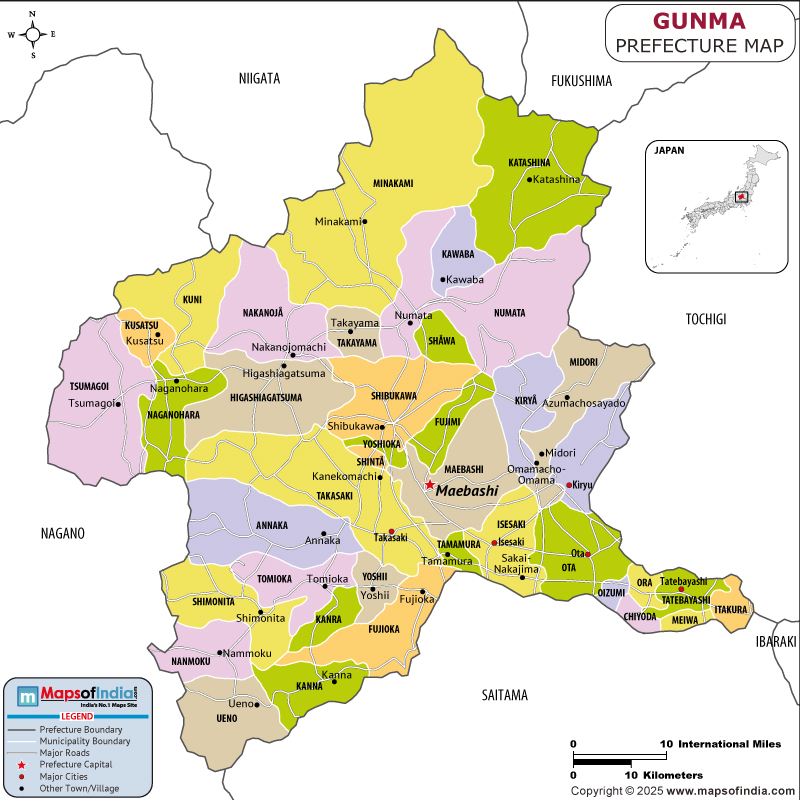



Gunma prefecture is located in the heart of Japan's Honshu island and is known for mountainous terrain, natural beauty and rich cultural tradition. Landlocked and located in the northwestern corner of the Canto region, Gunma borders several prefectures including Niigata, Fukushima, Nagano, Saitama and Tochigi. The capital of Gunma is Maebashi while Takasaki stands as the largest city. It has a population of over 2 million spread across the varied landscape from the low lying plains to the rugged mountains. The climate is marked by drastic seasonal temperature shifts and relatively low winter precipitation in part because of the strong dry wind obstructed by nearby mountains. More than 14% of the land is designated as natural Parkland. This highlights the commitment to preserving nature. Agriculture is strong with guluma leading Japan in konjac root and cabbage production.
History
Gunma history stretches deep into Japan's ancient past. Originally part of the Kenu province it was divided into upper Keanu now Gunma and lower Keanu now Tochigi. For much of its history the region was known as Kozuke province and sometimes as Jomo. Major volcanic events notably the reaction of mount Haruna in the 6th century and the devastating Tenmei eruption of mount Asama in 1783 left their mark on the region's landscape and society.
As the feudal era progressed Maebashi which is not the capital of the prefecture gained importance as the seat of Sakai and Matsudaira families prominent under the Tokugawa shogunate. After the Meiji restoration Gunma transitioned from a feudal domain to becoming part of the modern nation. The region's embrace of sericulture was transformative and the silk products became a crucial export supporting both Japan's economy and the livelihood of local women.
During the Edo period (1603-1868) Gunma Was part of the tokugawa shogunate holding home to many loyalist retainers first after the meiji restoration the region rapidly industrialized. In the 1870s with support of Italian and French mentors it built the first modern silk factory. The Tomioka Silk Mill became the emblem of the region’s role as a hub of sericulture and silk weaving, a legacy recognized today as UNESCO’s World Heritage site. World War II brought widespread destruction notably to the capital which suffered extensive bombings but rebuilt itself into a prosperous modern city.
Gunma played an important role in the democratization and modernization struggle of Japan. The Gunma incident of 1884 was a bloody clash between liberal reformists and the conservative nationalists where modern rifles were infamously used against farmers for the first time in Japan. In the 20th century innovation flourished as Nakajima Aircraft Company based in Ota shifted from aircraft design to becoming Subaru, a leading car manufacturer.
Modern history includes the presence of significant foreign residents such as the German architect Bruno Taut in the 1930s and pivotal moments like the 1957 Girard incident which affected the US -Japan relationship. 4 of Japan's Prime Ministers have hailed from Gunma underscoring its ongoing political influence.
Culture
Gunma has a vibrant culture which is a fusion of traditional nature and innovation rooted in the history as a major producer of silk agricultural goods and fine art for stock with a mountainous landscape and abundant hot spring. The view of life of people in the region has evolved alongside the land itself. It is reflected in the local dialect cuisine craft community ritual and a distinct identity which blends old and new.
Gunma is known for the textile industry especially silk and brocade full stocks the cities of Kiryu and Tomioko have a legacy of intricate silk weaving which dates back over 1300 years a heritage known by UNESCO designated Tomioko Silk Mill which played an important role in the industrialization of modern Japan. Traditions deeply linked with daily life include the colorful daruma dolls which are symbols of perseverance and luck and hand painted kokeshi dolls. Local artisans continue to practice and teach these crafts, encouraging hands- on experience and keeping heritage alive for the new generation.
The culture thrives in the festivals, some with roots reaching as far back as the 17th century. Notable events include the Gion festival which features sacred possession and mikoshi and Maebashi Hatsuichi festival known for the dramatic daruma burning and the silk market origin. The region's hot spring culture is another core element. There are around 100 hot spring resorts which are central to relaxation, health and hospitality.
A unique local dialect Gunma ben It remains in use and infuses everyday conversation and stories. Traditional games like jomu karuta celebrate local geography and legends through illustrated cards. Many temples and historical landmarks punctuate the landscape reflecting the spiritual depth of the region. Rural town centers proposed well preserved architecture and invited visitors to explore a lifestyle that values both serenity and the excitement of yearly festivals.
Modern Gunma harmonizes tradition with innovation. The identity is informed both by silk legacy and leadership in automotive technology all set within a framework of natural beauty. efforts towards sustainable tourism and Environmental Conservation highlights Gunma’s deep rooted appreciation for River Forest and mountain. Rural areas host events which allow guests to savour Gunma scenery and taste its local bounty.
The people in the region follow Buddhism and Shintoism which are deeply interwoven in the cultural and religious practices. These religions often coexist harmoniously with many individuals practising the rituals and festivals from both traditions. All practices focus on worshipping kami associated with nature and ancestral reverence. Buddhism addresses the spiritual teaching and the afterlife.
In Gunma religious practices are more about cultural heritage and customs than strict adherence to the doctrine. Many residents visit the shrines and the Buddhist temples for seasonal festival life events and ancestral memorial. Christianity and other religions have a minor presence accounting for a small percentage of the population. It also hosts some Muslim communities including the Rohingya refugees among others though these are relatively small in numbers.
Language
The primary language spoken in Gunma is Japanese. The local dialect is known as Gunma ben and it is part of the West canto dialect group testing from the east canto dialect spoken in the neighboring prefectures. Dialect varies within the Gunma itself with different speech patterns found in the mountainous northern and western area, the central plain and the southwestern region.
Gunma ben features unique phonetic and grammatical characteristics. The dialect also shows subtle differences in the verb conjugation and negation. It has a rich vocabulary with words unique to the region. Most of the dialect remains an important cultural marker for the residence reflecting the history and identity of the region. While standard Japanese dominating formal communication and younger generations increasingly adopting it, Gunma ben remains to be cherished in the local festival storytelling and daily conversation.
Aside from the local Japanese dialect the region does not have significant linguistic diversity in terms of indigenous languages as Japanese is overwhelmingly predominant. However Gunma has an international presence due to foreign residents including a notable Brazilian population which bring Portuguese into the linguistic landscape alongside Japanese. Educational centers and language schools offer Japanese language courses for non-native speakers supporting residents and newcomers and learning standard Japanese.
Geography
Gunma Prefecture is located in the central part of Japan's Honshu island and is one of the country's 8 landlocked prefectures and the northwestern most area of the Kanto plain. It covers approximately 6362 square kilometers. The population is concentrated largely in the central and the southeastern region such as the city of maebashi and takasaki while much of the rest of the prefecture is mountainous.
The geography is distinguished by the rugged terrain with about 2/3 of the land above 500 meters in elevation. There are notable mountains like Mount Akagi, Mount Haruna, Mount Myōgi, Mount Nikkō-Shirane and Mount Asama. These mountains contribute to the scenic beauty and attract tourists especially for hiking and skiing.
Rivers like the Tone River, the Agatsuma River, and the Karasu River flow through the prefecture shaping valleys and supporting agriculture. The southeastern corner belongs to the Kanto plain, providing fertile land where most of the population resides and agriculture flourishes.
The climate is characterized by wide seasonal temperature variation because of the inland location. Winters are cold and relatively dry because of the strong dry winter wind called karakaze which blows from NW and is intended to be intensified by the echigo mountains blocking the moisture. The distinct climate benefits the cultivation of certain crops like konnyaku and cabbage for which Gunma is nationally recognized.
Approximately 14% of the land is dedicated to natural parks which offer protected forests, wetlands and recreational areas to the residents and visitors alike. The combination of mountainous landscape hot spring and extensive park land make it a popular destination for outdoor activity and nature enthusiasts.
Quick Facts
| Official Name | Gunma |
| Location | Kanti region of Honshu |
| Area | 6362.28 km² |
| Population | 1937626 |
| Language | Gunma dialect |
FAQs
Q1: What is the capital of Gunma?
The capital of Gunma is Maebashi.
Q2: What are the mountain ranges in Gunma?
Mount Akagi, Mount Haruna, Mount Myōgi, Mount Nikkō-Shirane and Mount Asama are some of the mountain ranges in Gunma.
Q3: Name the rivers which flow through Gunma?
The Tone River, the Agatsuma River, and the Karasu River are some of the major rivers which flow through Gunma.
Q4: What is the climate of Gunma?
The climate is characterized by wide seasonal temperature variation because of the inland location. Winters are cold and relatively dry because of the strong dry winter wind called karakaze which blows from NW and is intended to be intensified by the echigo mountains blocking the moisture.
Last Updated on: April 15, 2026

