


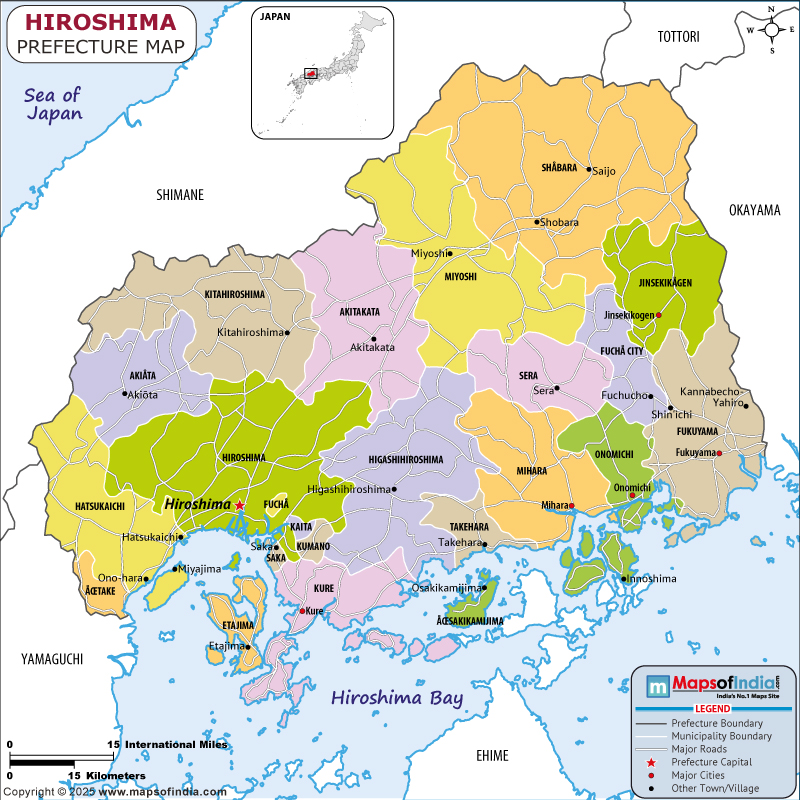



Hiroshima is a vibrant city located in Japan's Chugoku region on the western part of Honshu island. Founded in 1589 as a castle town in the Ottawa river delta Hiroshima developed as the political and military hub. Known world-wide for the atomic bombing during the Second World War the city has rebounded with profound resilience. It is an emblem of peace recovery and culture. The city is an urban centre which offers rich historical sites, modern attraction and a unique blend of tradition and contemporary Japanese culture which draws visitors from across the globe annually.
History
The history of Hiroshima is long and transformative, marked strongly by the ancient origin, rapid urban growth and devastating destruction in World War II with remarkable post war recovery. Hiroshima was founded in 1589 as a castle town by the feudal Lord Mori Terumoto strategically situated on the delta of the Ota river. It developed as a regional political and cosmological centre during Japan’s feudal era with its castle serving as the focal point of power and governance. The city's location on a flat river plain allowed its modest but steady growth through the centuries.
After the Meiji restoration in 1868 Hiroshima underwent a major transformation. The feudal order was abolished and Japan's modernization efforts reached Hiroshima turning it into a significant urban and military Center for staff by the late 19th and early 20th century Hiroshima emerged as an important hub which military bases schools industries and expanding urban infrastructure. It officially became one of the first cities in Japan under a modern municipal system in 1889. Throughout this era Hiroshima balance reports civilian and military significance housing large garrisons and critical facilities. It shaped the identity of Hiroshima as both the city and the stronghold.
However the most defining and the tragic moment in the history of Hiroshima came on August the 6th 1945. During the Second World War, as the allies wanted to compel Japan to surrender, the United States dropped the world’s first atomic bomb on Hiroshima. The bomb exploded approximately 600 metres above the city center with devastating force estimated at about 15 kilotons of TNT. The fireball raised temperature of around 7000°C producing a super heated blast wave that obliterated the city's wooden building within roughly a 13 square kilometer Area.
The immediate impact was catastrophic 10s of thousands of residents died instantly or within the day from burned trauma and radiation sickness will stop the human toll ranged between 1,00,000 to 1,80,000 deaths by the end of 1945 out of our population of around 3,00,000 30,000 first of about 90% of the deaths were civilians despite Hiroshima's military Garrison of approximately 24,000 troops. The explosive power leveled almost the entire neighborhood. It destroyed critical infrastructure including hospital firefighting stations, power plants and patient communication lines. This caused a massive firestorm. Most of the survivors faced acute radiation sickness with symptoms like vomiting, diarrhea, hair loss and immunosuppression. In the following months and year many more succumbed to cancer and illness related to radiation exposure.
The bombing of Hiroshima was part of a grim strategy outlined by the allies following Japan's refusal to surrender unconditionally first of this event was closely followed by the bombing of Nagasaki 3 days later on August 9 1945 most of the bombings together with the Soviet Union's declaration of war and invasion of Manchuria led to Japan's announcement of surrender on August 15 and the signing of formal instrument of surrender on September 2nd effectively ending the Second World War.
Postwar Hiroshima was initially a scene of devastation and hardship. The city once thought to be uninhabitable for many decades because of radiation began reconstruction efforts despite severe shortage of funds and resources. A monumental step in the recovery was the enactment of the Hiroshima peace memorial city construction law in 1949. This was Japan's first special law focused on rebuilding Hiroshima as a symbol of peace. This law supported the redevelopment effort and urban expansion. Subsequently Hiroshima experienced rapid growth during Japan's broader post war economic boom. The city absorbed nearby villages in do you think its population and land area. By 1958 the population of Hiroshima surpassed its pre-war level, reaching around 5,00,000. The rebuilt city gained recognition for its peace advocacy hosting the Hiroshima Peace Memorial Park and the atomic bomb dome landmark serving as a reminder of the horror of nuclear warfare and as embodiment of hope for peace.
Hiroshima is a vibrant metropolis which blends the historical legacy with modern urban life. The city’s identity is deeply interwoven with the past, the founding era the military significance and the particularly atomic bombing and subsequent peace movement first of Hiroshima serves both as a living memorial and a global symbol advocating nuclear disarmament remembrance and reconciliation.
Culture
Hiroshima has a culture which is reflected in the deep intervened history tradition and modern renewal. Aki cultural symbol is the cuisine with Hiroshima styled okonomiyaki being the most famous local specialty. Unlike the kansai version this savoury pancake features layered ingredients like cabbage bean sprouts, pork noodle egg and a distinctive sauce which provides a culinary experience closely tied to the local identity. Oysters harvested from nearby Seto inland sea are also known as regional delicacies.
Hiroshima has a rich cultural heritage through traditional crafts like Miyajima pottery, Miyoshi dolls and Bingo kasuri textiles. The city and the region celebrates numerous festivals including the Hiroshima flower festival in may and the ebisu festival in November which blends historical custom with Commonwealth celebration first of the city is deeply committed to peace culture symbolized by the Hiroshima peace memorial and the atomic bomb Dome go to UNESCO World Heritage sites. The annual peace memorial ceremony on 6th August draws visitors and locals alike to remember the victims and renew efforts towards nuclear disarmament.
Hiroshima’s cultural vibrancy extends into art with film festivals and a lively local music scene which supports diverse form of creative expression. Traditional Shinto and Buddhist practices continue to flourish with shrines and temples like the gokoku shrine featuring prominently in the cultural landscape. The city balances remembrance of its war history with a forward-looking ethos centered on peace reconciliation and cultural appreciation.
Language
Japanese is the predominant language spoken in Hiroshima as it is throughout Japan. The resident speaker of the regional dialect known as Hiroshima Ben, a member of a broader Chugoku Dialect group. Hiroshima ben features distinct intonation pattern vocabulary and grammatical nuances which set it apart from the standard Japanese dialect. This dialogue reflects the unique cultural and historical identity of the region.
Hiroshima Ben significantly uses softer vowel sounds and some unique expressions which convey local flavor to conversation. However with increased modernization and interaction standard Japanese is used widely in business education and media especially among the younger generation. The local dialect is often cherished as an important cultural marker and a point of regional pride.
English and other foreign languages are increasingly taught in schools and used in the tourism sector to accommodate the international visitors drawn by Hiroshima's historical site and peace messages. Language education programs and cultural exchanges further promote multilingual awareness among the local population. Despite globalization, the preservation of Hiroshima Ben remains alive in everyday life, local broadcast literature and cultural events which help to maintain a strong local identity within Japan's linguistic diversity.
Geography
Hiroshima is located in the southwestern part of Honshu Japan's main island facing the seto inland sea to the South full stuff the city lies on the delta formed by the confluence of several rivers the Ottawa river being the most prominent host of this creates a flat and fertile plains surrounded by mountain and hill on three sides this geographical layout has historically facilitated its development as a transportation and commercial hub linking sea and land route.
The proximity of the city to the seto inland sea provides it with an intricate coastline dotted with numerous small islands creating scenic views and a mild maritime climate. mountains to the north and northwest provide natural protection and contribute to distinct microclimate in the area. The region's mild climate features 4 distinct seasons with hot summer averaging high of about 30°C and relatively mild winter with temperature rarely falling below freezing. Hiroshima receives moderate rainfall throughout the year with the rainy season in early summer.
Because of the coastal position Hiroshima is susceptible to typhoons during late summer and early autumn which bring heavy rain and strong wind. The city has over decades developed extensive flood control and disaster preparedness infrastructure to mitigate such risks.
Quick Facts
| Official Name | Hiroshima |
| Location | Southwest part of Honshu Island |
| Area | 906.68 km² |
| Population | 1199391 |
| Language | Japanese |
FAQs
Q1: What are the other important geographical features of Hiroshima?
The geography of Hiroshima also includes urban park, river bank and green spaces integrated into the city’s landscape. This offers the residents and the visitors access to nature. The nearby Miyajima island is famous for the iconic floating Torii gate of Itsukushima Shrine. It is an accessible retreat known for natural beauty and cultural significance.
Q2: Which are the cultural festivals celebrated in Hiroshima?
Hiroshima Flower Festival, Peace Memorial Ceremony, Lantern Floating Ceremony, Ebisu Taisai Festival, Onomichi Betcha Festival, Yoshiura Crab Festival, Hiroshima Oktoberfest, Saijo Sake Festival, and Miyajima Oyster Festival are some of the popular cultural festivals in Hiroshima.
Q3: When is the Hiroshima peace memorial ceremony held?
Hiroshima peace memorial ceremony is held annually on 6th August for the atomic bombing victims.
Q4: What is the climate of Hiroshima?
Hiroshima has a mild Maritime climate with hot summer, mild winter and rainy season in early summer.
Last Updated on: April 15, 2026

