


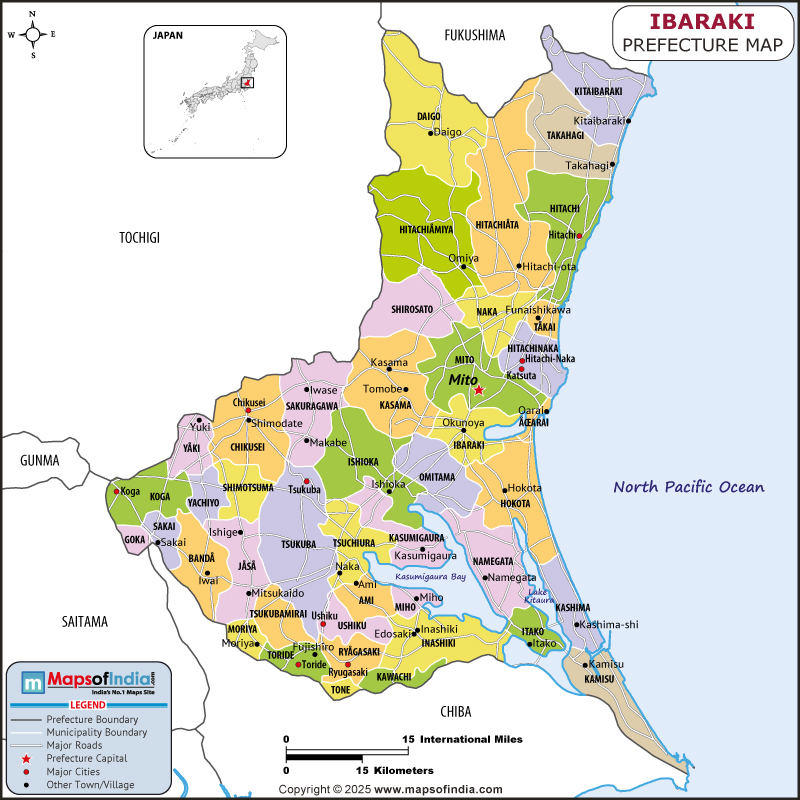



It is geographically placed at a strategic location in the Greater Tokyo Area with Fukushima on the north side, Tochigi on the northwestern side, Saitama on the southwestern side, Chiba on the south side, and Laurel Pacific Ocean on the eastern side. Covering an estimated area of 6,097 square kilometres and having an estimated population of about 2.83 million people, Ibaraki has the 11th highest prefecture population in Japan. Mito, its capital, is home to one of the three most famous landscape gardens in Japan, Kairakuen Garden, and its other larger cities, like Tsukuba, Hitachi, and Hitachinaka, present it with a variety of economic and cultural interests.
The location of the prefecture is diverse, including fertile plains, picturesque mountains and a lengthy Pacific coast. It has the second-largest lake in Japan (Lake Kasumigaura) and a double premier mountain, called Mount Tsukuba, which has long been the focus of spiritual admiration. Climate Ibaraki has a relatively mild climatic environment with dry and sunny winters and a warm and humid summer climate, which makes it an all-year-round destination. Its location is close enough to Tokyo, which can be accessed in approximately an hour through the trains, and still, it has its own identity as a result of the centuries-old tradition and an excellent respect for the land and the sea.
History
Due to its extensive ancient provincial system in Japan, Ibaraki has a rich history. The region was previously a part of Hitachi Province, which was powerful in terms of the political and cultural progress of eastern Japan. Archaeological records show that people have dwelt in the region as far back as the Jomon period, with shell mounds, burial stupas, as well as other artefacts showing that there had been an extended history of settlement in the region. In the Nara and Heian periods, Hitachi was notable in the output of agriculture as well as the provision of items to the imperial court.
During the feudal period, the fate of Ibaraki was closely associated with that of the Tokugawa shoguns. The prefectural capital, Mito, became the leader of the Mito Domain, which was under the control of a branch of the Tokugawa family. Comprising three of the three branches of the Tokugawa clan, the Mito branch was also a branch of one of the three distinguished, i.e. gosanke, branches in the official and intellectual life of the Edo period. It is a scholarly area that was characterised by the proliferation of scholarship, especially by the Mito School, which encouraged the study of Japanese history and Shingon philosophy. This intellectualism helped the emergence of sonnō jōi ideology (Revere the Emperor, Expel the Barbarians), which had an impact on the political movements which resulted in the Meiji Restoration.
The era of the Edo period had also witnessed the emergence of cultural monuments like the Kairakuen Garden, which was put in place in 1842, by one of the ninth lords of Mito, Tokugawa Nariaki. In contrast to the majority of existing gardens in Japan, the Kairakuen was constructed as a garden which could be enjoyed by people, which is due to Nariaki and his philosophy on shared cultural areas. Plum blossoms growing seasonally in the garden in the late winter are still one of the most well-known examples of seasonal attractions in Ibaraki.
The major transformations involved in Ibaraki in the modern age were when the feudal system was abolished in the year 1871 and when the prefecture was established. In the Meiji era, there was industrialisation, especially in the mining and manufacturing sectors, where the Hitachi region became a huge electrical equipment. The multinational corporation started in 1910 in the city of Hitachi and therefore carries the same name as the city. Another form of suffering the prefecture had suffered was in air raid damage during World War II, but this was compensated in the postwar years, and this time extended to the diversification of the economy as well.
Culture
The Ibaraki culture is a rich fabric which is also composed of its ancient samurai culture, farming and artistic great entities. The permeation of the Mito Domain type of the Samurai culture is also observed in historical sites, including the Kodokan, the largest extant school of Japan, whereby the samurai learnt Confucian classics, martial skills and a few practical skills. The visitors are presented with an opportunity to see the preserved buildings and gardens in the school, which helps to get the idea of the ideals of education in the Edo era.
Ibaraki's cultural identity also has a tradition and religion as a central element. Centuries old, Mount Tsukuba has been a place of worship and is related to the Shinto deities, Izanagi and Izanami. The foot of this mountain consists of two twin peaks, also termed as Nyotai-san and Nantai-san, which are associated with the principles of males and females, and the Tsukubasan Shrine at the base of the mountain is the venue of the festivals that celebrate these antiqueness ideologies. Another absorbing spiritual place is Kashima Shrine, which is one of the oldest Shinto shrines in Japan and is of an old god named Takemikazuchi, who was a deity of martial valour.
The prefecture also has traditional crafts. Kasama is a city located in the western region of Ibaraki that is known for its Kasama-yaki pottery, that have taken the turn of characteristic utilitarian vessels to become high art forms of ceremony. It is also possible to write about a great respect for craft that is reflected in the region's lacquerware, textiles, and handmade lanterns. Local festivals: The community is creative and committed to tradition, including in terms of festivals like the Hitachi Furyumono Festival with its giant floats and macho dolls.
Another pride point is culinary culture. Ibaraki is a major manufacturer of natto, one of the popular fermented soybean dishes in Japan, which should be added to Japan's list of manufacturers. The rich plains produce quality rice, vegetables, and fruit, and the Pacific coast source is the better part of sea creatures, with whitebait (shirasu), or flounder and anglerfish. The agricultural diversity of the prefecture is represented by the new seasonal products (sweet chestnuts in autumn, fresh strawberries in winter) that indicate the abundance of agriculture. The history of sake brewing is long, and some of the breweries, such as Sudo Honkey, regarded as the oldest in Japan, are still producing some acclaimed varieties.
Language
Ibaraki mostly speaks Japanese as its main language, although the local one, which is identified as the Ibaraki dialect (Ibaraki-ben), has certain peculiarities which make it different to standard Japanese. It belongs to the larger North Kanto dialect group, but also has certain features in common with Tohoku dialects. There are also distinctive intonation patterns, vowel mergers and the dialectal inclination to voice the unvoiced consonants, which are unvoiced in Japanese standards.
In the past, the dialect did not count as a unique type of [speech] until the creation of the prefecture in the late 19th century. To this day, although standard Japanese is spoken in schools, mass media and in a context of official needs, the dialect itself is still a source of important locality, particularly among the older generations and in countryside schools. It may be very seldom used by younger residents, who nonetheless know the cultural meaning well and value it.
Japanese language education can be found in Ibaraki among non native speakers at universities, vocational and community services. The availability of Tsukuba Science City and foreign researchers has introduced a more globalised population to the prefecture, which has seen English and other languages being used in some situations. But Japanese is the language which still predominates in day-to-day lives.
Geography
The geography of Ibaraki is heterogeneous because it provides a combination of low Lay land, coastal, and mountainous areas. Its eastern border is marked by expansive Pacific coastline, sandy beaches, fishing ports, and scenic cliffs. The coast not just provides an inspiration of natural beauty, but it is also a basis of the fishing business and the sea tourism. The large Kanto Plain, found inland, has good farmlands that host the well-established agricultural industry of the prefecture.
The second-largest lake in Japan, but significant to the prefecture as a whole, is the lake of Kasumigaura, located in the south of the prefecture, useful in the areas of irrigation, fisheries, and recreation. Wetlands around the lake are also very biodiverse and will appeal to birdwatchers and nature lovers. On the west hand, there is Mount Tsukuba, which stands 877 meters, providing super panoramic views of the Kanto plain and on clear days, Mount Fuji. The mountain can be reached either through a rope way or by hiking trails, hence making it a major tourist and pilgrimage destination.
The highland that is north of Ibaraki is rougher, and the Abukuma Highlands spread to the prefecture. This location is also the location of one of the three most popular waterfalls in Japan, which are known as Fukuroda Falls that fall in four stages and alternate according to the seasons, meaning winter with frozen rocks and the spring season with green bushes. The Kuji River and other water bodies make it a scenic region and give people a chance to engage in outdoor recreational activities, e.g. fishing and kayaking.
The climate in Ibaraki is mostly moderate; the temperature difference along the coast is comparatively low because the Pacific Ocean mitigates those changes. Winters are clear and sunny with a scarcity of rainfall, and plentiful rainfall comes during the summer rainy season and at the beginning of winter. Fog prevails along the coasts, particularly in the mornings. Together with fertile soil, these conditions make the prefecture a perfect farmland where diverse land types bear a large number of flora and fauna.
Quick Facts
| Official Name | Ibaraki Prefecture |
| Area | 6,097.19 km² |
| Population | 2,828,086 (As of 2023) |
| Religion | Shinto and Buddhism |
| Language | Japanese |
FAQs
Q1: What is Ibaraki Prefecture most famous for?
It is renowned for Kairakuen Garden’s plum blossoms, Mount Tsukuba, and the research hub of Tsukuba Science City.
Q2: Which major Shinto shrine is located in Ibaraki?
Kashima Shrine, one of Japan’s oldest and most important shrines, is located in Kashima City.
Q3: Does Ibaraki have any notable waterfalls?
Yes, Fukuroda Falls in Daigo is considered one of Japan’s three most beautiful waterfalls.
Q4: What large body of water is found in Ibaraki?
Lake Kasumigaura, Japan’s second-largest lake, lies in the southern part of the prefecture.
Last Updated on: April 15, 2026

