


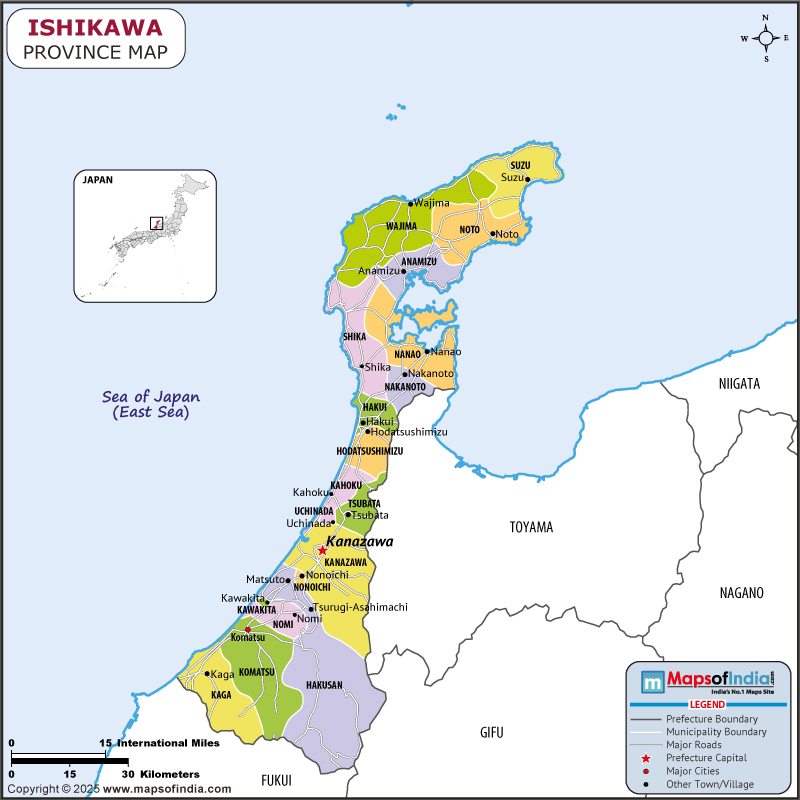



Ishikawa Prefecture covers the coast of the Sea of Japan in the Hokuriku region and the plains of coastal and mountainous lands with the symbolic Noto Peninsula and historic Sado Island. The seat of this tiny kingdom is the colourful capital of Kanazawa, whose various historical locations such as the Kenroku-en Garden, reputed as one of the three best gardens in Japan; Kanazawa Castle, and the geisha-district of Higashi Chaya keep the air smelling of samurai. The traditional arts of the area are ardently reflected in the masterpiece crafts: The gold leaf fine work, Kutani colorful porcelain, the unique Kaga-yuzen silk dyes, and the fine Wajima lacquerwork are all still extant in the region. In the meantime, the relationship between rugged coast, terraced rice fields and cultural heritage designates a landscape that intersects between natural beauty and art. Whether you are strolling through the coastal landscapes or the more ancient of crafts, Ishikawa presents an enriching, immersive experience into the rural heart of the Japanese and the more civilized aspects of Japan.
History
The modern day Ishikawa area was originally divided between two ancient provinces Kaga and Noto. In 1872 they were combined during the Meiji Restoration to create the new prefecture, with its center provisionally at Mikawa and then relocating to Kanazawa the following year.
Kanazawa, literally translated as marsh of gold, became known as such when gold dust was found being washed into potato peelers in the soil of the region--which spawned some legends and set it firmly in stone. The great craft work and culture of the territory grew and flourished under the regency of the Maeda clan governing the former Kaga Domain and spanned almost 3 centuries. They promoted Kanazawa as a centre of culture by building emblematic places like Kenroku-en Garden and sponsoring local trades like lacquer, Kutani inlaid porcelain and textile painting.
The Noto Peninsula was a culturally important and strategic area of the north coast. Settlement in this area can be traced back to ancient times with evidence of interaction with the Tsushima Island and places such as northern Korea. The peninsula was moved around among the different clans before the Kaga Domain became part of Tokugawa shogunate during the Sengoku period. Later on towns such as Wajima gained fame due to salt farming, lacquer ware, and the ongoing trade in seafaring.
The modern Meiji era saw the development of Wajima and other towns in the form of municipalities and Wajima eventually became a city in 1954 by means of joining other villages nearby.
The region has become resilient under difficult times in the past few decades. On January 1, 2024, a massive earthquake with a magnitude of 7.6 struck the Noto region, resulting in many damages, including fires and disruption of the artisans working on lacquerware. Further flooding and landslides in the year later due to heavy rains added to the problems of the region. In spite of the destruction, local communities, and particularly in Wajima, rose to their feet to protect centuries-old traditions- boosted by rebuilding efforts and a new wave of cultural revival as a result of the tourism and artisan events.
Culture
Ishikawa is commonly referred to as a national center of traditional arts-especially those that were cultivated during the Edo era and under the patronage of the Maeda clan. This aristocratic leadership opened workshops at Kanazawa and invited master artisans throughout Japan and developed the methods of gold leaf gilding, Kaga-yuzen silk dyeing, Ohi tea-ware, Kutani porcelain, and the mythical style of Wajima and Yamanaka lacquerware.
All these crafts survive until our times, not only as living traditions, but also as commemorated examples in museums such as the Ishikawa Prefectural Museum of Traditional Arts and Crafts. The journeyer can meet 36 local crafts, demonstrations and even workshops that bring centuries of craftsmanship to life. One of these is gold leaf production, not merely on the level of conspicuous use in architectural and other ceremony adornment, but even for amusement more food-stuff gilding as in gilt soft-serve ice cream.
In addition to crafts, cultural life is active in restored historical quarters. Geisha perform in the gracious wooden tea houses of Higashi Chaya in Kanazawa, as part of a network of areas that captures the samurai period sophistication, skill and allure. This careful observance of urban art is reflected in the city to this day in such locations as the Kenroku-en gardens and the Kanazawa Castle where beauty, architecture, and harmony with the seasons represents a very fine mixture.
Another vital strand of the cultural fabric in the area is food and ritual. There are fine rice and sake culinary cultures. Lots of sake breweries have modernized centuries-long techniques, and lately, communities have organized to maintain their practices during natural calamities that have affected their activities.
Overall, Ishikawa is a combination of the remnants of the past with the present--where craftsmanship, ritual, performance, and daily routine accompany each other. You can dip your brush in a Kaga-yuzen handi-craft atelier, indulge yourself with sweets decorated with gold-leaf in a teahouse, or taste the elegance of master craftsmen; cultural experience here can be intimate as well as abundan
Language
The standard form of the Japanese language is the most common language that is spoken in all parts of Ishikawa whether in schools or official social places or in day-to-day conversations. Nevertheless, we can also note peculiarities of local languages, which color dialogues in the area.
The region is included in the general Hokuriku dialect region. Among the representatives of this linguistic group, we can identify two local variants. Kaga dialect is found in the southern part also called Kaga, which is a local dialect, and Kanazawa dialect is particularly strong. This is the tame, melodious version, particularly in service settings. A characteristic example of this is the soft imperative suffix -masshi, in the same manner as -nasai in the standard Japanese, and so suwaru masshi ne comes to mean a soft, “Please sit here”. More geographically isolated variants like Gige-ben do develop in some villages such as Shiramine.
The identity of the communities of the peninsula is captured in the Noto dialect of the north. It has much in common with other Hokuriku dialects--including lax intonation--but also has grammar and specific vocabulary peculiar to the region.
In this part of the country, dialectal variations usually affect the ending of sentences and particles. An example is the grammatical particle no can be substituted by the grammatical particle ga and questions can have an ending -ke rather than the usual ka. Such insidiousness adds to the rhythm of speech which seems so familiar and classic Hokuriku.
In addition to native language, an increase in use of multiple languages, especially within the category of public services, is witnessed. On the official websites by local governments, the translations or translation tools are provided automatically in such languages as Chinese, Korean, Vietnamese, etc. In cases of emergencies like natural disasters special multilingual hotlines are set up so the non-Japanese speakers who speak a particular language (say English, Vietnamese, Chinese and Indonesian) can be helped. These initiatives have provided access and community participation in a growing diverse society.
Geography
Situated between the Pacific and the rocky mountains on the northwest coast of Honshu, Ishikawa stands complacently in the midst of the Sea of Japan. The region is anchored by the rich Nakano Plain scoured by the Shinano River and the millennium of sediment deposition that causes the hills and peaks to rise in its southern and central areas.
This low-lying plain has at its heart a city Kanazawa, which is located on the coast, and has direct access to the sea through its port. Such a special place has enabled urban life to co-exist with rural life, and the gravity to be attracted to the sea and land.
Go inland, and the land suddenly shifts into the Asano and Echigo ranges of mountains that trap heavy snowfall in the winter. The resulting excessive snowmelt supplies rivers and freshwater springs, the rice paddies and a robust hydroelectric base. These landscapes also produce remarkable contrasts: snow fall and -40 degrees during winter, then humid and warm weather during summer, a pattern that determines life during the seasons.
To the west of the mainland is Sado Island, a geologically and culturally different island. This island has two mountain ridges-O Sado and Ko Sado and the main basin is the Kunikaka Plain. There is another volcano, Lake Kamo, the only natural brackish lake in Japan, which formed due to the action of volcanic and marine forces. Topography provides special conditions to traditional agriculture, inland fisheries, and a microclimate, which support rare wildlife and plants.
There are significant climate variations. This is because coastal regions tend to be relatively warm during winter because of the influence of the sea; however, they receive a combination of rain and snow. There are inland mountain regions, with severe snow seasons, that are perfect to both ski and also irrigate rice fields. Sado Island is warmer and more temperate being smoother with ocean currents and damp air masses.
Quick Facts
| Official Name | Ishikawa Prefecture |
| Capital | Kanazawa |
| Region | Chūbu, Hokuriku |
| Area | 4,186.09 km² |
| Population | 1,133,294 |
| Island | Honshu |
FAQs
Q1: Where is Ishikawa in Japan?
It borders the Sea of Japan on the northwest of Honshu and contains the picturesque Noto Peninsula and the ancient Sado Island.
Q2: Does sightseeing have easy access by transport?
Yes. Kanazawa has a fairly effective bus transit system with station loops that bring you to Kenroku-en Garden, Omicho Market and other attractions. Cars and bikes are also available in large numbers to explore rural locations such as the Noto Peninsula.
Q3: What is the cultural experience of the region?
The region is also a master at the classical arts of gold leaf, Kutani porcelain, Wajima lacquer, Kaga-yuzen silk dyeing, and has preserved more traditional arts like the Noh theatre and the tea ceremony.
Last Updated on: June 22, 2026

