


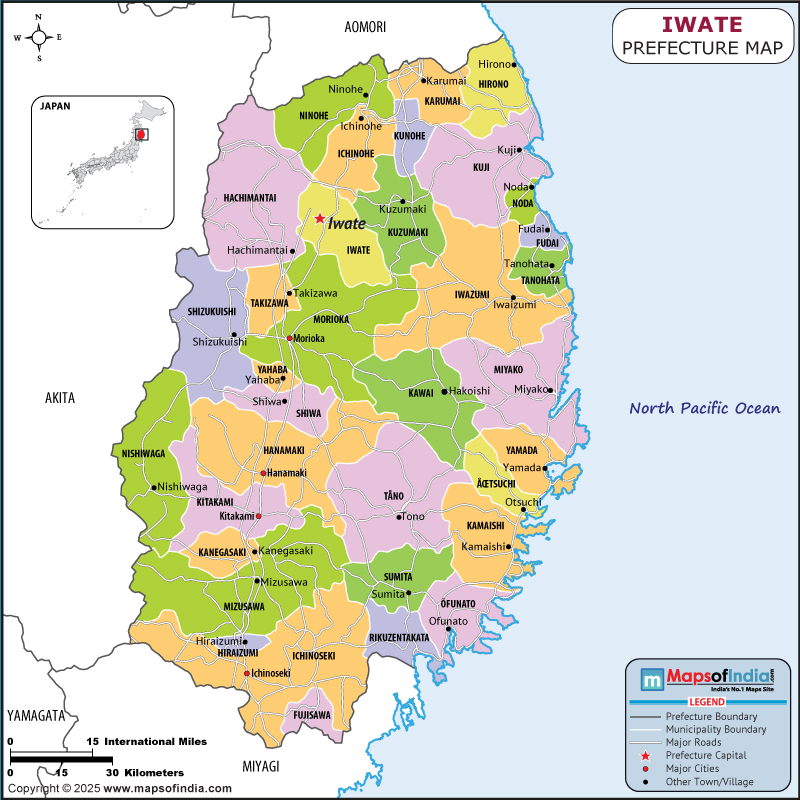



Iwate Prefecture in northeastern Japanese Tohoku region is a historical site with an immense natural charisma, and a high level of cultural continuity. Being the second-largest prefecture in Honshu, it presents immense landscapes of rugged coast through the Sanriku Coast and mountainous interiors sprinkled with forests, rivers and hot springs. It is due to this geographic diversity that the character of people and their lifestyle has been formed.
Its capital city Morioka is also a cultural center with traditional crafts, original noodle dishes as well as the intelligent local atmosphere. The political and spiritual centre during the late Heian period was located just south of the city in Hiraizumi. There are other World Heritage Sites, like Chuson-ji and Motsu-ji, in this town which display a high culture of Buddhism that once competed with Kyoto.
Thus, in the modern context, much of the identity of Iwate is still founded upon traditions. A strong cultural continuity is manifested in seasonal events such as the Sansa Odori drum parade and strong underlying folk narratives of locations such as Tono. This historical-nature mixture is observable also in local industries: ironware and textiles, agriculture and fishing.
History
The narrative of Iwate starts even earlier in prehistoric times, as numerous archaeological locations of the Jomon-period have been located throughout the area, including clay figures, masks, burial pits, and others, that testify to the ancient human presence. The traces of these items left in occupation areas like Nishida and Kitakami testify to Iwate as a centre of early Japanese civilization.
At the beginning of the 8th century, the Yamato court started to expand its land to the North. The court finally overcame the indigenous Emi people despite strong opposition by the native populations through leaders such as Aterui and More. The chieftains capitulated in 802 AD, and military camps, castles, like the one at Isawa and Shiwa, were built in order to cement the law.
One place that acquired significance during the later period of the Heian, under the Northern Fujiwara clan, was Hiraizumi in southern Iwate. Fujiwara no Kiyohira established a seat of culture and government abundant with magnificent temples and gardens, in hopes of competing with the standards of aesthetics in Kyoto. That golden age came to an end at the end of the 12th century when Minamoto no Yoritomo devastated Hiraizumi, changing the course of Iwate history.
It seems that at the beginning of the modern period, the Iwate region was governed by two branches: the Nanbu clan perched on the north and south through the Morioka Domain and the Sendai Domain. Modern boundaries of the prefecture were established only in 1876 during the Meiji Restoration, when feudal estates were replaced by the system of prefectures.
The 20th century was the century of challenge and change. On March 11, 2011 at half past nine, the magnitude-9.0 earthquake and coastal tsunami hit the coastline of Iwate as a part of Sanriku region. Miyako, Kamaishi, Otsuchi, and Ofunato cities were devastated and killed numerous lives.
However, even in the face of this tragedy Iwate has made impressive strides to recover and maintain both natural and cultural heritage. To-day it forms the second-largest prefecture of Honshu, abundant in tradition, in difficult literature, in folklore--symbols of pride to its inhabitants.
Culture
The Sansa Odori festival, every August, is one of the best-known cultural festivals in Iwate, held in Morioka. The festival has been dubbed as the biggest taiko drum parade in the world, boasting thousands of performers dressed in colorful costumes which move rhythmically down the city streets. It is not only a production on its own, but also an emblem of local identity and team spirit.
Kabuki, folk dance and other performing arts continue to be an important element in rural Iwate. Kagura dances, among other ancient rituals, are performed in townships, including Tono and Hanamaki, to honor the gods of that place. Of script or interest is Hayachine Kagura, a holy masked dance in honour of Mount Hayachine. It is considered as an Intangible Cultural Heritage by UNESCO as the stories about the spirits were scrupulously kept.
We also have longstanding crafts in Iwate. Some products are practical as well as artistic, such as nambu tekki, or cast ironware made in the Morioka region, typically in teapots and kettles. Other Another Hiraizumi Android Hiraizumi, and There is Hiraizumi Hiraizumi, lacquerware Hidehira-nuri, a form of exquisite encasing in gold leaves, tradition. They are practical crafts as well as an expression of local design and esthetic.
When speaking of cuisine, the food culture of Iwate is characterized by straightforwardness, locality, and sociality. There is pride in Morioka with respect to its soba served in massive portions called bite size bowls, which are consumed in quick setups (wanko soba; known as three great noodles); eaten hearty soba, miso with minced meat called jajamen; and cold soba called reimen in Korean style influenced by naengmyeon. Fresh seafood like sea urchin, abalone and other oysters are also seasonal delicacies along the Sanriku Coast. Maesawa wagyu beef is noted to be tender and very flavorful inland.
Also of central importance is rice culture, particularly mochi. Currently, some of these southern Iwate towns, such as Ichinoseki, have a designated calendar (mochi calendar) to show what kind of rice cake to consume on which days throughout the year- a local tradition.
Language
In Iwate Prefecture, they speak the language easy to understand; it is the Japanese; yet the Japanese culture and history have numerous peculiarities which are reflected in local languages. The Iwate dialect (or Iwate-ben) is part of a more general set of dialects called Tohoku; the accent is most readily recognizable by its unusual intonation, intonation, vocabulary and pronunciation styles and patterns, which differ to the standard Tokyo Japanese.
The rural and coastal dialect is slightly different in Iwate. The accentual wording rarely sounds loud, particularly upon the Sanriku Coast, although the inland region like Morioka features louder and prominent accents.
The language used in Iwate-ben contains lots of words, which are not well known by the other part of Japan and anyone speaking by such language is likely to sound to them as being non-English. Brominatively: e.g. in parts of Iwate, the term koma means child, where standard Japanese competence would be kodomo. There are also subtle differences in the conjugations of a few verbs, and phrases, in keeping with the rural roots of most of the prefecture.
The Tohoku dialects, the one Iwate applies being no exception, has traditionally been labeled as harsh or hard to know. However, new cultural pride movements were able to rescue and at the same time, celebrate these dialects as important constituents of ethnicity.
Besides Japanese there is little use of Ainu language which native people in the north of Japan previously used, now there is little active usage of this language in Iwate precept.
Geography
Iwate Prefecture is found towards the northeast of Honshu (the largest island of Japan), and belongs to the Tohoku region. The second-largest in Japan, in terms of land area, It is covered by around 15,275 square kilometers in what is called Shinsyu prefecture. It is a large region endowed with rich geography characterized by plains along the coastline, steep mountains, forests, and river basins.
On the prefecture's east side, Iwate opens into the Pacific Ocean with the Sanriku Coast running along the shore. The most familiar characteristic: the all too gullied coast of rias, is a sign quite clearly not only of a tectonic action, but also of erosion. The Sanriku Coast is punctuated by dramatic slopes, smaller bays and fishing ports and is one of the most attractive and biologically diverse coastal areas in Japan. However, it has been found to be highly vulnerable to tsunamis through the unfortunate tsunami experienced during the great east Japan quake in the year 2011.
Ōu Mountains form a natural boundary between Akita and Iwate Prefectures, dominating inland Iwate on a northsouth line. The highest of these is a dormant stratovolcano, mountain Iwate, also known as the Mt. Fuji of the north, located just south of Morioka at 2,038 meters high. The eastern side of the plain basin presents the Kitakami Mountains, generally of inferior height, forming a wooded hilly topography.
One of the major rivers in Japan is called the Kitakami River, which flows north-south across the central basin of the prefecture. It may be considered an important part of the agricultural and settlement territory and will lead to the planting of rice and urbanization of the snow Karen such as Morioka or Kitakami City.
Quick Facts
| Official Name | Iwate |
| Capital | Morioka |
| Area | 15,275.01 km2 |
| Population | 1,65,886 |
| Governor | Takuya Tasso |
| Region | Tōhoku |
FAQs
Q1: What is historically and culturally famous about Iwate?
Iwate prides itself on its important historical and cultural heritage, especially the temples in Hiraizumi, a UNESCO World Heritage site, including Chuson-ji with its famous Golden Hall. The capital city of the prefecture Morioka has had a rich history as a castle town, as well.
Q2: What are the natural high points in Iwate?
The naturalist tourists flock the Iwate region with its beautiful Sanriku Coast, the serene boat ride at Geibikei Gorge, the crystal-clear Ryusendo Cave, and the only vast wild lands at Hachimantai. Both are different aspects of the beautiful geography of the prefecture.
Q3: What are the unusual foods that Iwate offers?
One point of interest in Iwate, which should not be overlooked, is the Moroke noodles of the city of Morioka: the wanko soba (mini-bowl of noodle you get as much as you can eat), reimen (spicy), and jajamen savory (all of them taste a bit of local tradition).
Last Updated on: April 15, 2026

