


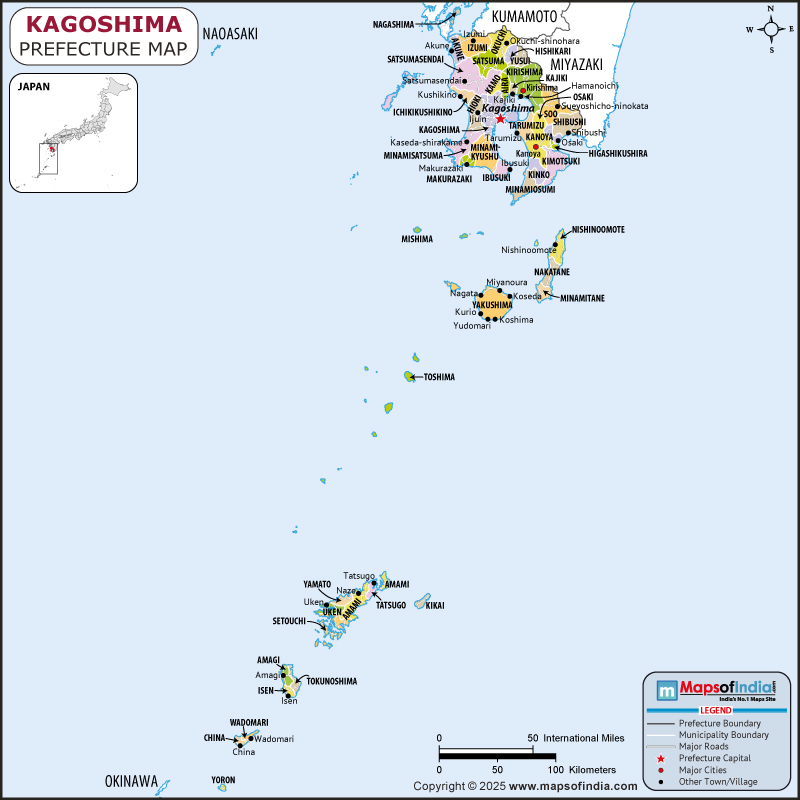



Kagoshima is a vibrant region with a good history and culture. It has a long, productive history of connection with the mighty clan of Shimazu, and was among the most important participants in the modernization of early 19th century Japan. The soul of the populace remains intact in that now Kagoshima is a stunning spot that accepts conventional artistry, colourful festivals and unique dishes. Many people recognise the region due to a warm and friendly atmosphere, good community relationships and accent that has given it a unique identity. History and modern-life are combined with each other; that is the reason why Kagoshima is an interesting and busy area in Japan.
History
The history of Kagoshima links further back to the historical era of Satsuma Province where the great Shimazu clan established the kingdom at the end of the Kamakura period. This clan rose to greatness and towards the 16th century with Shimazu Yoshihisa it united a good part of Kyushu. Kagoshima became great as a political and military base in this way.
The city had thrived during the Edo era (1603-1868) when it was the capital of Satsuma Domain. Kagoshima became one of the most prosperous areas in Japan due to its strategic location as a port and wealth coupled with ambition of the Shimazu. The domain kept alive an intercourse and a sphere of influence, particularly with the Ryukyu Kingdom, and even established a formal embassy to control relations.
Kagoshima has been the cradle of modernization in the 19th century, owing to the strategies of leaders like Shimazu Nariakira. He led the industrial awakening of Japan, master of the first modern industrial complex in Japan called Shuseikan, and introduced shipbuilding, Western factories, and reorganized education. These developments formed the foundation of the greater Meiji Restoration.
In fact, Kagoshima played a major role in the stormy Bakumatsu period. The city was subsequently attacked by the British as part of the Anglo-Satsuma War of 1863 to exact vengeance on the Namamugi Incident. However, this was also the period during which several powerful leaders of the later Meiji government, Kagoshima Samurais, ascended to power.
It was one of the most fateful periods in Kagoshima as it was accompanied by the Satsuma Rebellion of 1877 led by Saigo Takamori who was a sacred Samurai and the key figure of the Restoration era. The revolution led to the Battle of Shiroyama-thoughtful last stand at Shiroyama hill-saigo fancied the result. The conclusion of the revolt and the period of insurrection managed by Samuari happened because of his death.
The story of Kagoshima is also influenced by natural activities. In 1914 the Sakurajima volcanic island burst out in a manner that was highly dramatic, linking the island with the mainland, and enveloping the city with volcanic ash. Moreover, Kagoshima suffered greatly during World War II, when nearly half of the urban city was vanishing in a single night, during June of 1945, as American B-29 aircrafts bombed the city almost to death.
Kagoshima also culturally flourished and saw the production of such specialty crafts as Satsuma pottery (Satsumayaki) and Satsuma Kiriko glassware--local crafts developed under Shimazu patronage over centuries. The Amami Island oshima-tsumugi silk textiles also exhibit strong cultural roots, which are at least 1,300 years old.
Culture
At the very southern end of Kyushu lies a small island called Kagoshima that has developed a very strong sense of culture because of its warm climate, its volcanic nature, and its strong history. It boasts of an excellent cuisine- the people enjoy meals prepared of sweet potatoes, Berkshire pork (kurobuta), and lightweight Satsuma jidori chicken, often served as sashimi. Topics such as the satsuma-age (deep fried fish cakes), kibinago (silver striped herring) sashimi, tasty karukan sweets, and hearty Kagoshima ramen (pork broth with a little chicken stock and dried fish) are also a part of the food culture in Kagoshima. The creativity of the people in agriculture is also evident in sweet potato based snacks like the gane (fritters with the shape of crab legs). Akumaki, sticky rice dessert in bamboo leaves barely dipped in lye, has centuries of tradition--at one time preferred by samurai on the battlefield and now being.
Other than its food, Kagoshima is a nest of traditional crafts. Satsuma-yaki is a glaze and gold-adorned pottery dating up to the late 16th century, which has continued to exist in the region as a living art form. In the same way, the Satsuma Kiriko cut glass of very bright colors and complicated, geometric shapes came back to life in recent decades and is praised both at the national and the international levels. The Oshima-tsumugi textile of Amami Oshima, Kagoshima Prefecture--another cultural treasure--is a fine and elegant hand-woven, mud-dyed silk textile, with a history stretching back more than 1,300 years.
Kagoshima is a place of festivals. The Ohara Matsuri held in November every year fills the street with mad dancing, traditional music (Ohara Bushi) and colorful dresses inviting both residents and visitors to join the colorful experience. The Shibushi Buddha Festival, where horse-drawn bridal processions and swinging basket-carrying children instrumentalize centuries of spiritual and inter-tribal feastings in the Osumi region of the prefecture annually in April.
In the meantime, Sumiyoshi Shachu Dance and Tea Ceremony traces the traditions of ozashiki dance and tea ceremony in a historical context and in the southern part of Kagoshima on the territory of the Sumiyoshi Shachu Troupe.
Filling this paucity of culture is that Kagoshima is intricately entrenched in the hot spring (onsen) culture - boasting of thousands of geothermal springs courtesy of the adjacent Sakurajima volcano. Kagoshima is a destination that symbolizes not only the relaxation it offers, but also its traditions and culture, including the symbiosis of sand baths in Ibusuki and the traditional sentos.
Language
On the lower part of the Kyushu, Kagoshima boasts a very bold linguistic identity, marked by the Satsugu dialect, what is popularly referred to as the Kagoshima dialect. This is an expressive dialect existing as a continuum in the region that once constituted the Satsuma and Osumi Provinces and with minor differences existing between the nearby towns and islands.
Another way Kagoshima differs is at prosody. On the main island unaccented phrases have a low pitch until the final syllable as an accented phrase rises up the sixth syllable, and a complex system that brings uniquely rhythmic interest to spoken Kagoshima dialect.
The dialect, despite its rich-cultural origins, is no longer under pressure. The sound of the Kagoshima expressions are disappearing as younger generations are more and more conscious of Standard Japanese, both in parks and national schools, as well as through mass media. Still, such local expressions as kibai-yanse (do your best), oyattosaa (thank you, treat your work) are preserved, as their local beauty is the pleasure of the young generations, although the latter is less obvious nowadays.
The language culture of Kagoshima is influenced by the natal Northern Ryukuan tongues too, including the degraded Yoron language of the Yoron Island, in Kagoshima Prefecture, which bears the explicit lingual legacy of the greater Japonic family.
Geography
Kagoshima lies on a singularly peninsular location, at the very southwestern end of Kyushu, extending over the Satsuma and Osumi Peninsulas and extending offshore to take in an area of over 600 islands, the most notable in the list being the Amami, Tokara and Osumi archipelagos. This stretch of sea is enclosed to the west by the East China Sea and south and east by the Pacific Ocean making it a rugged, densely indented coastline formed as a result of volcanic activity.
Kagoshima Bay or Kinkowan is one of the most memorable groups of landmarks in the Prefecture. The two peninsulas frame this dramatic inlet and become preside over by the large cone of Sakurajima, an active stratovolcano. Sakurajima usually generates ash and small eruptions, and the volcano had an eruption in 1914 that left enough material to permanently join the volcano to the mainland. The soil of the region itself, to the east, is, as we see it, of volcanic origin; and beaches bordered by deposits of pumice, like Ibusuki; with crater-lakes as well, we have at one time or another witnessed in our geological career.
In addition to the mainland borders, Kagoshima has natural resources such as Yakushima which is a UNESCO World Natural Heritage site and is known as the home of ancient cedar forests and ecosystems. The prefecture is also home to a remarkable number of climate zones - temperate to subtropical - that allow the establishment of diverse natural environments, including mangrove swamps, camphor groves, and endemic species such as the Amami rabbit.
The topography of much of Kagoshima is under protection as national and quasi-nation parks including Kirishima-Kinkowan, Amami Gunto and Yakushima, to conserve the volcanic rocky highlands and its forests and island coast.
Quick Facts
| Official Name | Kagoshima |
| Area | 547.61 km2 |
| Population | 583,966 |
| Region | Kyushu |
FAQs
Q1: What is Kagoshima known for?
Kagoshima is also home to an active volcano, Sakurajima, which is just on the opposite side of the bay. It is also home to hot springs (onsen), historical places associated with the Meiji Restoration and special delicacies like kurobuta (black pork) and satsuma-age (fried fish cake).
Q2: Where is Kagoshima located?
Kagoshima sits at the very south of Kyushu, the third largest island in Japan. It borders Okinawa and Amami Islands and East China Sea.
Q3: Is Sakurajima safe to visit?
Yes it is quite safe to visit Sakurajima. The volcano is well observed and visitors advised on any future activity. They have areas of observation and safety shelters. Certain regions can be closed at the period of increased volcanism.
Last Updated on: April 15, 2026

