


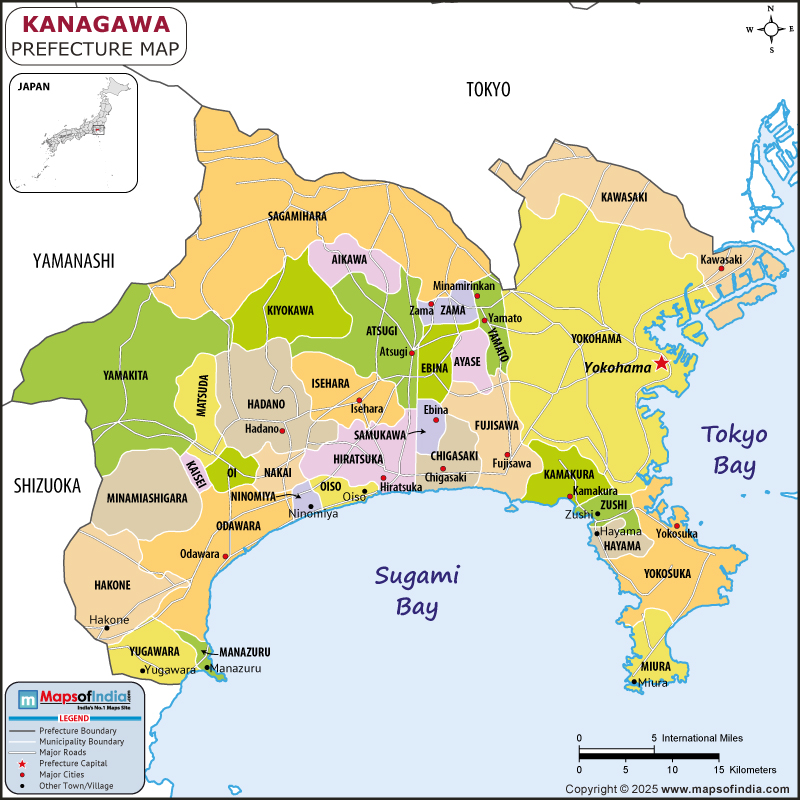



Kanagawa is Japan’s second-largest prefecture, located right at the foot of Tokyo. It is made of busy urban centres and stunning scenery. Its center, Yokohama is a busy port city, Cosmopolitan city-building, lively Chinatown and the skyline overlooking the sea are also part of Tokyo-Yokohama megalopolis. Kanagawa serves history and leisure in the Pacific coast either in the samurai-era temples and the Great Buddha of Kamakura, or the sun-dipped and surfing beaches of Shonan region. Domestically, the prefecture covers mountainous resorts, such as Hakone, which is the classical Japanese hot-spring resort with Mount Fuji on site. The prefecture is economically dynamic by nature and it has taken advantage of being part of the Keihin Industrial Area and the development of targeted R&D and dynamic cultural tourism.
History
The Kanagawa saga is seen to trace back to implementation of prehistoric descent and at present is gaining prominent status in the contemporary world. The area has archaeological records dating that of the Jomon period which is a period two millennia ago, and a volcanic eruption taking place in the mountain Hakone, formed characteristics such as Lake Ashi. In the early period, the plains were sparsely occupied but over time the region came out under imperial rule and as a region of the ancient provinces in Sagami and Musashi.
In the late 12th century Kanagawa took its real identification chapter when the city of Kamakura gained prominence as a samurai capital in the country. Between 1185 and 1333 a highly important step in creating the first shogunate in Japanese history was set during an era known as the Kamakura period that will prepare the line on which warriors rule and courts based on the development of Zen Buddhism. One of the symbols of the time which continue was the Great Buddha of Kamakura.
Hundreds of years afterward under the Edo period, the area was under the influence of the local domains with Odawara playing a significant role at Edo Tokaido and extending to the larger territory controlled inconsistently by Edo (modern Tokyo). Kanagawa increased in strategic relevance - interrupted, in 1854, by a turning point when Commodore Perry entered and Japan was pushed to abandon her isolationist policy. This led to the Convention of Kanagawa that opened up trade with the west and what used to be a rural port village of Yokohama soon turned to an international point of entry.
The coming of the Meiji era speeded up modernization of Kanagawa. Yokohama grew into a globalizing hub of exchange, shipbuilding, and manufacturing and railroad created connections between Kanagawa to Tokyo and further. Everything went tragic in 1923 when the Great Kanto earthquake devastated the area-destroying huge portions of this area yet forcing it to start its rebuilding and modernization.
It had gaped through the turmoil of World War II, but it came out resiliently. The economic boom after the war gave back significance to Kanagawa as a component of the Keihin Industrial Zone where big firms were now located and as a location where research and development were to take center stage.
Culture
Kamakura-bori, complex carved and lacquered woodware attributed to the Kamakura era is one of the acclaimed crafts of the region. It is highly valued as a revered piece because of the way it is beautifully rided with relief as well as deep lacquer finishes, which are very desirable by today’s collectors and artisans. One of the related traditions is Odawara Shikki which is a form of lacquerwork tradition on Odawara that uses the local timbers in Odawara mountain forests in order to make their beautifully finished products. Meanwhile, Hakone yosegi zaiku (marquetry) is mesmerising in its geometric designs; small pieces of wood selected to match their natural colours and fitted together as a puzzle into decorative designs, a craft of both beauty and precision and became popular in the Edo period.
Other arts that are happening in the cultural canvas of Kanagawa include inclusive of festivals and long term rituals. In Kamakura, historic yabusame (mounted archery) and ceremonies in Kamakura also bring an annual holiday at Tsurugaoka Hachimangu Shrine with roots in centuries old traditions. Of Hakone, there is also the distinct Yudachi Lion Dance that serves both ritual cleansing chores and party dance, which captures the lion dancer in splashing holy water for good health and security- a phenomenon that emerged as an eminent folk dance practiced in the prefecture. Within the area the colourful light events such as Miyagase Christmas can be seen as an indication that the Kanagawa mixes celebration with the season and creativity.
The element of spiritual life is also of critical importance in heritage and identity. Hakone Shrine is a tranquil place on the coast of lake Asi tracing its roots to the Nara era and providing good relaxation amid towering cedars. In Kawasaki I, Kawasaki Daishi is not a version of hatsumode--the first visit to the shrine of the New Year, but millions continue to flock there to pay their respects and pray.
The food culture in the prefecture has been influenced by the twin aspect of the prefecture in terms of its seascapes and soils. Whitebait (shirasu) is served locally in dishes such as a famous shirasu-don, in both Sagami Bay and Miura Peninsula. Coupled with seafood, the home-town vegetables-particularly on and around Kamakura introduce freshness and taste to the table in a seasonal manner.
Language
The most dominant language used is; Japanese, and just like other areas there are mild dialectual differences such that the local form of speech is not the same as that of the standard that is taught throughout Japan. Older generations and rural regions are seen as the most prominent places of these differences as speech style remains with the Kanto dialect family.
In big cities like Yokohama and Kawasaki, internationalisation has had a strong influence on the language environment. Yokohama is especially rich in a history of international exchange with the opening of its port in the mid 19th century. This history brought the foreign languages into daily life mostly in trade, education and hospitality. In the modern world, signage, tourism, and business places are highly exposed to the English language due to the openness of Kanagawa portals to foreign countries.
The residents also adopt multiculturalism in Kanagawa. The prefecture boasts a large Chinese, Korean, and Western expatriate community and with Chinatown Yokohama, it has become a place with several lingual coexistence. This diversity is frequently stressed in restaurants, in community buildings and in cultural occasions, and Kanagawa is a linguistically more diverse prefecture than many of the other prefectures in Japan.
This linguistic mixture becomes more solidified by the educational system. In schools, emphasis is put on the study of foreign languages, especially English. Most of the institutions also collaborate with international organizations. Cultural festivals that cherish the diversity of linguistic diversity are also held at Kanagawa which can span over the Japanese old school of calligraphy up to festivals that demonstrate other languages worldwide.
Geography
Situated in the southeastern corner of the Kanto Plain, the city bordered Kanagawa is a compact but diverse terrain stretching some 80 km east-west and 60 km north-south in area approximately 2,420 km2 of land.
In the north is the Tokyo-Yokohama metropolitan sprawl, on flat densely urbanized land, home to major port metropolises such as Yokohama and Kawasaki, congested industry suburbs and residential precincts. This is the prime in the Eastern part of Tokyo that makes up the Keihin Industrial Zone indicating economic vibrancy.
The south eastern rugged Miura Peninsula and the coastward area of Kamakura provide a different landscape. Here the stylistic beauty and beach scenes get to meet the relaxing beat of the ocean.
To the west, the topography ascends in a steep way into the Tanzawa Mountain Range and the volcano-induced heights of Hakone, including the well-known Mount Hakone with its intricate calderas where Lake Ashi rests in them and the other ranges such as Mount Oyama. This west mountainous area comprises natural sanctuaries and hot-spring resorts such as Odawara and Hakone making major places of destination.
The border between these areas is an intermediate zone of semi-circular foothills, such as the Tama Hills, and low-lying terraces as influenced by rivers such as the Sagami, Tsurumi, Sakawa and the Tama, which also properly divides the Tokyo border.
This region has a diverse topography means that about 23% of the Kanagawa is designated as natural park-among it are Fuji-Hakone-Izu national park, Tanzawa-Oyama quasi-national park, and other preservations such as Jinba-Sagamiko national park and Manazuru peninsula. These space areas preserve the natural wealth of the prefecture and provide the means of escape out of urban life.
Quick Facts
| Official Name | Kanagawa Prefecture |
| Region | Kantō |
| Island | Honsho |
| Capital | Yokohama |
| Area | 2,415.83 km² |
| Population | 9,201,825 |
FAQs
Q1: How was Kanagawa formed as a prefecture?
It formed in 1868 out of the historic provinces of Musashi and Sagami.
Q2: What are the major geographical characteristics?
Its topography consists of rough coastline, such as that of the Miura Peninsula, and has been changed rapidly inland to mountainous land in places such as the Hakone district and the sub-mountains of Fuji mountain.
Q3: What is the contribution of Kanagawa as a tourist destination?
Its beaches and ancient cities are open all year round to tourists, surfers will go to Shonan and history fans to Kamakura and spa devotees to Hakone, all within reach of Tokyo.
Q4: Do they have any different experiences that are local to Kanagawa?
Yes -be it watching the sun rise over the Sagami Bay, visiting Enoshima or lazing in seaside resort towns, the diversity of the prefecture does not fail any type of traveler.
Last Updated on: April 15, 2026

