


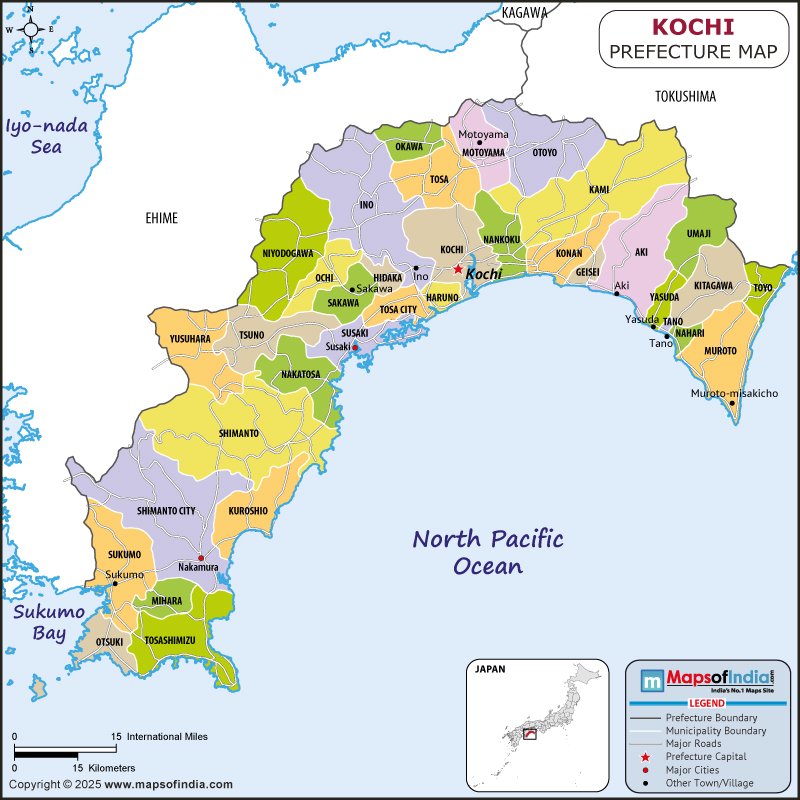



Kochi is the largest prefecture in Shikoku Island occupying an area of approximately 7,103 square kilometers on the southern coastline, and facing broadly upon the pacific ocean. The capital of the prefecture, Kochi City, is located in the flat Tosa Plain, and the rest of the prefecture is filled with steep mountainous terrain and intertwined forests, which occupy over 80% of the entire prefecture. Such a rugged landscape has influenced the setting patterns and the domestic economy, with settlement trussed on the coast and in the oases of rivers. It has a fairly small population of about 650,000 to 700,000 people but its size is so enormous that Kochi is among the least densely populated prefectures in Japan. Main industries are agriculture, forestry and fishing due to the favorable climate and presence of numerous rivers including the Shimanto which is commonly referred to as the last clear stream in Japan. The prefecture has an excellent reputation of being clean, having seared bonito dishes and other attractive festivals such as Yosakoi, that draw people to explore the culture, history and non-polluted landscapes.
History
Kochi province, presently known as the city of Kochi, was once the province of Tosa, which happened to be the earliest province in Japan. There were multiple small clans that ruled the region in ancient times and their record, including the Kojiki, and Nihon Shoki, list the officials who were to rule the region. The geographical isolation of Tosa lay to the south, between mountains, and north, between ocean; it resulted in geographical development of an unusual channel compared with the more central provinces. In the middle ages, the region passed through multiple ownerships. During the Sengoku (Warring States) period, the Chosokabe clan came to power and consolidated most of Tosa, consolidating their strength after the Late 1500s. They would thus be made the governors of the Yamauchi clan over Tosa Province after the battle of Sekigahara (1600) and the establishment of the Tokugawa shogunate. A seat of policemen was set up under their rule (Kochi Castle), local government reinforced and growth in trade, agriculture and the casting towns established. The Meiji restoration (c.1868) was characterized by significant transformation. The Sayon feudal domain was ruled out and the new administrative system, which is modern Kochi Prefecture in the region, was established. There was a gradual increase in modern infrastructure i.e. rail and ports and education system. The reformers that had helped democratic movements in the late shogunate era emerged and took up important roles in the region. Kochi had its good and bad times in the 20th century. The prefecture was woodland and rural depopulation restricted the industrialization of large scale, yet the prefecture preserved a vibrant culture consisting of its traditions, nature and local industries such as fishing, agriculture and forestry. Countless historical buildings, such as the original keep and buildings of Kochi Castle, managed to withstand many catastrophes, becoming symbols of strength.
Culture
Kochi has a vibrant and affectionate culture, the main features of which are the celebration by the whole community and craftsmanship, as well as local food as the main part of everyday life. Among its cultural peculiarities, what stands out most is its tradition called okyaku. However, whereas the elements of a guest normally connotate a guest,okyaku in this part of the planet translates to the assembly or party. The okyaku give celebrations to marriage, season, harvest, or even to purchase a house. Such events include friends, friends of friends, and family playing, local brewed sake, huge common dishes of food (abundant, gorgeously displayed), and festivals, rituals. Hospitality is very high and it is rather common to find oneself being invited to local parties by merely attending. Kochi attracts festivals. The best known one is perhaps the Yosakoi Festival of August: the wooden clappers and wild choreography are held by dancers in colorful costumes and parade in the streets. The other big festival is the Tosa no Okyaku, a festival at the beginning of March where the city is transformed into a huge party area with food, drink, and people celebration. Another area also has deep roots, craftsmanship. The handcrafted paper (Tosa Washi) production process is also held in such locations as Ino; the visitors will be able to make their own paper, dye it, and make some crafts. Another field is metalwork: the forging of traditional knives called Tosa Uchi-hamono is very highly regarded, both in practical use and in making. Food and drink are both significant components and forms of identity. Kochi cuisine focuses on freshness- seafood (especially the bonito), river fish, and local vegetable crops. Special foods that show the season and community can be found at local markets, okyaku occasions, and festivals. These foods are commonly served with sake brewed in the region and as a part of celebration culture. Another way culture is determined by natural beauty. Tradition, crafts, and local festivals are affected by rivers, such as the Niyodo (which has pure blue water), forests, and isolated towns. The setting is not just an object but it is embedded in the arts, food and narratives.
Language
There are a number of allied dialects in Kochi Prefecture that sometimes the group is referred to as the Tosa dialect group. This includes central and eastern areas of the prefecture. In the west coast areas, it has a different variant called the Hata dialect. These dialects vary in pronunciation, grammar, vocabulary and accent depending on the geography and the relative isolation of some regions. An example of such characteristics is the application of some verb endings and sentence-ending particles in colloquial speech that are not Standard Japanese. Some forms, e.g. there are some forms that, when used, refer to continuous or repeated action in non-standard ways of Japanese. Also, in a way that Standard Japanese would employ a single particle of either because or reason, in sound Kochi people employ different particles. The accent system (increase or decrease of pitch in a word) also differs within the prefecture. In most central and eastern regions, the accent systems are affected by earlier dialect systems in the case of Western Japan. Some of the sound shifts are significantly different in the Hata region (western edge). The coastal regions are also affected by the neighboring dialects and not necessarily Kochi; where there has been movement or more trading, they are influenced there. Although there are powerful regional dialects, the majority of the inhabitants of the prefecture speak standard Japanese (not only in schools and the media, but also in official meetings). In most cases, speakers alternate between the standard and the local dialects depending on the circumstances. They are also a powerful source of local identity, retained more among locals when casual, when talking with family, or when discussing locals among themselves than in official and formal circumstances.
Geography
Kochi Prefecture covers half a southern part of the Shikoku Island, it is the largest prefecture in the Island having an area of about 7,103 square kilometers. To the north it is bordered by the Shikoku mountains which creates a natural divide between Ehime and Tokushima, to the south is the pacific ocean with a coastline of 700km. This is the opposition of the mountains, which are rugged, and the sea, open. Kochi is also densely wooded, and it can be discussed as one of the densely forested areas in Japan as woodlands occupy the majority of the territory of the city (nearly 84 percent). The land is predominantly mountainous and there are not many plains, the few that exist are in Kochi City and Tosa Plain. These well-watered plains have proven to be fertile and support farming and habitation, and the mountains in the inland areas are sparsely inhabited. The main feature of geography involves rivers. Shimanto River is the so-called last clear stream in Japan though it passes through the western side of the prefecture. Niyodo River is the river with its magnificent blue water flowing in the middle of this area. The two rivers are well valued due to their natural beauty and clarity, and hold ecosystems and traditional livelihoods. Kochi has a moderate climate due to its location on the Pacific. The summers tend to be warm and humid at the same time, winters are quite moderate as compared to the north. Nevertheless, the prefecture itself is also among the most rainy of Japan, and since it is open to the sea, typhoons can lead to heavy rains.
Quick Facts
| Official Name | Kochi Prefecture |
| Region | Shikoku |
| Governor | Seiji Hamada |
| Area | 7,103 km² |
| Population | 652,459 |
FAQs
Q1: What are the key natural characteristics of Kochi?
The prefecture is highly mountainous and forested. It is covered by forest by about two thirds. Large rivers such as the Shimanto (known as the last clean river in Japan) and the Niyodo are well-known. It has a long and diverse pacific coastline.
Q2: What are the special cuisines of the prefecture?
Seared bonito (katsuo no tataki). Regional sushi does exist whereby there are river fish and the greenery and mountain sea foods are integrated to present unique dishes.
Q3: Important industries and agriculture in Kochi?
Food production (particularly, horticulture of vegetables, citrus and yuzu, and fruit) and Agriculture is prominent. Fishing is also important.
Q4: What is Okyaku culture?
Okyaku is a custom of celebrations in the form of a banquet during festivals, rituals, birthdays and celebration of the community. The local social and food culture is partly based on it.
Last Updated on: April 15, 2026

