


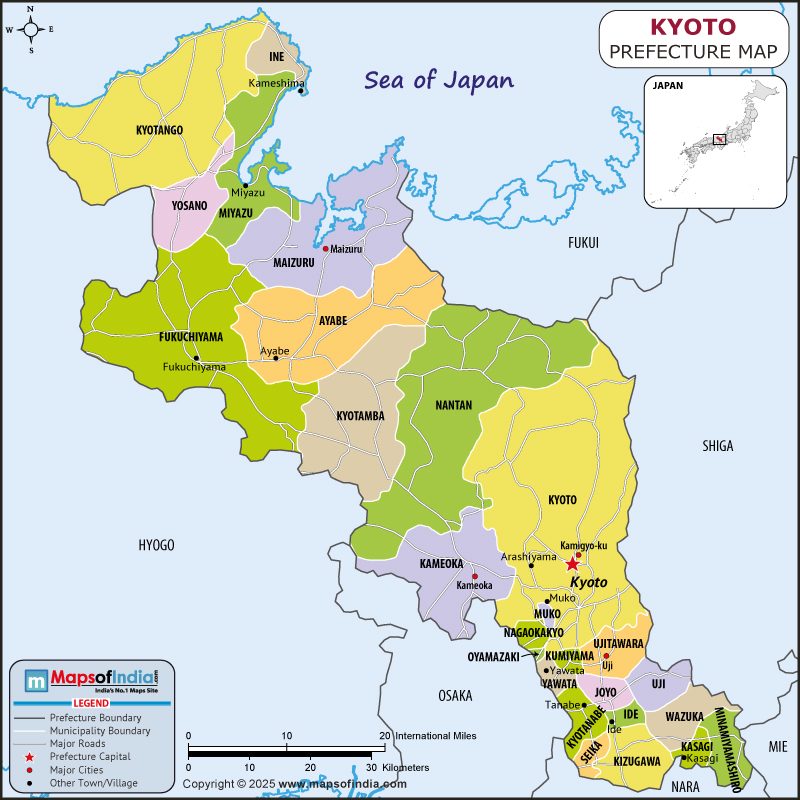



Kyoto Prefecture, Japanese Kyoto-fu (also referred to as Kyoto), is a region in Japan that is the most historically and culturally rich. Located in the Kansai region of Honshu, it runs along the Sea of Japan in the north and the inland basins and mountains in the south and with a land area of about 4,612 square kilometres. It is part of only two prefectures in Japan that are named fu and not the more typical ken, owing to their connection to their historical significance.
Kyoto City was the Imperial capital of Japan directly between 794 and 1868, a period of more than a thousand years, and it has still retained the privilege of linking both the traditional culture of Japan as well as exuding sophistication. Kyoto Prefecture's current population is approximately 2.58 million residents; over 2 million in Kyoto City itself. Such a combination forms a favourable impression of the prefecture, which appeals to both local and foreign tourists because of its rich ancient history, stunning scenic landscape, and a modern atmosphere.
History
The history of Kyoto Prefecture is intricately connected with the trends of the entire Japanese history. The area, including portions of the historic provinces of Tamba and Tango, became the Yamashiro Province before the Meiji Restoration. The eminence of the region started at the end of the 8th century when Emperor Kanmu relocated the capital of his kingdom to Heian-kyo in the year 794. This became a starting point of the Heian period, the period of literary and artistic prosperity of court culture. Kyoto was the seat of the Imperial Court for over a millennium, even at the times when the political forces shifted to other capitals, e.g., Kamakura or Edo (modern-day Tokyo).
Kyoto has political and religious influences that are embodied in its architecture, religious organisations and the city structure. Coupled with a grid style in its street pattern and the huge avenues, the city was patterned after the Chinese Tang dynasty capital of Chang’an. During the course of centuries, Kyoto was the place of wealth and destruction. It survived the Onin War (1467-1477), which had left a lot of the city in ruin and additionally fires and natural catastrophes. However, the historical site was not destroyed on a serious basis in World War II and therefore left the cultural treasures in place.
In 1868, the Emperor relocated to Tokyo, and Kyoto stopped serving as a political capital as Meiji's sdownionče. Nevertheless, Kyoto was still a cultural and spiritual centre of Japan. Northern coastal regions of the prefecture, centred in Maizuru, that evolved to be significant ports, whereas the southern regions attained the status of participants in the rapidly growing Kansai economy. Higher education and research in Kyoto developed into a 20th-century centre of research and higher learning, demonstrated by international research units such as Kyoto University.
The Kyoto historical account is based on a religious background, too. It contains some of the most important Buddhist temples and shrines used by Shinto and many of which date back to Heian and Kamakura. The mixing of these traditions has made Kyoto a special place spiritually, as religious elements of Zen gardens, Shinto rituals and seasonal festivals co-exist.
Culture
The Kyoto prefecture is more or less considered to be the mother of Japanese culture. It has 17 UNESCO World Heritage Sites with some of the most recognisable architectural masterpieces encompassing Kiyomizu-dera, Kinkaku-ji (the Golden Pavilion) and the ancient Nijo Castle. Geisha culture still has a mind base in the Gion sector of the city, as classical acts performances and tea houses still dominate there.
Cultural festivals in Kyoto are a part of the seasonal festivals. And one of the oldest in Japan, the Aoi Matsuri, which originated way back in the 6th century, involves a big procession in Imperial Palace costumes to the Kamo Shrines. The most well-known is the Gion Matsuri held in July, whereby, in abundance, the decorated yamaboko floats are followed by traditional music and rituals along the streets. The Jidai Matsuri in October is a festival celebrating the history of Kyoto, wherein people wear costumes that symbolise different eras in the history of the ancient city: ancient court officials or even Meiji people.
Kyoto is associated with more traditional crafts, too. A well-known feature of the area is Nishijin-ori- clothwork on which elaborate patterns are stitched, frequently using threads of gold and silver. Other examples of the artisanal quality of Kyoto include Kiyomizu-yaki pottery, lacquerware, handcrafted fans and exquisitely crafted kumihimo braids. These crafts do not just serve decorative purposes; they have a strong connection to the city's rituals, practices, architecture and day-to-day activities.
There is a certain position enjoying tea culture, especially in Uji, a city of the prefecture, where some of the best green tea in Japan is grown. The tea ceremony house, or chanoyu, thrived in Kyoto with the great masters such as Sen no Rikyu, and it is still practised with sacredness. The Byodo-in Temple of Uji, a sight in the 10-yen coin of Japan, is a mark of the cultural and historical value of the area.
Dining in Kyoto is a study of its beautiful taste and the taste of the seasons. Kaiseki meal, a multi-dish meal with the focus on fresh ingredients and artistic presentation, was born in this place, and it is viewed as the perfection of Japanese high-dining cuisine. Thanks to Buddhist vegetarian food (Shojin ryori), which is served in numerous temples, the religious and dietary customs of monks have a chance to be observed. Yatsu, a pastry of rice flour and cinnamon, and wagashi, a pastry created to be eaten with tea, are all part of the food and beverage culture that Kyoto embraces. Along the coasts of the prefecture, seafood and the basins bring vegetables very unique to the area called Kyo-yasai.
Kyoto is also a nurturing place for performing arts. It is a Noh / Kyogen theatre hub, and it is also Kabuki. One of the oldest theatres in Japan, Minama-za Theatre, still performs the performances attracting people throughout the nation. The traditional music as a part of the cultural life of Kyoto still includes gagaku (court music) and shamisen concerts.
Language
In Kyoto Prefecture, the most common language spoken is Japanese, although the local forms of the Japanese native language, called Kyoto-ben, have several unique aspects and differences from the common Japanese language. Kyoto-ben is regarded as under the group of the Kansai group, but this is said to be chastened and somewhat cultured as compared to the gurut hurrah Osaka-ben. This linguistic beauty has also been ascribed to the long period of time that Kyoto served as an Imperial capital, whereby courtly approaches shaped the style of speech.
The characteristic features of Kyoto-ben are the peculiar vocabulary, intonation and expressions of honour. An example is that the normal Japanese "arigato" (thank you) can be said as the okini in Kyoto-ben, but it is also widespread in other Kansai. The Kyoto speech formike-dosu, rather than the normal -desu in sentence terminal morphemes, is referred to as part of the historical speech of Kyoto, which is now largely spoken only in historical drama or by actors in the geisha quarters. There are also unobtrusive changes in the intensity and rhythm used in the dialect that can translate into politeness or familiarity in such a way as will not be the case in standard Japanese.
Besides Japanese, English and other foreign languages are increasingly gaining presence in the tourist locations, which acknowledges the fact that Kyoto is a bigger and popular destination in the international world. The prefectural government and institutions in the area equip the area with multilingual materials to support visitors, and the dialogue and exchange programs promote the maintenance and distribution of the linguistic legacy of Kyoto.
Geography
Kyoto Prefecture is as varied in geography as in culture. It is not only a long and narrow prefecture but also along the coasts of the Sea of Japan, and the inland basins and mountains extend to the north and south, respectively. Through the Tanba Highlands, which run through the middle, the prefecture was split into different climatic regions. The northern part of the Tango is coastal to the Sea of Japan and as such has a wet, snowy climate around -10 degrees C, but the southern Yamashiro Basin depicts a more temperate continental climate.
The north coast is steep and picturesque, and it has such landforms as Amanohashidate, one of the 3 views in Japan, where there is a sandbar filled with pine trees over the Miyazu Bay. Fishing towns such as Ine forsink the Tango Peninsula with the traditional funaya boathousing on the waterfront. Such boat houses, the first floors of which are boat garages and higher levels are residential areas, are a peculiarity of the maritime culture of the appropriate region.
Forests, rivers and agricultural land are located within the central highlands and stand to support crops like rice and tea as well as speciality vegetables. Kyoto City is set in a perfect settlement environment, with the three sides of the basin mountainous and forming the southern part of the basin. This place has subjected the city to climatic conditions with hot, humid summers and cold winters, and its ability to be defended historically.
The Yamashiro Basin receives the major rivers like the Katsura, Uji and Kizu, and these rivers create rich plains where agriculture has been practised over centuries. This natural environment of the prefecture is safeguarded by the fact that 21 per cent of its territory is designated as Natural Parks (including sections of the San-in-Kaigan National Park and Kaiza-Hasu Kuya Quasi-National Park). The regions harbour varying ecosystems such as wetlands and mountain forests, as well as hiking, fishing and other outdoor activities.
Quick Facts
| Official Name | Kyoto Prefecture |
| Area | 4,612.19 km² |
| Population | 2,578,087 (As of 2020) |
| Religion | Shinto and Buddhism |
| Language | Japanese |
FAQs
Q1: What makes Kyoto Prefecture different from most other prefectures in Japan?
It is one of only two prefectures designated as a fu due to its historical role as Japan’s Imperial capital.
Q2: Why is Uji in Kyoto Prefecture famous worldwide?
Uji is renowned for producing some of Japan’s highest-quality green tea and for its UNESCO-listed Byōdō-in Temple.
Q3: How many UNESCO World Heritage Sites are located in Kyoto Prefecture?
There are 17, including temples, shrines, and a castle, collectively known as the Historic Monuments of Ancient Kyoto.
Q4: What is the most famous summer festival in Kyoto Prefecture?
The Gion Matsuri, held every July in Kyoto City, is one of Japan’s largest and most historic festivals.
Last Updated on: June 22, 2026

