


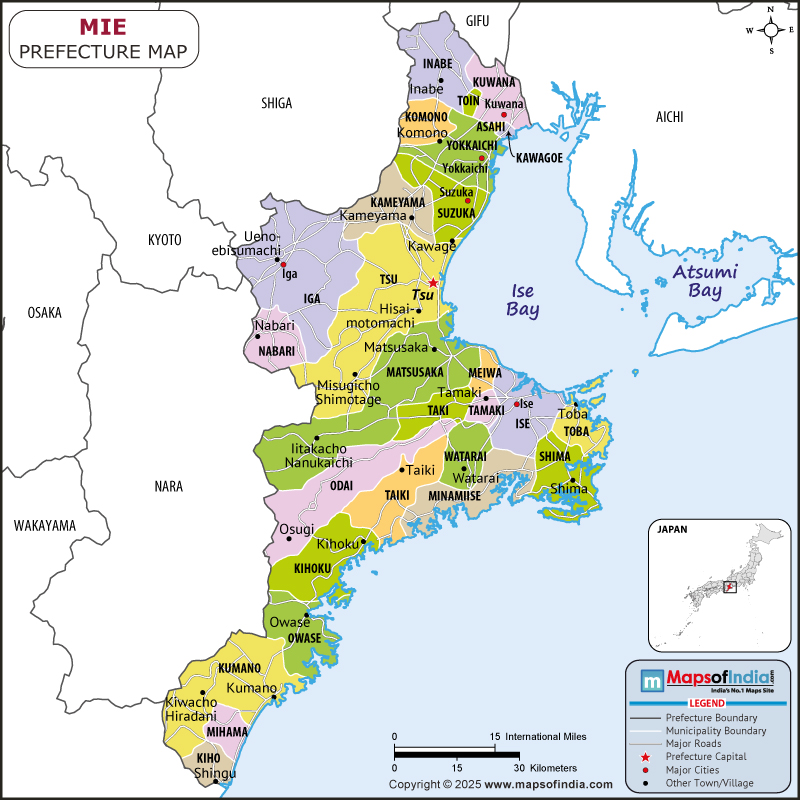



The Mie Prefecture is a picturesque province in central Japan in the Honshu island extending along the eastern side of the Kii Peninsula with access to Ise bay and the Pacific Ocean. Its largest city is Yokkaichi but the capital is Tsu. It covers a landmass of approximately 5,774km2 and a population of about 1.78 million.
Mie economically is a trade-off between industry and agriculture: such sectors as manufacturing (with a strong focus on transport equipment, parts, and electronics), forestry, seafood, and tourism have significant presence. Summing up, Mie is one of the prefectures that give an impression of tradition and its own natural beauty mixing with heavy industry.
History
Mie Prefecture dates back several thousand years, and trace remnants of human habitation dates all the way back to the Jomon age when hunter-gathers left remains of pottery and tools used on its coasts. The Jayoi period can be regarded as the time of the development of wet-rice agriculture, which took the shape of the fertile area of modern-day prefecture and determined the environment of the settled life and religious practices of people. By the time of the Kofun period (3rd-6th centuries) burial mounds sprung up throughout the region, indicating the formation of local elites with control of trade and agriculture.
Perhaps in the early historical period Mie was split up into multiple provinces that included Ise, Shima, Iga and currently portions of Kii. Ise was particularly important when the Ise Grand Shrine (Ise Jingu) was built for the sun Goddess Amaterasu. Since the 7th century, the shrine had assumed the center of Shinto adoration and national prayer. To settle the rituals of the shrine, the imperial court formed the Saiku, the abode of Saio, a virgin princess of the imperial family that represented the high priestess. The Saiku which is presently referred to as Meiwa was in operation over centuries connecting the imperial household with the spiritual topography of Mie.
During the medieval and early modern times, religion and traveling influenced the identity of the region. Pilgrimage to Ise Shrine expanded in a massive way particularly during the Muromachi and Edo periods attracting people of the entire Japan. The culture of pilgrimage even thrived to the point that in Edo era commoners even said Ise-maari boom in mass hordes of people traveled to Ise worshipping. Mie's towns thrived that ran through the Tokaido, the great highway, and ran through the movements in Edo, and Kyoto. Kuwana and Anotsu turned out to be the important strategic stop points for travelers and merchants. The mountainous Iga area acquired its own legend, which began to be romanticised as the birthplace of the ninja, with their use of espionage and martial arts in the era of warring states of the Japanese.
The transformation in Japanese political geography came with the Meiji Restoration of 1868. The traditional feudal domains of Mie were broken up and new prefectures were started in 1871. Originally the split was into Anotsu and Watarai prefectures, it was merged in 1876 into present day Mie Prefecture. It fixed the capital in Tsu and Yokkaichi developed into an industrial county.
Mie had her opportunities and struggles in entering modern Japan. Developments with regard to industries grew around the coasts and the pre-existing industries of pearl farming or fishing continued to flourish. However, the prefecture was devastated in the year 1959 by the Ise-wan Typhoon which was known to claim thousands of lives across the nation and destroyed most infrastructures and farmlands of Mie. The support in the recovery efforts in the decades that followed increased resilience at the local level.
Culture
Mie is traditionally known as the country of culinary wealth, and it was called Umashikuni, that is, a delicious country. The region makes the valued Matsusaka beef, seafoods like spiny lobster and abalone, and unique dishes of the region Ise udon, tekone-zushi and sanma-zushi. Spanning handicrafts and confectionery like traditional salt-making are the season see specialties with the prefecture taking pride in its natural abundance and skills.
Other art cultures also survive in Mie. The Iga and Nabari areas are famous due to kumihimo, complex twisted belts made to wear in clothing and ritual gear, and Suzuka is popular because of well-crafted sumi, which was used by the calligraphers since ancient times. Yokkaichi also manufactures ceramics such as Banko-yaki which are hardy and heat resistant, used in Japanese households, and old Ise Katagami stencil-making still takes place in Suzuka, where carvers chisel out small patterns to dye fabrics. There is nothing mere in these crafts, but an essential element of the living tradition containing, as well, regional aesthetics and skills handed down through generations.
Perhaps the most homogeneous characteristic of the cultural identity of Mie is spiritual life. The Ise Grand Shrine, which has been built in honor of the sun goddess Amaterasu, is one of the most sacred Shinto locations in Japan. Reconstruction of the shrine every twenty years (Shikinen Sengu), is symbolic, indicating continuity and also renewal, and maintaining the skills of carpentry and ritual. Centuries of practice have formed the Japanese cultural life through pilgrimage to Ise, and the paths to the shrine are one of its witnesses to the Japanese spiritual center of the prefecture.
Massive floats, gongs and drums are present in huge processions in the Ishidori Matsuri in Kuwana which is also known as the loudest in Japan. Tado Festival is an adventure where horsemen jump up earthen barriers during audacious and fearless showmanship and coastal towns like Toba have their own festival like Shirongo Matsuri where female divers or ama present their first haul of the season to deities. These festivals unite performance, ritual and local pride, as well as connecting the people of Mie to their natural habitat and the traditions of their ancestors.
Language
Japanese is normally used among people in Mie Prefecture although there is also a great degree of regional variation referred to in totality as Mie-ben. The cluster of dialects is associated with the geography, their history, and influence of the neighbouring territories.
A sub-dialect of Mie-ben exists: in mid-northern Mie, Ise-ben; in the southern and seashores, Shima-ben; and in the western of the prefecture, Iga-ben. They all differ in their ways of pronunciation, vocabulary and grammar, but they have much in common with dialects in the larger Kansai area.
Indicatively, the sentence-final particles which are commonly found in central Tokyo Japanese speakers include the final particles, such as, ni or de. The words in Shima-ben are more archaic and rather old fashioned. In the meantime Iga-ben uses a special request form, "-te daako," rather than with the standard "-te kudasai."
Mie dialect's accent and intonation are affected both by Kansai-ben and Nagoya / Aichi dialects, particularly in the north of the prefecture closer to Aichi. The closer one gets to the borders the greater the blending of features of some neighbours speech styles.
The speakers in Mie are however in general competent in standard Japanese too, particularly in formal, media, education, and inter-regional or inter-prefectural communication in spite of these dialectual variations. The local dialects commonly appear in a day-to-day dialogue of locals and contribute significantly to the local identity.
Geography
The prefecture can geographically be split in a number of regions. The Suzuka Mountains found in the North west introduce the Highland interiors and snowfall during winter. On the eastern side is the Ise Plain that runs out of the Aichi border and to the city of Ise. This is a flat and fertile land and it is one of the most heavily populated areas in Mie which sustain urban growth and agriculture. To the south of the plain is the Shima Peninsula with its coast of bays, inlets and islands. The Iga Basin extends inland along the border of Nara where it is characterized by the extreme swings in temperatures. The rugged mountains that dominate central and southern Mie dictated river systems and isolated communities in past times, in prior periods.
Mie has an extended coastline of over 1,094 kilometers in Ise bay and the pacific ocean. Coasts are described as being typified by rias, and advanced notches, offshore islands and isolated bays which are beneficial in fishing and aquaculture. One of the prefecture's most important rivers is the Miya River. It starts in the highlands of Mount Odaigahara and passes through valleys and plains until it gets to Ise Bay sustaining agriculture and settlements throughout the path.
Two-thirds of the land in Mie is covered by forests and a greater than ten percent portion of it is covered by agriculture. The mountainous areas are densely forested whereas basins and plains which are relatively flat are either agriculturalized or urbanized.
The climate is quite different within the prefecture. Ise Plain has good climate though the Iga Basin under the influence of the mountains has hotter summers and colder winters with greater change in temperatures. Southern coastlands like Owase are considered the wettest regions in Japan and heavy rain occur due to wet ocean winds they receive when hitting mountain slopes. The mountainous regions in the north and central areas get snow during winter and the other regions in the lowlands are usually colder.
Quick Facts
| Official Name | Mie Prefecture |
| Island | Honshu |
| Region | Kansai (Tōkai) |
| Capital | Tsu |
| Area | 5,774.41 km² |
| Population | 1,781,948 |
FAQs
Q1: What is the location of Mie and which is its capital?
Mie lies in the eastern region of the Kii Peninsula in the middle of the main island of Japan, Honshu. Its capital city is Tsu.
Q2: Which are the core industries of Mie?
Mie experiences both traditional and modern sectors, seafood (especially pearls cultivation), agriculture (Matsusaka beef), forestry and manufacturing (parts and components and sophisticated materials).
Q3: How geographically is Mie like?
Mie is geographically diverse. It has coastline on one side and on the other it has deeply inland bays, mountainous regions, forests, and magnificent natures. National parks comprise parts of some areas.
Last Updated on: April 15, 2026

