


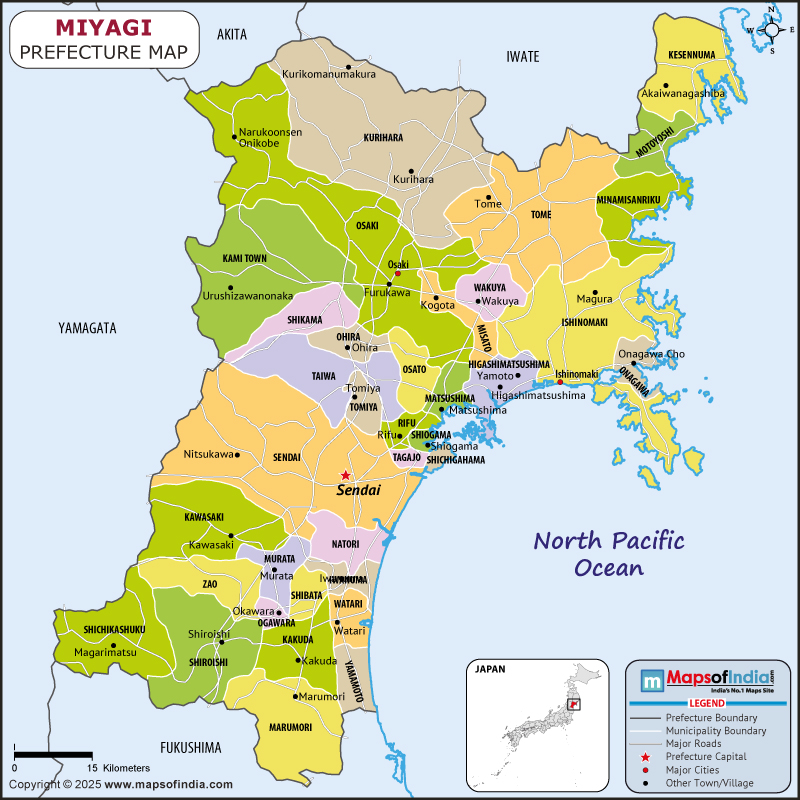



The Miyagi Prefecture of the Tohoku Region, northern Honshu, has probably one of the most diverse cultures and geography in Japan. Its largest city is the land of industry, education, and culture: Sendai, the capital of Mito. The prefecture has a population of more than 2.2 million people and a size of around 7,282 square kilometres. Miyagi, which is bordered by the Pacific Ocean to the east, has a picturesque coastline, rich plains, and mountainous western areas.
Matsushima Bay lies there, one of the Three Views of Japan, due to its spectacular pine-covered islands. The economy of the region is reliant on agriculture, fishing, manufacturing and tourism, among which rice planting and fish farming are especially visible. Miyagi's identity is closely associated with its rural beauty, historical presence, and capabilities to overcome all natural calamities, including the 2011 Great East Japan Earthquake and tsunami, which severely affected communities along the coastal belt of Miyagi.
History
Miyagi Prefecture has origins that date as far back as the days when it was under the greater Mutsu Province. How can you explain the thousands of years old archaeological remains of the Jomon people, with their unique Jomon pottery and pit dwellings being found in numerous locations? The Yamato court resorted to extending influence into the region and opened administrative, military outposts in the period of Nara. Tagajo Castle is one of the most important primitive administration centres constructed in the 8th century as the provincial capital of Mutsu.
The history of Miyagi became linked with warlord Date Masamune, the One-Eyed Dragon, in the late 16th and early 17th centuries. Masamune built Sendai Castle and transformed the city of Sendai into a city of politics and economics. During his reign, the Sendai Domain thrived, pursuing trade and cultural exchange, and dispatching an embassy to Europe, aboard the vessel San Juan Bautista, in 1613.
After the Meiji Restoration of the late 19th century, the abolition of the feudal realms had occurred, and in 1871, Sendai Prefecture was created. One year later, it became the Miyagi Prefecture due to its former name, Miyagi District. The early Meiji period saw the prefecture undergoing changes in its administrative boundaries that eventually settled around the present-day boundaries of the prefecture.
Modernisation and suffering were a part of the 20th century. Miyagi industrialised, especially in pulp and paper, machinery and food processing and did not abandon agriculture. But natural catastrophes struck the region as well, like earthquakes or tsunamis. The most damaging event that has occurred in recent history was witnessed on March 11, 2011, when a magnitude 9.0 earthquake hit off the Pacific coast that generating a massive tsunami that inundated much of the coastline of Miyagi. In cities like Ishinomaki, Kesennuma and Minamisanriku, devastating damage was caused, and thousands of lives were lost. Since then, Miyagi has been undergoing massive reconstruction and renewal projects, juggling the conservation of its cultural heritage with disaster resilience challenges.
Culture
A cultural group embedded in the history, climate and geography of the Tohoku region, Miyagi has become a cultural identity that has been established through centuries. This heritage is profusely manifested in festivals: the most popular one is the Sendai Tanabata Festival. Every August, the streets of the city are converted into huge bamboo poles covered with coloured paper streamers, each painted to represent wishes of good fortune. In May, the Aoba Festival commemorates the legacy of Date Masamune, with parades of armoured samurai, traditional music, and portable shrines; the towns along the coast, such as Shiogama, hold the Shiogama Port Festival, when Shinto priests are rowed across the bay in decorated boats in a procession celebrating the sea and the fishing community.
There is an element of tradition in crafts in Miyagi. One place is Naruko Onsen, home to hand-tinted kokeshi dolls, a practice that goes back to the governments of the past, all made of wood with ornamental designs painted onto them. The region also produces lacquerware, bamboo and textiles that are hand dyed, which are commonly sold in the local markets as well as at various artisan fairs. These arts are not uniformly artistic phenomena: they are also markers of the eternal community of the prefecture with its past.
Dining is at the centre of the cultural life in Miyagi, which is characterised by the productivity of fertile plains and the presence of good fishing areas. Gyutan (grilled beef tongue), another dish of Sendai, is popular in the prefecture and has been adopted as the culinary emblem. Matsushima Bay oysters (fresh), Kesennuma skipjack tuna and Ishinomaki haddock are local and national favourites. Candy treats- the zunda mochi are served during the entire year and are prepared using smashed edamame, while brewing of sake is successful due to the availability of pure mountain water and local rice. Miyagi does not simply eat food, but rather they celebrate the city and the seasons.
Miyagi culture is also characterised by religious and artistic traditions. Matsushima Zuigan-ji Temple is a masterpiece of architecture and a meditation and art centre, which will furnish anyone with art and spirituality through the rebuilt Temple of Zen Buddhism, the Date Masamune Temple. Shiogama Shrine boasts a long history of protecting fishermen, and it continues to practice worship and other annual festivals. Modern Miyagi is a city that welcomes modern creativity as well as tradition, with artistic events such as the Jozenji Street Jazz Festival introducing world music to the tree-lined boulevards of Sendai. This combination of the old and new gives Miyagi an appreciation of cultural identity that is both time-honoured and welcoming to the world.
Language
Japanese is the native language of Miyagi, although it has a particular set of characteristics that distinguish it from standard Japanese since it is a local dialect called Miyagi-ben. Miyagi-ben belongs to the bigger Tohoku dialect group with specific patterns of intonation, words and grammar. One example is that some vowel sounds can be different in articulation, and that some words can have regional equivalents that are not generally used in the rest of Japan.
One of the reasons why younger generations and residents of urban centres frequently use dialogue closer to standard Japanese as a result of media and education is that Miyagi-ben can be viewed as a potent symbol of regionality, particularly in the countryside. The local dialect may be cordial and friendly to the inhabitants, but some people may use the dialect in advertisements and cultural promotions to create a sense of naturalness.
Besides the usage of Japanese, a small yet increasing usage of foreign languages in Miyagi, especially English, Chinese, and Korean, is a result of tourist usage, exchange programs and the existence of foreigners resident in Miyagi. Some schools, such as Tohoku University in Sendai, help create a multilingual atmosphere in some areas of this prefecture.
Geography
The location of Miyagi Prefecture on the Pacific coast and its topographical diversity are the geographical factors. On the West side, the Ou Mountains create a natural border with the surrounding prefectures, which are typified by Mount Zao, Mount Funagata and Mount Kurikoma. These mountains are certified hiking, skiing, and hot spring tourism destinations and significantly contribute to the climate and water resources of the region.
The main section of the prefecture is occupied by a lowland called the Sendai Plain, which is an agricultural land; rice paddy fields are all over the land. Rivers like the Hirose and the Natori cross this plain and have been useful since time immemorial in supporting farming and also supporting settlement. The eastern shore is greatly indented, with bays, peninsulas and fishing ports. The Matsushima Bay, which has more than 200 islands underpinned by pine trees, is both a beautiful marvel and an effective fishing farm.
The climate of Miyagi can be described as humid temperate; warm and humid in summer and cold in winter. The westerly mountainous regions have more snowfall, and the winters are milder in the coastal regions since they are moderated by the ocean. The Newlandian landscape contributes to a very diverse biodiversity, including marine life found on the coasts and also forest ecosystems in the mountains. Miyagi is concerned about the environment and hence has approximately 24% of its land area designated as Natural Parks.
Its geographic position (the prefecture is in the Pacific Ring of Fire) predisposes it to earthquakes, and its topography exposes it to tsunamis. These are natural hazards that have determined the patterns of settlement, design of infrastructure, and disaster preparedness policies. Meanwhile, the local presence of natural resources such as fertile farmland and extracted fisheries has been supporting communities since time immemorial.
Quick Facts
| Official Name | Miyagi Prefecture |
| Area | 7,282.22 km² |
| Population | 2,265,724 (As of 2023) |
| Religion | Shinto and Buddhism |
| Language | Japanese |
FAQs
Q1: What is Miyagi Prefecture most famous for?
Miyagi is best known for Matsushima Bay — one of Japan’s “Three Most Scenic Views” — as well as its Sendai Tanabata Festival, fresh seafood, and the legacy of samurai lord Date Masamune.
Q2: Is Miyagi worth visiting outside of festival season?
Absolutely — from hot springs like Akiu and Naruko to the Zao Fox Village, ski slopes, and coastal scenery, the prefecture offers year‑round attractions beyond its summer celebrations.
Q3: How far is Miyagi from Tokyo, and how can one get there?
Sendai, the capital, is about 1.5 hours from Tokyo by Tōhoku Shinkansen, making it an easy and popular weekend or short‑stay destination.
Q4: What unique local foods should one try in Miyagi?
Signature dishes include gyūtan (grilled beef tongue), zunda mochi (sweet edamame paste over rice cakes), and oysters from Matsushima Bay.
Q5: How has Miyagi preserved its culture after the 2011 disaster?
Through rebuilding historic sites, continuing traditional festivals, and supporting community arts projects, Miyagi has woven resilience into its cultural identity while honouring its past.
Last Updated on: April 15, 2026

