


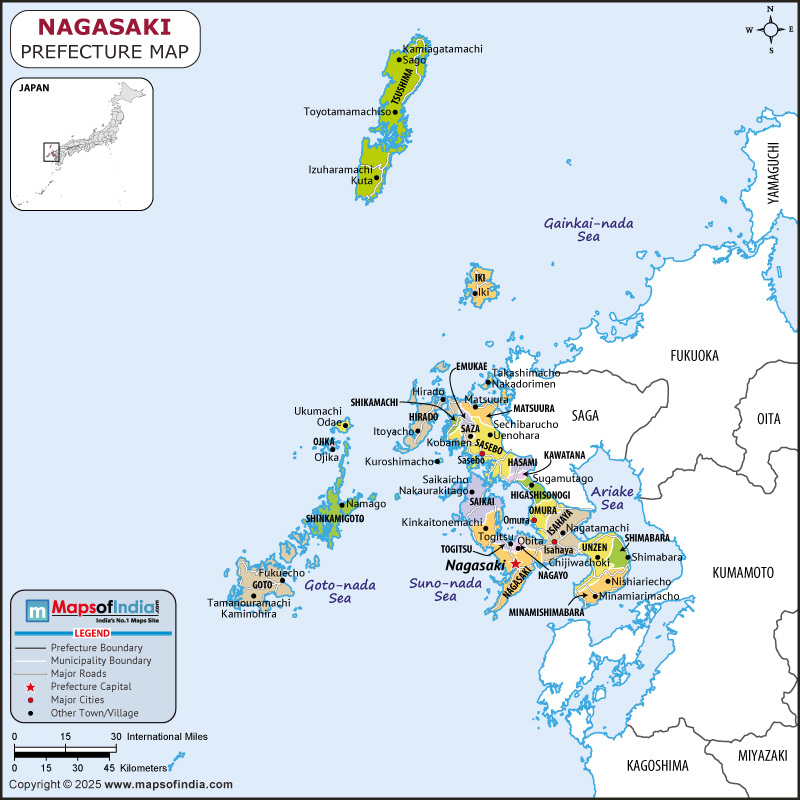



Nagasaki prefecture is a region on the northwest coast of Japan celebrated for its rich maritime history, diverse cultural influence and striking landscape. It has an intricate archipelago over 600 islands and the natural harbor of Nagasaki once needed the gateway between Japan and the outside world first the the cosmopolitan legacy stems from centuries of exchange with China Korea and netherland and Portugal which have left indelible mark on the local cuisine architecture and religious tradition. Today Nagasaki is not only remembered as one of the first Japanese lands touched by Christianity but also the site of profound wartime tragedy and resilience. Dynamic festivals' unique dialect and the vibrant fusion of eastern and western custom make it an enduring symbol of both global interconnectedness and the spirit of recovery.
History
The historical narrative of Nagasaki is woven from themes of commerce, cultural convergence, adversity and renewal. The earliest records trace Nagasaki's route to the province of Hizen, Iki, and Tsushima after Japan's taika reform in the 7th century. During the early feudal period its proximity to China and Korea made the region the Center for both legitimate trade and piracy.
Nagasaki truly entered the national stage in the 16th century with the arrival of Portuguese traders and Catholic missionaries. Nagasaki prefecture is notably the most russianized region in Japan with Roman Catholic missions established as early as the 16th century. Christianity arrived in Japan in 1549 through the tourist missionary Francis Xavier and Nagasaki quickly became a central hub for the faith and European trade. the local feudal Lord Omura SumitadaWas the first Japanese to convert to Catholicism gifting land to missionaries and supporting the Christian communities establishment. Hirado was the first locus of contact but Nagasaki soon eclipsed it as the principal port opened to foreigners. The transformative visit of Jesuit missionary St. Francis Xavier In 1550 heralded the spread of Christianity which began to gain followers among the local population including influential daimyo. Portuguese trade introduced new goods ideas and technologies from firearms to refined sugar all of which left a permanent imprint on the local lifestyle.
The city’s cosmopolitan openness was dramatically curtailed by the centralizing tokugawa shogunate. Sharing the foreign influence and the Christian loyalty above allegiance to the Japanese state the shogunate enacted a strict seclusion policy sakoku in the 1630s. All western traders except the Dutch were expelled. Nagasaki, through the artificial island of dejima, became the sole point of the legal contact between Japan and the western world for over 2 centuries as the only Dutch and the Chinese merchants could enter another surveillance zone. The underground survival of Christianity is a unique chapter of this era where hidden Christians continue to practice their faith in secrecy facing harsh persecution. Forced to step on icons to renounce their faith, some converted publicly while maintaining clandestine rituals.
The resistance flared from the Shimabara uprising in 1637 led by the oppressed Christian peasants on the Shimabara peninsula. The revolt was brutally suppressed, affirming the authority of Tokugawa and further justifying nationwide Christian persecution. The following quiet centuries saw Nagasaki grow as a cultural and intellectual Nexus, the Dutch learning and medicine and science filtered through the city's closely regulated exchange.
The mid 19th century meiji restoration brought an end to the isolation regime. Nagasaki once again flourished as an international port absorbing modern industries and western influences will stop shipbuilding led by Mitsubishi becoming the cornerstone of the economy. The city's openness was mirrored in its architecture and cuisine with western style churches and distinctive ceased becoming common features.
However the fate of Nagasaki would turn dramatic again during the Second World War. On 9th August 1945 the city became only the second to its prevalence of atomic bombing following Hiroshima. The attack brought devastation instantly killing 10s of thousands and leaving lasting care on the survivor. Out of this tragedy Nagasaki emerged as a Center for peace activism memorializing its experience through museum piece park and annual commemoration.
In the post war era guard city rebuilt itself as a thriving port educational hub and symbol of reconciliation. The unique mix of Shinto Buddhist and Christian traditions, vibrant Chinatown and enduring European and Chinese architectural influences remain points of pride. Nagasaki stands as a testament to resilience and cosmopolitanism which layered history celebrated through annual festivals, preserved historical districts and intercultural exchange.
Culture
The culture of Nagasaki is a vibrant tapestry defined by centuries of international contact and enduring spirit of adaptation. Nowhere is this more evident than in Nagasaki's celebrated cuisine, particularly ship poku, a banquet blending Chinese Japanese and Dutch preparation often shared at round table and spirit of communal enjoyment. Portuguese influence is apparent in the castella and other baked treats hallmark of local patisserie.
The city retains an active multicultural calendar. The annual Nagasaki loyalty and festival coinciding with the Chinese New Year transformed the city into a spectacle of color and light with dragon dance acrobatics and Chinese instrumental performances eliminating this ancient St. Similarly Nagasaki kunchi festival which dates back to the 17th century honors the local suwa shrine with processions, traditional dance and floats, some featuring Dutch and Chinese cultural elements. These are the reflection of the city’s tolerant heritage.
The cultural richness of Nagasaki is a vivid expression of its diverse and frequent festivals held year round. The Nagasaki kunchi festivals with over 380 years of history exemplifies the city’s multicultural heritage through dynamic dragon dance and floats influenced by Chinese Dutch and Japanese heritage. The spirit boat procession in August uniquely honours ancestors with elaborately decorated both amid lively firecracker displays.
Historic preservation blends with modernity in the cities gave first of Roman Catholic churches sit alongside Buddhist temples and Shinto shrines evidencing religious coexistence. The presence of hidden Christian relics is Japan's oldest church, Oura. An active international community bifurcates the urban experience. Locals celebrate a rich narrative of survival and reconciliation making Nagasaki not just a crossroad but also a living tradition of Japan's diverse values infused with global connection that continue to shape its openness and forward-looking identity.
Language
The primary language spoken in Nagasaki is Japanese with the local Nagasaki dialect a branch of the Hichiku group of Kyushu dialect Serving as the marker of regional identity for starters dialect is divided into two main subgroups central southern spoken in and around Nagasaki city and Nathan centered around Sasebo and Hirado. Key differences arise in pitch accent and vocabulary for example the Nagasaki dialect exhibits a non accented pattern while the northern style is closer to the western Nagasaki prefectures accent.
The dialect is known locally for regional flavour and proverb with distinct pronunciation, grammar and vocabulary; some words trace their origin to the sanctuaries of exchange with China and the Dutch during the Edo period. The complexity and diversity of the dialect echoes Nagasaki's historical role as Japan's window to the world. Standard Japanese is widely used in schools and public life but the dialect remains a source of pride in everyday use among residents which fosters a sense of community identity.
Geography
Geographically the Nagasaki prefecture is defined by a dramatic coastline, a dense cluster of over 600 islands and a deep natural harbor. Nagasaki city spreads over the Nagasaki and Nishisonogi peninsulas hemmed In by hills and intersected by two main rivers. The sprawling Bay is regarded as one of the finest natural harbors in Kyushu. The sheltered water long supports both fishing and international commerce.
The region's terrain is mountainous with narrow plains suited to habitation and agriculture. Climatically it enjoys a humid subtropical climate typical of kyushu with mild winter and long hot hot humid summer. It is among Japan's wettest major cities with rainfall, though the heaviest precipitation occurs during the early summer monsoon. Average annual rainfall approaches 2000mm with July being the wettest month. Average daily temperature ranges from about 7.2°C in January to 28.1°C in August.
The landscape is further enriched by islands like the Tsushima and IkiWas the strategic position historically facilitated
both defence and cultural contact with Korea and China. Nagasaki is a unique blend of maritime landscape urban valley and lush hill which fostered scenic beauty while the interplay of land and water continues to shape the local livelihood and connections with the wider world
Quick Facts
| Official Name | Nagasaki Prefecture |
| Language | Kyushu, Japanese |
| Capital | Nagasaki |
| Area | 405.86 km² |
| Population | 392281(As of 2025) |
FAQs
Q1: Which are the top attractions to visit in Nagasaki?
Popular sights in Nagasaki include the Nagasaki Atomic Bomb Museum and Peace Park, Glover Garden, Dejima Island, Suwa Shrine, Nagasaki Chinatown, and Mount Inasa with its panoramic views. The UNESCO World Heritage listed Hidden Christian Sites and the nearby island of Hashima (Gunkanjima) are also major attractions.
Q2:Which is the best time to visit Nagasaki?
Spring and autumn are considered the best time to visit because of the present weather and seasonal beauty. Summers can be hot and humid with heavy rains due to the monsoon season.
Q3: How has Christianity influenced the culture of Nagasaki?
Christianity introduced western architecture festivals and customs and Nagasaki remains one of the few Japanese cities with a significant Catholic population and churches.
Q3: What other traditional festivals are unique to Nagasaki?
The Nagasaki kunchi festival is a famous traditional event featuring dance floats and cultural performances which reflect the city’s multicultural heritage.
Last Updated on: June 22, 2026

