


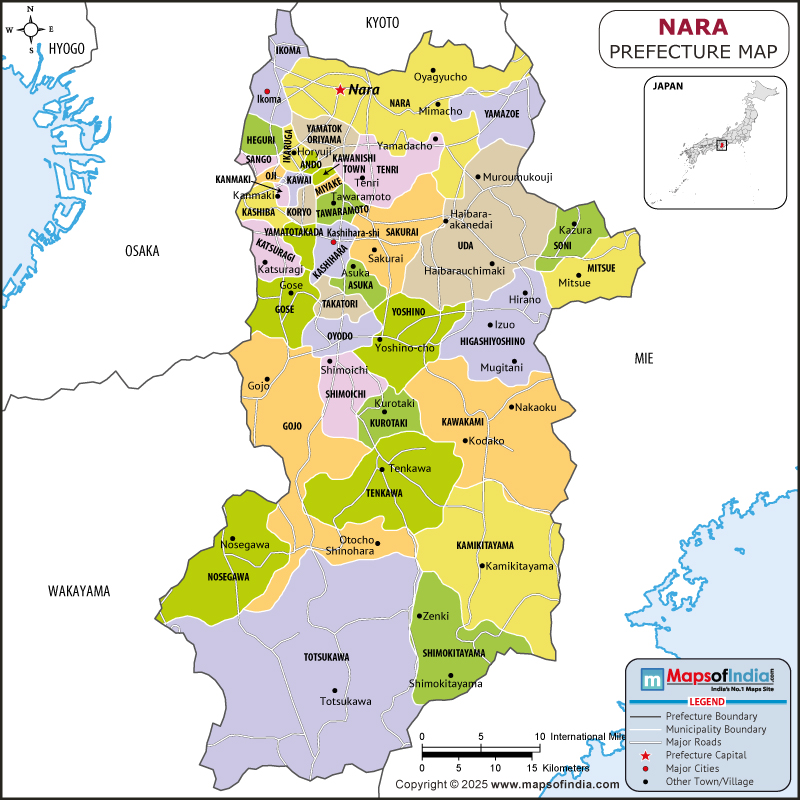



Nara Prefecture ( Nara-ken ) is located centrally on the Kii Peninsula of the Kansai region of Japan. It is a landlocked with Kyoto, Osaka, Wakayama and Mie, which surround it, and it also has a wide area spanning about 3,691 square kilometres. In spite of its humble dimensions, Nara has a huge impact on history and culture. It is consistently nicknamed the cradle of Japanese civilisation, which it gained through its use as the location of the first permanent Japanese capital and as a hub of growth of Buddhism, statecraft and arts.
Nara city of the prefecture serves as one of the living relics of the 8th century, and the ancient temples, shrines, and the remains of the palace co-exist with modern life. The traditional machiya townhouses are built upon the streets, and the surrounding scenery is a mixture of the fertile Yamato Basin and forested mountains of the south. The landscape of Nara is well-known and seasonal: cherry blossoms in the spring, greenery in the summer, heat-seeking maples in the fall, and snow on the roofs of temples in winter.
History
The history of Nara began deep in the prehistoric history of Japan. Early sources of the Jomon and Yayoi periods have documented finds of the architectural settlements in the Yamato Basin, plagued by the fertile land as well as its advantageous strategic geographical site. The region was transformed by the Kofun period (3rd-6th centuries) into the centre of politics of the Yamato polity, the first system of centralised Japanese government. There are now large keyhole-shaped funeral mounds or kofun that mark the terrain, and they are silent reminders of the influence rulers had in the past.
The Asuka period (538-710) was a transitional period of Nara. Buddhism was introduced in the mid-6th century in the Korean kingdom of Baekje and was a welcome figure to the Yamato elite. Religious buildings like Asuka-dera, or the first full-scale Buddhist temple in Japan, and Horyu-ji, founded by Prince Shotoku, turned into religious and artistic education centres. The Asuka court embraced the Chinese along with their governance, structure and urban design and from this developed the foundation of a more centralised state.
Then, in 710, the first permanent capital of Japan was formed by the imperial court as Heijo-kyo in modern-day Nara City, and the Nara period began (710-794). It was a calculated denial of a past establishment of the tradition of transferring the capital with each passing emperor, predicated on Shinto perceptions of ritual purity. Patterned after the Tang dynasty capital city of Chang'an, Heijo-kyo was outlined in a grid system with wide streets and large palaces. It appeared to be the centre of political administration, diplomacy and cultural exchanges, as envoys were sent to and from China and the Korean Peninsula.
During the Nara period, several canonical texts were collected, including the Kojiki and Nihon Shoki, which chronicle the mythology of Japan and its early history, along with the Man'yoshu, the earliest extant collection of Japanese poetry. Imperial patronage made Buddhism prosper so much that the Todai-ji and Great Buddha (Daibutsu), the massive bronze statue, symbolised the oneness of the realm unified under independent Buddhist doctrine. Nevertheless, the established political power of the Buddhist institutions in Nara later led the imperial court to open the capital there to Nagaoka-kyo in 784 and subsequently to Heian-kyo (Kyoto) in 794.
Even though Nara became deprived of its political capital, it had great religious and cultural importance. It emerged as one of the key pilgrimage sites over the centuries, and temples and shrines still flock with visitors and followers. The medieval approach is also characterised by conflicts in the region, with Buddhist sects and monk warriors competing to win the supremacy of the land. The Tokugawa period of the early modern era inspired some stability, and temples and shrines at Nara served both as monuments to the Japanese past.
In 1887, the modern prefecture was separated and born out of Osaka Prefecture. Since Nara has struck a balance between modernisation and conservation, whereby its ancient monuments are maintained by the newer generation of people.
Culture
The culture of Nara is incomparable to that of other regions in Japan. The prefecture has three listings on the UNESCO World Heritage list, including the Kofuku-ji, "Historic Monuments of Ancient Nara," which includes the Todai-ji, Kasuga Taisha, and related remains of Heijo Palace, the Buddhist Monuments of the Horyu-ji Area, and the Sacred Sites and Pilgrimage Routes in the Kii Mountain Range, which include the mountains of Yoshino and the other holy mountains.
Religious traditions have remained more significant to Nara. Shinto and Buddhism do not conflict with each other; sometimes they share cultural spaces successfully. One temple, Kasuga Taisha, which was built in the 8th century, is known to have thousands of bronze and stone lanterns, lit at Lantern Festivals in February and August. The Omizutori ceremony in Nigatsu-do Hall of Todai-ji, which is done every March in a span of over 1,250 years, is one of the few events in Japan that has been continually happening and has dramatic fire rites to purify sins and generate spring.
Probably the most popular representative of the prefecture is the sika deer of Nara Park. Considered to be messengers of the gods according to the Shinto belief, they wander between temples, shrines, and tourists. It has become a favourite custom to feed them "shika senbei" crackers, but the deer also reminds of the total immersion of the Nara into the spiritual world of nature.
The art and craftsmanship have existed in Nara for centuries. Buddhist sculpture flourished in the prefecture, and masterpieces of bronze, wood, and clay are now recognised as National Treasures. The crafts (nara ink (sumi), calligraphy brush, lacquer or Itto-bori wooden) and work of traditional craft are still in production, frequently with techniques that are generations old.
The food culture of Nara is associated with the farming background and historical relations. Sushi made out of persimmon leaf is kakinoha-zushi, a local speciality believed to have begun as a method of preserving fish when refrigeration was not possible. Miwa somen, the fine noodles of wheat cultivated in the Miwa region, are admired for their fine texture. Narazuke, vegetables pickled in sake lees, provide a thick, somewhat sweet taste that is original to the area. Here, sake brewing was well established, with the Miwa region frequently mentioned as a contributor to the birth of Japanese sake, attributed to the divine mountain of Miwa, the Omiwa Shrine.
Language
Nara Prefecture mainly speaks Japanese; nonetheless, the local dialects are an indication of the past and a sense of identity. Nara dialect (Nara-ben) has so much in common with the Kansai dialects used in Kyoto or Osaka that it is also characterised by the peculiar intonation and vocabulary. But there are also still older forms of the language, which are now extinct in other parts of the world, especially amongst the remotest communities of the mountain south.
The region was very significant in influencing the Japanese written language during the Nara period. The imperial court facilitated the compilation of the Kojiki, Nihon Shoki and Man'yoshu, which, besides documenting history and mythology, laid the foundations of literary tradition. It was these works that were written with Chinese characters, both with the meaning and occasionally with the phonetic value, to base what today are known as the kana syllabaries of modern Japanese.
Presently, when the standard Japanese is dominant in the education sector, media and official communication, the local languages are nonetheless alive in day-to-day conversations. They have also been maintained through ancient narration, folk-songs and local theatre, and can be regarded as a living connection with the past of the prefecture.
Geography
The geography of Nara is the story of opposites. North of the prefecture and especially the Yamato Basin is level and fertile, making it the historical focus of settlement, agriculture and political authority. The Nara City area contains most of the prefecture's landmarks in terms of historical locations. Mild climate and fertile soil of the basin have been nurturing rice farming for centuries its contributing to the prosperity of the area.
The southern and eastern regions of Nara, on the contrary, are under the Kii Mountains, a steep and jagged region abounding with shallow valleys and dense cedar and cypress forests. These mountains are not densely populated, and small villages adhere to the river valleys and mountain slopes. The prefecture has one of the lowest ratios of habitable land in Japan, of approximately 23%. The isolation of the southern mountains has served to maintain their natural beauty and cultural values such as sacred places relating to Shugendo, a syncretic Shinto religion, which is an amalgamation of Shinto, Buddhism and mountain shrines.
In the central-southern section of the prefecture is Mount Yoshino, one of the most popular cherry blossom viewing sites in Japan; the thousands of trees are planted in phased stages up the mountain. Yoshino is also the access point to the Omine Okugake pilgrimage route of the Sacred Sites and Pilgrimage Routes of the Kii Mountain Range, designated as such by UNESCO.
The rivers of Nara, including the Yoshino and Yamato, have also been instrumental in the agricultural activities and functioned as a transport channel of the area. It is normally temperate with hot and humid summers and cool winters.
Quick Facts
| Official Name | Nara Prefecture |
| Area | 3,691.09 km² |
| Population | 1,280,930 (As of 2025) |
| Religion | Shinto and Buddhism |
| Language | Japanese |
FAQs
Q1: Why are there so many deer in Nara Park?
The sika deer in Nara Park are considered sacred messengers of the gods in Shinto tradition and have roamed the area for centuries.
Q2: What makes Tōdai‑ji’s Great Buddha special?
Tōdai‑ji houses a 15‑meter‑tall bronze statue of Vairocana Buddha, one of the largest bronze Buddha statues in the world, completed in 752 CE.
Q3: What is Mount Yoshino famous for?
Mount Yoshino is renowned for its thousands of cherry trees planted in stages along the slopes, creating spectacular layered blooms each spring.
Q4: Can one still see ancient wooden buildings in Nara?
Yes, Hōryū‑ji Temple in Nara preserves some of the world’s oldest surviving wooden structures, dating back to the 7th century.
Last Updated on: April 15, 2026

