


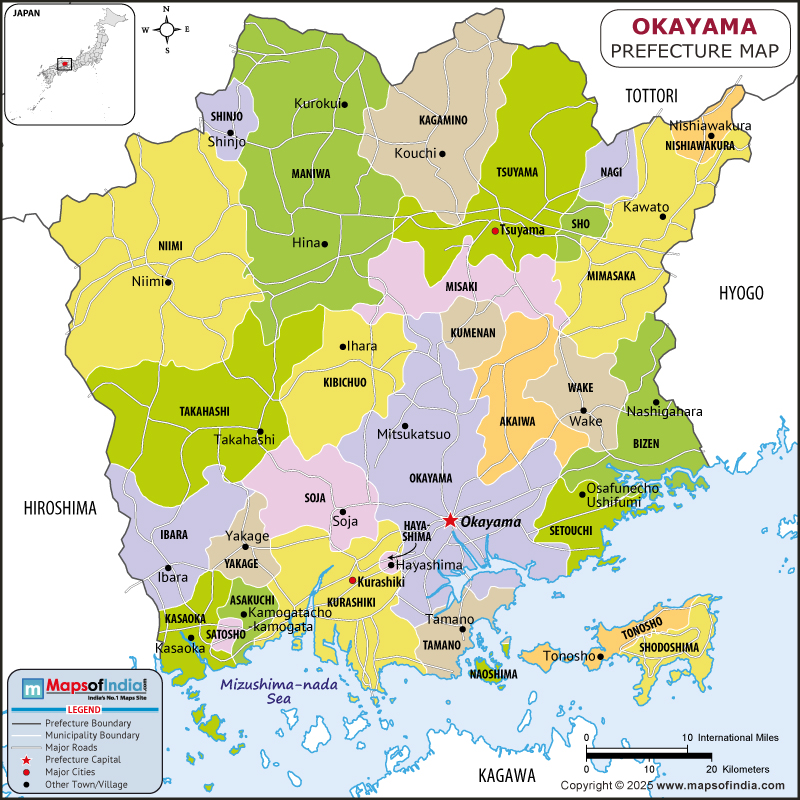



The Chugoku area of western Honshu is known as the Okayama Prefecture to the Japanese as Gang Shan Xian (Okayama-ken), a very fascinating place to visit, in their country, Japan. It is shaded on the north by Tottori Prefecture, on the east by Hyogo Prefecture and on the west by Hiroshima Prefecture, basking in the gentle serenity of the Seto Inland Sea, except where on the east border, where Japan borders the Sorin reading a hiwa. The sightseeing Great Seto Bridge makes them two together, with its amazing design of contemporary technology, which serves as a palisade of local connections. In size, Okayama is the 17th largest prefecture in Japan with a land area of 7,114.50 square kilometres. It has an estimated population of 1.83 million as of February 2025, the 20th most populous prefecture in the nation.
The centre of both the prefecture and the largest city is the capital of Okayama City, an urban centre which is very vibrant and forms the political, economic and cultural centre of the region. The other important cities are Kurashiki, Tsuyama and Soja. The relatively low levels of rain annually also make Okayama the Land of sunshine because its low temperatures have enabled it to be one of the most productive regions in Japan. Its most renowned product is its high-quality fruits, in particular, the Shimizu white peach or the Muscat of Alexandria grapes, renowned throughout the country due to their amazing sweetness and quality.
History
The history of the Okayama Prefecture is closely entrenched in the ancient and feudal history of Japan. The modern-day border of Okayama was split into three historical provinces, namely, Bizen, Bitchu and Mimasaka, before the Meiji Restoration of 1868. They were also significant political, cultural and commercial hubs in turn. Another advanced polity that existed in the region during the Kofun period (3rd to 7th centuries) was the ancient Kibi Kingdom. The Kibi culture was in competition with the new Yamato state and even left numerous burial mounds (kofun), numerous artefacts and legends, such as the beautiful folktale of Momotaro, the folktales of the Peach Boy, which, until nowadays, is so far a favourite icon of Okayama.
The fortune of the Ikeda clan came during the reign of the Edo period (1603-1868): the group, which ruled the Okayama Domain, moved the city to prosperity. The Ikeda lords were characterised by the quality of their administration, infrastructure investment and has been urged by patronising arts. The construction of Okayama Castle likely has been one of their most durable legacies that bears its moniker of U-jo, or the Crow Castle, due to its dark, blatant appearance. This turned the castle into a political and cultural centre, and it was supplemented by the establishment of the Korakuen Garden in 1700 by Ikeda Tsunamasa. Korakuen (which today appears in the list of Three Great Gardens type) was created by specialising not only in aesthetic pleasure, but also by taking into account practical factors of resistance to flooding, which demonstrates the vision of its owners.
That area also gained a reputation for craftsmanship, especially Bizen ware pottery, which is more than a thousand years old, and it goes all the way to the Heian period. Bizen ware is a half of the six ancient Japanese kilns, which has gained popularity due to its hesitant, unglazed surface that it reached by firing in high temperatures with wood. Such a tradition of pottery became an icon of cultural continuation, which is able to survive the shock of modernisation and industrialisation.
After the feudal domain system under the Meiji government was abolished, one year later in 1871, Okayama Prefecture was officially created (although its present boundaries were not finalised until 1876). The modernisation of the prefecture was also high, with the emergence of industries like textile industries and steel and petrochemical industries, especially in the Mizushima industrial district located in Kurashiki.
World War II exposed Okayama to a lot of suffering. The air raids which hit Okayama city on June 29, 1945, ravaged the urban core of this city. During the postwar period, the prefecture was being rebuilt by giving attention to infrastructural forces, green space and economic diversification. Nowadays, Okayama is a strong and progressive area, combining the historical landmarks with the contemporary buildings.
Culture
The culture of Okinawa is the balancing conflict of ancient customs, artworks, and glamorous celebrations. The knowledge about the Kibi culture and patronage of the Ikeda clan is manifested in architecture, in gardens and in the arts of the prefecture. The Korakuen Garden is a treasured cultural destination that welcomes tourists with the beauty of colours throughout the year, starting with the cherry blossoms in spring and blazing leaves in autumn. Another cultural activity practised in the garden is the tea ceremony, Noh theatres and other related activities which uphold the ancient Japanese aesthetic.
Bizen ware pottery, A cultural symbol of Okayama, is the Bizen ware pottery that is made in the town named Imbe in Bizen City. The Bizen ware is also unique due to its solid colours and absence of glaze, and is known to be durable and simple in beauty. Its manufacturing process, which entails firing clay at high temperature over a long period, incurs postatic surface patterns. Tourists are able to visit CRAFT workshops and meet and talk to artisans, as well as attempt to carve clay.
Another gateway to the culture of Okayama, Kurashiki has a Bikan Historical Quarter. It is a well-preserved area that has its white storehouse, merchant houses and canals of Edo, when Kurashiki took advantage as a port of rice storage and distribution under the direct domination of the Tokugawa shogunate. Currently, the area is the site of museums, the first museum of western art in Japan, the Ohara Museum of Art, has works of masters like El Greco, Monet and Gauguin as well as Japanese artists.
The central feature of the arts and cultural life of Okayama refers to festivals. Every August, the well-known folk hero of the prefecture has also been celebrated by the Okayama Momotaro festival that includes parades, traditional dances, and fireworks. One of the most renowned and vigorous winter festivals in Japan, Saidaiji Eyo Hadaka Matsuri, also known as the Naked Festival, is a festival held in the month of February every year at Saidaiji Kannon-in Temple, which is replete with prizes such as sacred sticks (shingi) hurled by priests, which are thought to bring good fortune to all.
The gastronomic culture of the prefecture is also very elaborate. Along with its famous fruits, local delicacies can be seen in Okayama to include barazushi, a colourful sushi dish made by roasting seasonal ingredients, and demi-katsudon, which is a breaded pork cutlet that is served on a rice dish with a demi-glace on top. These meals depict classic Japanese taste, as well as an importation of Western culture in the form of cuisine that came out during the Meiji era.
Language
The main language in Okayama is Japanese, although the local dialect falls in the Chugoku dialect group, which is the San'yo subdialect. The dialect is called the Okayama dialect (Okayama-ben), which has unique grammatical and phonetic features that contribute to the difference between it and standard Japanese. One notable feature is the use of the copula “ja” instead of the standard “da” or “desu” in informal speech. For example, “Sō ja” means “That’s right” in Okayama-ben.
Geography
The geography of this region is very diverse and desirable, with so many features that include mountains, rivers, plains, and coastline. Chugoku Mountains dominate the northern portion of the prefecture and present a natural boundary with Tottori Prefecture. The area is full of steep hills, thick forests, and small, unsophisticated villages. It also hosts a great variety of hot springs (onsen), which include those found in Yubara and Okutsu, which offer visitors relaxation and beauty day trips.
Its central part boasts of the Kibi Highlands, which is a mountainous area with several archaeological sites that have strong associations with the ancient Kibi Kingdom. The region is also full of kofun burial mounds, shrines and temples, which can provide a sense of touch with the early days of Japan. The Southern Okayama region is fertile, and the plains stretch towards the Seto Inland Sea. The climate of the region is mild, and the surrounding soil is favourable to agriculture. This is the centre of fruit growing of the prefecture, and the orchard fruit yields come in peaches and grapes, amongst other fruits.
The inland topography of the prefecture is conditioned by its three great rivers in the Chugoku mountains, among which include the Yoshii, Asahi, and Takahashi Rivers actually flow to the south of the Seto Inland Sea. Also, such rivers have long been the backbone of agriculture that providing ample rice planting in the fertile alluvial plains. The valleys are also good transportation and settlement pathways, which have seen the growth of numerous towns and cities along the banks. Earlier flooding events of seasonal nature led to the building of levees and irrigation systems, some of which are more than several centuries old and still in operation.
The climate of Okayama is a humid subtropical which has hot and humid summers and cooler and relatively dry winters. Prefecture is among the sunniest in Japan, and the number of rainy days in this region is less than the national rate; this has given it the title of Land of Sunshine. The snow in the plains is uncommon to the south side, but it is found mostly in the mountains in the north, where it aids in covering winter activity and seasonal tourism. The agriculture in the prefecture, its success, and in the particular field of growing fruits, is attributed to mild weather and fertile soils.
Quick Facts
| Official Name | Okayama Prefecture |
| Area | 7,114.50 km² |
| Population | 1,826,059 (As of 2025) |
| Religion | Shinto and Buddhism |
| Language | Japanese |
FAQs
Q1: What is Okayama Prefecture most famous for?
It is best known for its premium white peaches, Muscat grapes, and the folktale hero Momotaro.
Q2: Which historical garden is a major attraction in Okayama?
Kōrakuen Garden, one of Japan’s Three Great Gardens, is located in Okayama City.
Q3: What traditional craft is unique to Okayama?
Bizen ware pottery, an unglazed ceramic with over a thousand years of history, originates here.
Q4: Why is Okayama called the “Land of Sunshine”?
It enjoys one of the highest annual sunshine rates in Japan, with relatively low rainfall.
Last Updated on: April 15, 2026

