


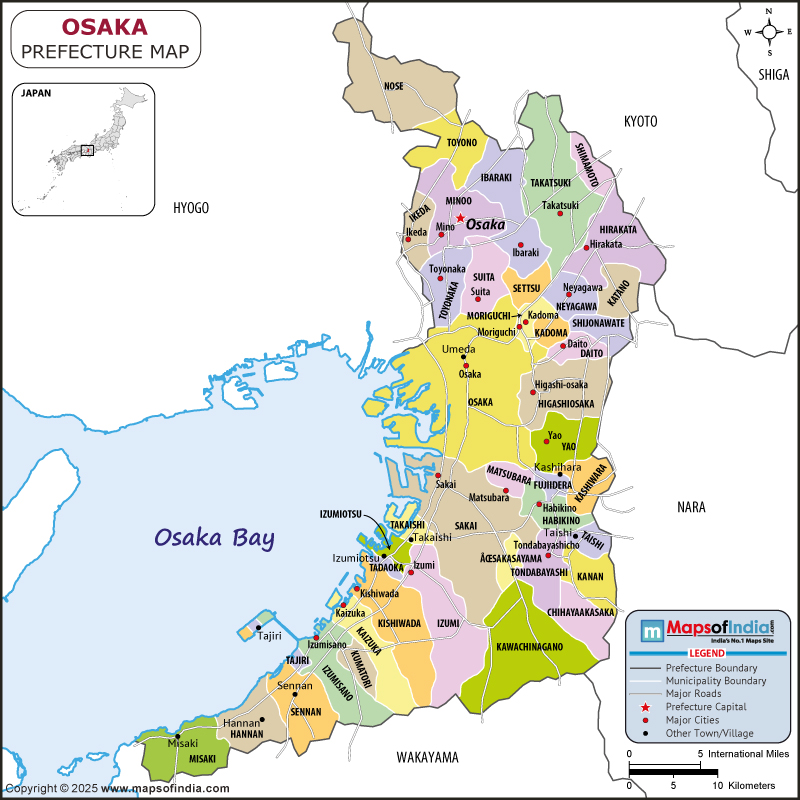



Osaka is the capital city of Osaka prefecture and the third largest city in Japan. It is located in the Kansai region on the island of Honshu. It has a population of about 2.7 million and a metropolitan area exceeding 19 million people. Osaka is a major economic, natural and historical hub of Japan. It first originated as an important regional port during the ancient time briefly serving as the imperial capital of Japan. It is known as the nation’s kitchen and has long been the country’s commercial heart and flourished through its role in trade industry and finance. It is recognized for its dynamic urban life, rich history and iconic landmarks such as the Osaka castle.
History
Osaka is one of Japan's most vibrant and historically rich cities which has a complex history spanning thousands of years. It has evolved from an ancient settlement to a crucial political, economic and Cultural Center of Japan.
The history of Osaka starts in prehistoric time. During the jomon. The area that is now Osaka was largely submerged. The uemachi plateau A long narrow peninsula separated kawachi bay from the seto inland sea and was one of the earliest places where people settled because of the favorable environment rich in fresh water and resources. Archaeological sites show early human activity including tools, pottery and remains of rice processing indicating a transition between the jomon hunter gatherer culture and the latter farming culture of Yayoi.
In the Yayoi period the area saw increased permanence and agricultural development, especially rich rice cultivation. The plateau expanded and the kawachi lagoon transformed during this time. The early 3rd century CE saw the establishment of sumiyoshi taisha , a significant Shinto shrine near Osaka harbour, marking early religious and cultural investment in the region. These early developments set the stage for the future of Osaka as a strategic and economic hub.
By the 5th century Osaka flourished as an economic and political gateway connecting Japan with Korea, China and broader Asia. The port was important for trade and cultural exchange. Influence from the Asian continent brought advanced craft techniques including ceramic and blacksmithing as well as Buddhism which began spreading in Japan during the time. Significant structures were built by influential leader exemplifying the role of Osaka as centered for cultural and religious exchange.
In 645 CE emperor kotoku moved the capital temporarily to the naniwa palace in Osaka marking it as Japan's imperial seat although the capital was later moved to successive locations like kyoto kamakura and Edu. Despite these shifts Osaka remained an important hub for trade and diplomacy maintaining the status as one of Japan’s largest cities.
During the turbulent muromachi period. Osaka's strategic importance grew as warlords fought for control. In 1496 the Ishiyama Hongan ji temple was established as a fortified temple complex to protect the city from military threat. In the late 16th century the powerful warlord Oda Nobunaga laid siege to this fortress but eventually destroyed it after prolonged battle. His successor Toyotomi hideyoshi rose to prominence in Osaka making it his political base and building the iconic Osaka castle in 1583. The period marked a turning point as Osaka transformed into a major transportation and commercial hub. Heidi Yoshi construction projects expanded waterways and facilitated trade and military defense. The surrounding castle town developed into a bustling urban center.
Under Tokugawa rule Osaka lost its political primacy to Edo but quickly rebounded economically. During the Edo period Osaka became known as the kitchen of the nation because of its important marketplace where agricultural products especially dried goods were traded and distributed throughout Japan. The city became the financial center for rice brokerage and hosted the world’s first future market, the dojima rice exchange which served as the forerunner to modern banking.
The geography of Osaka, the rivers and proximity to the sea enabled it to thrive as a centre of Commerce and Industry. Markets and warehouses flourished and the city became an export hub connecting to domestic and international trade routes. During this time Osaka also developed a distinct culture. The wealth of the merchant class enabled the growth of popular art and entertainment like puppet theatre and unique style of kabuki. Literary figures contributed to the vibrant urban culture known as the genroku culture. Education thrived as well with schools pioneering western sciences and medicine contributing to the modernization of Japan in the late Edo period.
With the abolition of the shogunate and the meiji restoration in 1868 Osaka entered a new phase of industrial growth. The city industrialized rapidly, becoming a manufacturing powerhouse with a focus on textile machinery and chemicals. The introduction of railroad and modern infrastructure connected Osaka more broadly across Japan and the world. During the early 20th century Osaka was Japan's largest city by population and industrial output. The city hosted industrial exhibitions and expanded the urban area.
Osaka suffered heavy disruption from aerial bombing in World War II which devastated much of the city's industrial and residential area. Post war Osaka rebuilt swiftly, reestablishing itself as an economic and Cultural Center. The city diversified the economy embracing commerce, finance and technology sectors while preserving the deep historical legacy.
Osaka is Japan's third largest city and remains an important economic hub with a rich blend of tradition and modernity. The historical sites like the Osaka castle draws tourists while its legacy as a trading gateway and cultural centre continues to influence the economy of Japan and culture. The history of resilience and adaptation reflects in its thriving present day vibrancy.
Culture
Osaka’s culture is celebrated for its energetic approachable and commerce driven personality. Historically known as the nation’s kitchen, Osaka has gained a reputation for its rich culinary heritage. Iconic street food is deeply embedded in everyday life and the city’s social fabric. The local culture emphasizes warmth, humor and friendliness traits reflected in the unique Osaka Ben dialect and the thriving comedy scene particularly manzai which is a style of rapid fire double act comedy. The city's merchant class history has nurtured a direct communication style distinguished from other regional cultures in Japan.
Performing arts play an important role. Osaka is the birthplace of bunraku theatre traditional puppet performance and an active hub for kabuki theatre. Artists and playwrights from the city have contributed richly to Japanese literature and art. Festivals showcase the vibrant cultural heritage of Osaka through elaborate boat parades and fireworks. This reinforces community pride and tradition. The blend of historical legacy with modern urban vibrancy shapes Osaka as a cultural hub that celebrates both the merchant root and the contemporary innovation.
Language
The primary language spoken in Osaka is Japanese but the city is distinct for its use of kansai dialect locally known as Osaka Ben. The dialogue differs sharply from the standard Tokyo dialect and is characterized by its unique vocabulary pronunciation and pitch accent. Osaka Ben is often perceived as more casual, friendly and humorous embodying the personality of Osaka's residents. The dialect has linguistic roots tracing back to the Edo period where Osaka thrived as a merchant city.
The words and phrases in the Osaka Ben often carry nuances of warmth and directness making communication lively and engaging. Some expressions and pronunciation features can sometimes be challenging for non locals to understand which adds to the dialect's distinctiveness. The language in Osaka extends beyond daily conversation into performing arts notably in comedy where Osaka Ben is the norm and a critical element of humor delivery especially in manzi performance. The dialect also influences the lyrical style of local music and theater which enhances the reputation of Osaka as a place with rich oral and performative tradition.
Geography
Osaka is situated in the kansai region on hansu japan’s main island positioned around the mouth of the yodo river leading into Osaka Bay which is part of the Seto Inland sea. The city spans approximately 222 square kilometers making it the largest city in Osaka prefecture by area. It lies on the Osaka plain of fertile flat land formed by river deposits which have historically supported agriculture, especially rice cultivation.
The geography features a mix of rivers, coastal area and Urban Development. The Yodo river flows through the city and contributes to its strategic importance as a port and commercial hub. Osaka Bay on the city’s West side has facilitated trade and maritime activity for centuries. The highest elevation elevation is a modest 37.5m above sea level in the Tsurumi ward while parts of Nishiyodogawa ward lie below sea level.
Osaka experiences a humid subtropical climate with four distinct seasons including hot humid summers and mild winters with low or little snowfall. Rainy seasons occur in the early summer with typhoons sometimes affecting the region in late summer or early autumn. The coastal geography of the city and the river plain have shaped its urban layout, transportation and economic activity centered on Commerce and Industry.
Quick Facts
| Official Name | Osaka |
| Location | Kansai region of Honshu |
| Area | 225.21 sq. km |
| Population | 2753862 |
| Language | Osaka-ben |
FAQs
Q1: What is the climate of Osaka?
The climate of Osaka is a humid subtropical climate zone with four distinct seasons. The winters are generally mild. January is the coldest month. There is rare snowfall during winter. Spring starts mild but ends up getting hot and humid.
Q2: Which are the major divisions in central Osaka?
Central Osaka is divided into downtown and uptown areas known as Kita and Minami.
Q3: Name the rivers which flow in Osaka?
The rivers which flow through Osaka are : Yodo River, Kyū-Yodo River, Yamato River, Aji River, Dojima River, Tosabori River, and Dotonbori River.
Last Updated on: June 22, 2026

