


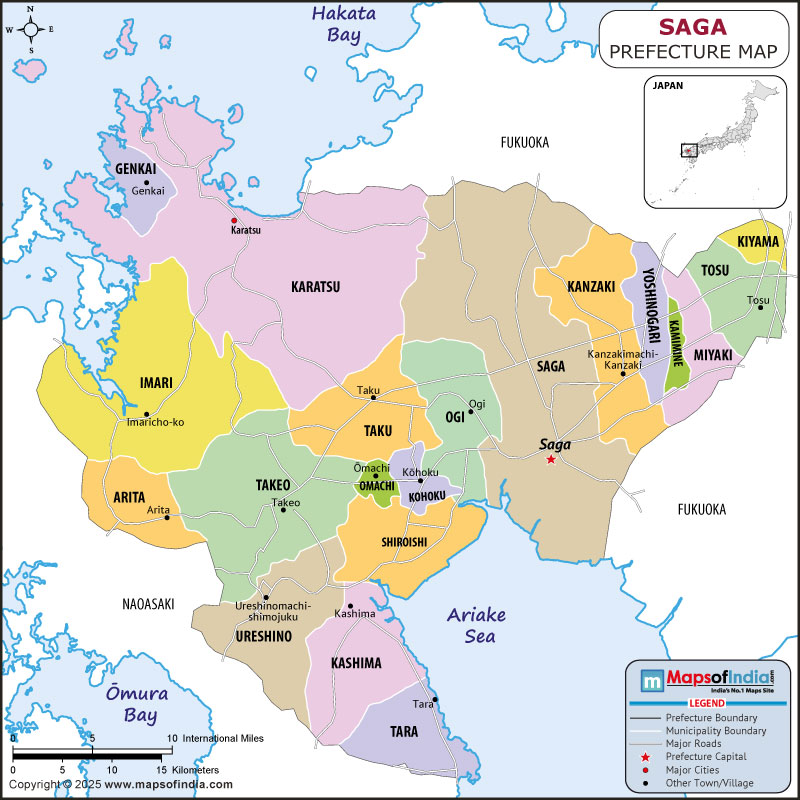



The Saga Prefecture is situated in the north west of Kyushu, with Saga on its eastern side and Nagasaki on the western one, the Genkai Sea on its north coast and the Ariake Sea on its south. It is made up of an area of approximately 2,441 square kilometers with a population of approximately 800, 000. Its topography is also mixed, i.e. it is hilly and mountainous to the north and west, with the southeast being primarily covered by fertile plains. The capital is the Saga City and other major towns include Karatsu and Tosu. It has a tradition of producing ceramics and its towns such as Arita, Imari are hailed as a haven of porcelain arts with a long history traceable several centuries. Seaweed and seafood, particularly seaweed, are central to the food culture of the locality with tidal flats contributing within the Ariake Sea. It features historic sites, including the Yoshinogari Ruins, one of the largest archaeological icons of the Yayoi Period, as well as onsen (hot springs) towns, including Takeo and Ureshino. Weather is very favorable, with comfort, and is a fusion of custom, naturalness and agro industry.
History
People inhabiting the area trace their way back several millennia. The Higashimyo site is among the oldest archaeological sites ever, some of which belonged to the early to middle Jomon period, such as shell moulds, ancient baskets, plates and tools. These findings reveal that, during prehistory, this area was inhabited by semi-settlements, which utilized wet lands and rivers systems, as well as constructed their tools and crafts, quite skillfully.
As in later periods during the Yayoi period (around 3rd century BCE -3rd century CE), wet-rice agriculture penetrated into the plains, and huge settlements developed. One of the largest sites of its era with residences, burial mounds, storehouses, and trading artifacts such as glass beads and bronze tools is the renowned Yoshinogari site. The excavation of the structure in the 1980s indicated that the administration and defence claims of the people of that period were completed indicating that people of that time had more sophisticated social organization.
In ancient and medieval eras this land was included in the Hizen Province. The feudal era consisted of influential local clans like the Ryuzoji and the Nabeshima. Castles and fortresses were constructed: The example of the Suko Castle is notable which was developed according to Ryuzoji management as the central base of power in the northern Kyushu.
The region had predominantly been dominated by the Nabeshima domain when the Edo period was instituted and the Nabeshima domain engaged in domain management, agriculture, water management, and trade. It was also interesting how waterworks and land reclamation in tidal flats of the Ariake Sea, along with advanced irrigation systems in the plains was developed and is beneficial to support agriculture in the flood-prone or water-scarce regions.
Through the Meiji Restoration (mid-19th -century), provincial and domain systems were brought to an end. The modern government organizations were introduced through administrative reorganization. The development of infrastructure like roads and rail started to open the area much wider to national networks. Trade in ceramics (especially at Arita, Imari) and other creating and art forms also Westernized, yet much remained the same as before.
During the 20th century, population changes, modernization and agricultural shifts employed new challenges. In mountain villages and ocean coastal villages, rural depopulation became a problem. Meanwhile, ancient locations such as Yoshinogari, ancient castles, ruins became well known and historical locations were preserved by building museums or parks and encouraging cultural tourism. The acknowledgment of the Yoshinogari Ruins as a sensitive historic site and the creation of the Yoshinogari Historical Park serve as illustrations of preservation and containment of ancient heritage possibilities.
Culture
The region has strong connections with arts and porcelain and ceramics. Arita, Imari and Karatsu towns are recognized all over Japan (and even further) due to their Arita-yaki and Imari-yaki porcelains, and Karatsu ware. Dating back to early in the 17th century, these crafts merge local techniques with Chinese and Korean elements and materials. Practitioners still keep to an earlier method, smoke in the kilnroom, hand technically ornamentation, and old smithys.
Crafts made out of handmade paper such as washi also constitute a key cultural fibre. The Hizen Nao Washi Kobo workshop manufactures Nao Washi, a durable paper produced from paper mulberry trees. It is an over 300 years old craft which involves the use of natural materials and processes which require a lot of labor such as steaming of leaves, washing, and using the fingers to dig off impurities. It is applied on lanterns, sliding doors, interior decorations, and art objects.
Festivals and seasonal events are vital and real. One of the giant hot air balloon events in Asia is the International Balloon Fiesta which takes place in early November attracting both competitors, as well as visitors. Meanwhile, close to the same period, the Karatsu Kunchi festival occurs; their mounts are huge and are carved and lacquered followed by traditional songs and the takes part of the community. A still denser sight is the Gatalympics, when they have to run on the mudflats of Ariake Sea, it is a kind of funny festival related to the beating of the waves.
Culinary culture can be characterized as land and sea. Fish, shellfish and seaweeds (particularly along the Ariake Sea) can be grown along coastal waters, but rice, onions, asparagus, lotus root, and so forth can be cultivated on plains. Freshwater fish, sea products and vegetables are often merged in local dishes in relatively simple and natural fashions.
Hot springs (onsen) are integrated in traditions of relaxation and wellness. Sights like Ueshino Onsen and Takeo Onsen have long been visited by the people in search of refreshing baths where in most cases the scenery, the inns, and the traditional quarters have always been enclosed.
Language
The residents of this area of Kyushu speak a regional type of the Japanese language commonly referred to as Saga-ben or Saga dialect. It is one of the Hichiku subgroups of Kyushu dialects, and it also comprises speech varieties in neighboring prefectures. It exhibits characteristics that are not shared by the Standard Japanese, particularly in pronunciation, particles, verbs, and vocabularies.
Among them is the usage of various particles in sentence ending instead of the usual Yo, most people tend to use Bai or Tai. Some other peculiarity is attribution of some grammatical particles: marker of the direct-object "o" can be substituted by marker of the direct-object "ba" and marker of comparison with others may change into the marker no.
A change in pronunciation is prominent as well. Growth and shift (or coalescence) of some consonant and vowel sounds are found in the rural or older speaker set. As an example, conjoined negatives such as -nai can turn to -n, adjectives which end in -i can alter their end or the vowel in an informal speech.
Due to the tenacity of the dialect in some of the smaller towns, it has sometimes happened that a person who had been speaking Standard Japanese may not comprehensively understand. The accent and tones also change with the place of place - each town or region has its unique turn of phrase in sound or other terminology.
Geography
The area was in northwest Kyushu bordered by Saga in the east and Nagasaki in the west. It borders the Genkai Sea and the Tsushima Strait runs across the entire northern tier with Ariake Sea forming the southern coastline.
In the north and west, much of the topography is hilly or mountainous and comprises ranges like the Sefuri and Tara mountains. Mountains such as Mount Kyoga soar 1000 meters above the ground. To the southeast, but at least in the predetermined sense, the flat terrain turns into deep plains - particularly into the Saga Plains and the Shiroishi Plain - which when fertilized would offer vast agricultural lands.
In the north and west, much of the topography is hilly or mountainous and comprises ranges like the Sefuri and Tara mountains. Mountains such as Mount Kyoga soar 1000 meters above the ground. To the southeast, but at least in the predetermined sense, the flat terrain turns into deep plains - particularly into the Saga Plains and the Shiroishi Plain - which when fertilized would offer vast agricultural lands.
The highlands receive rain carried along several rivers that drain into the coastal seas on these plains. The major ones are the Kase, Matsuura, and the Rokkaku rivers. These characteristics also influence the land use by their release and floods during the seasons with excessive rainfall which in most cases necessitates proper control of water.
Coastlines are varied. The coast to the north is rugged, having cliffs and bays and numerous little off-lying islands, including Takashima and Kakarajima. The south is marked by large tidal flats of Ariake Sea which are good habitats of bird life, seaweed and shell life. There are islands, and the main ones are deprived of the North coast.
Farmers have split land use into arable plains and forests. They have almost twice the proportion of forest as well as Fallow or land which they can make limited use of, and arable land is also taken in nearly half of the total land, and is seriously more in several classes than the national average. Outside the major towns residential and built-in territories are less significant in share. Mountain coastal areas are covered by natural parks, both prefectural and quasi national.
Quick Facts
| Official Name | Saga Prefecture |
| Region | Kyushu |
| Language | Japanese |
| Capital | Saga |
| Island | Kyushu |
| Area | 2,439 km² |
| Population | 785,748 (As of 2025) |
| Governor | Yoshinori Yamaguchi |
FAQs
Q1: What are the important towns and cities?
The Genko Bulwark ruins along Hakata Bay commemorate Japan’s successful resistance against the Mongol fleets in the 13th century.
Q2:What are the names of local industries and crafts?
The construction of famous ceramics production (Arita, Imari, Karatsu wares) is a strong tradition. Agriculture also performs well.Important crops are rice, onions, asparagus, and lotus root. Other major activities include seafood and seaweed harvesting.
Q3: What are the attractions or experiences of the tourism that must be visited?
It include Yoshinogari Ruins, Arita Porcelain Park and kilns, Yutoku Inari Shrine, Karatsu Castle, Ureshino Onsen, and seaside caves such as Nanatsugama.
Last Updated on: April 15, 2026

