


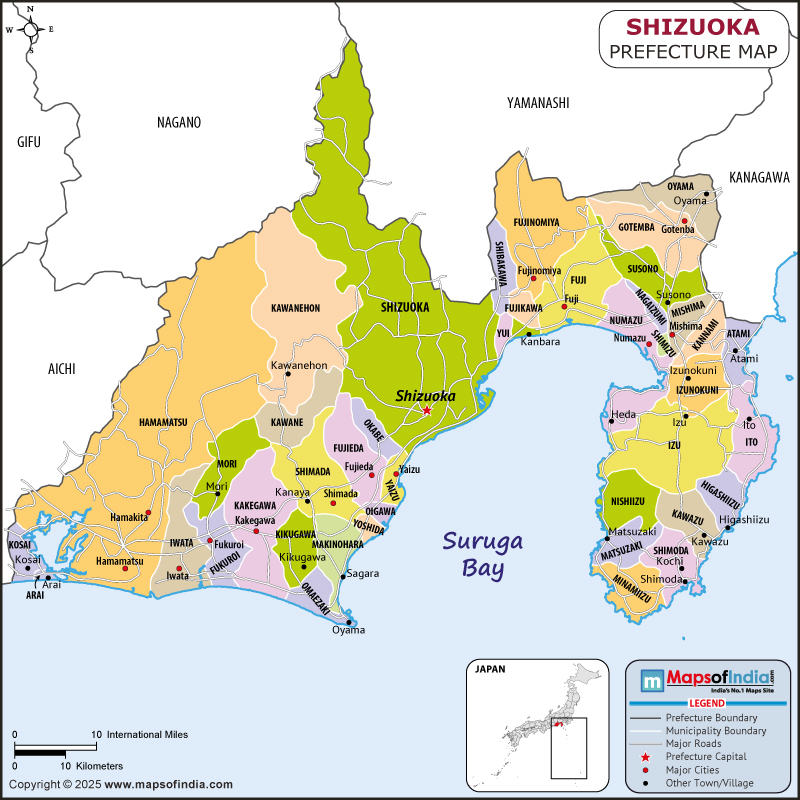



The central Honshu has Shizuoka which is a coastal prefecture that is between Tokyo and Nagoya facing the Pacific Ocean. It spans just under 7,777 square kilometers including both the many treasured natural resources and flourishing cities. Mount Fuji and picturesque Izu Peninsula are located in the eastern region and are renowned for the human-volcanic topographies, hot springs, and sea beaches. On the western side the terrain gives way to Lake Hamana and rice paddies made by rivers including the Oi and Tenryu.
The climate of the region is relatively cool and the coast is warm, whereas the mountains are cooler and snowy. This diversity has facilitated an excellent agricultural foundation, especially the green tea, citrus fruits, and wasabi, which is well-known in the country. Along with agriculture, Shizuoka is homogenized between industry, culture and tourism, attracted by historic structures, sea resorts and natural beauty. The positioning on the Tokaido route is also a significant route, as it is easily accessible; it is an important connection between the eastern and western parts of Japan.
History
Modern day Shizuoka has existed since ancient times. One of the most significant early Japanese archaeological sites is the Toro site found in modern Shizuoka City depicting a large Yayoi-period settlement (ca. 300 BCE-300 CE) with wet-rice fields, and equipment.
During historical days the prefecture was divided into 3 provinces: Suruga, totomi and Izu. During the Muromachi period, Sunpu (modern day Shizuoka City) Province was under the heavy Imagawa clan rule. They lost their power after they lost the Battle of Okehazama in 1560 and were beaten by Oda Nobunaga who conquered Imagawa Yoshimoto. The quartet of Imagawa, Takeda and Tokugawa challenged totomi power and Tokugawa Ieyasu finally emerged victorious in the late 16th century.
In Edo, Tokugawa Ieyasu retired to Sumoto in Sunpu castle even though he continued to rule Japan using shogunate in the year 1607. Sunpu in this way, was symbolic in Japan as well as a strategic location in early modern Japan. The Tokaido road, going through Shizuoka, connected Edo (Tokyo) and Kyoto providing the area with the representation in the form of post towns and trade routes.
After the Meiji Restoration (1868) and the abolition of feudal domains, the 3 old provinces became a modern day administrative organization in 1876, officially becoming Shizuoka Prefecture. To this day, the prefecture developed during the Meiji period to be one of the pioneering capitals of Japan to modernize with railways, ports, and industrial bases and remained at the forefront in developing agricultural conditions especially the green tea that flourished on the Makinohara Plateau.
In the 20th century Shizuoka was hit by natural disasters including the Shizuoka earthquake of 1935 and 1944 Tonankai earthquake that transformed coastal protection and city planning. Post World War II, reconstruction and burgeonic economic growth transformed Shizuoka into an industrialised city, which specializes in musical instrument, motorcycle and machinery production in addition to its continued tea, citrus and wasabi production.
Tourism increased continuously following the war. Mount Fuji, half of which was on Shizuokalai land, became an icon to the world, and the Izu Peninsula grew up as an ocean resort with a hot spring atmosphere. The cultural legacy was preserved keeping historic monuments like the Sunpu Castle; also, the archaeological relics like Toro.
Culture
There is a strong tradition of crafts at Shizuoka, particularly in the Suruga area. Shizuoka City the Sunpu Takumi Shuku (Traditional Craft Center) maintains craft work like Suruga bamboo ware, lacquer, wood working, ceramics and doll making. Most of these crafts were founded within the Tokugawa and Imagawa period of time where artisans were congregated to construct shrines and temples that remained in the region. Tourists have the opportunity to experience practical learning in places such as Takumi-yado: dyeing, woodwork, bamboo work and so on.
The culture of Tea is at the core of Shizuoka. The prefecture is amongst the leading in green tea production in Japan. In the Suruga parts, Gyokuro tea is a well-known tea in the region. Numerous tea houses, gardens, and museums enable individuals to experience and get to know more about the traditional tea ceremony and tea preparation, particularly, throughout ancient paths like the Tokaido corridor.
The festivals and the rites are colored and various. Hamamatsu City uses kites to hold kite flying contests, floats and parades at the Hamamatsu Kite Festival that bring immense crowds during the month of May. Others are the Yoshiwara Gion festival in Fuji city, and the festivals of fireworks in the city of Atami and the typical celebrations such as the Hina no Tsurushi hanging ornament festival of the Izu Peninsula during the Girls day. There are also Shinto practices such as having yabusume (horseback archery) in Mishima Taisha and other rituals.
Local culture is also largely food-based. The local food focuses on the items produced around the area: fresh Suruga Bay seafood, mountain spice, together with snacks native to the area. Special food festivals, such as oden festivals and food-festivals, are used to maintain the regional recipes and unite communities.
Rural areas conserve the performing arts and folklores: dances and rituals relating to agriculture, like rice planting combined with harvesting rites are still practiced. These traditions are more than a thousand years old and are characterized by a mix of Shino and folk themes and demonstrate the integration of spirituality and the ordinary world by communities.
Language
The speech patterns of Shizuoka are part of the overall Japanese dialect continuum, and there is a range of local dialects, referred to collectively as Shizuoka-ben. These dialects belong to the Tokai-Tosan group (sometimes referred to as: nayashi dialects), which occupies an intermediary between the Eastern and Western dialects of Japanese. These dialects are in reality a reflection of geographic variation and in some ways history.
It consists of a number of regional subdivisions. In the eastern side of the prefecture, Izu Peninsula speech, and parts of Suruga, there are characteristics that are more suited to Eastern dialects of the Japanese language. As one travels and heads towards the centre, speech modifies, and then further west (particularly Enshu), some others develop. As far as the remote mountainous region of the upper river of the Oi has some remote or isolated characteristics, there is even a special Ikawa dialect.
The blend of the successive vowels are some of the phonetics and grammatical aspects. The regional pitch accent of Shizuoka dialects differs. Significant numbers of words that contain two-mora of accent are read flat in western regions around Hamamatsu. The eastern side of the Oi River has more words that are stressed on the final mora. Depending on the eastern, central and western regions the three-mora nouns can change stress to either front-mora stress or middle-mora stress.
Nevertheless, even with these dialectal differences, standard Japanese is widespread and is understood, particularly in official occasions, media, education and internal intra-regional communication. Often, individuals alternate between local dialect and standard Japanese based on the context, providing them with communication ease and regional identity.
Geography
Shizuoka is located in central Honshu with its front to the Pacific Ocean through Suruga bay and onward on Izu peninsula. The size of the prefecture is approximately 7,777 square kilometers with a length of approximately 155 kilometers east to west, and a width of approximately 118 kilometers north to south. It lies in an area filled by dramatic contrasts: ocean, plains, high mountains and islands.
To the North, there are mountains over 3000 m, such as sections of the Akaishi Mountains (also called Southern Alps ) and the enormous Fuji mountain on the border with Yamanashi. These highlands are drained by rivers like Oi, Tenryu and Abe that flow southwards to Suruga bay. These water-courses have cut great deep valleys in the form of V, and produce very high alluvial plains in their lower courses.
The Shizuoka coast is both quite long and diverse and its length is more than 500 kilometers. It encompasses the deep Suruga Bay, the Enshu-Nada Sea and portions of the Sagami Bay. The Izu Peninsula brings in rough, jagged coastline, plenty of coves, cliffs and hot springs. Land drops severely in most places, falling off the mountains to the sea.
The climate in the area changes largely depending on the exposure and elevation. Lowland and coastal areas have moderate marine climate with cool winters, four distinct seasons, high levels of precipitation (usually in excess of 2,300 millimeters yearly), and hot and humid summers. Inland mountainous regions which extend towards the north experience greater amounts of snow during winter and also experience strongly cool temperatures. High mountains also have an impact on precipitation patterns and temperature variations.
In Shizuoka, several regions are subject to conservation as natural areas: parts of both national and quasi national parks are focused on mountains, coastal areas, forest, and island habitat. The rugged interior is sparsely inhabited in contrast to the coast, the bulk of agriculture and buildings, and transport infrastructure centres itself.
Quick Facts
| Official Name | Shizuoka |
| Capital | Shizuoka |
| Island | Honshu |
| Region | Chūbu (Tōkai) |
| Area | 7,777.42 km2 |
| Population | 3,555,818 |
| Governor | Yasutomo Suzuki |
FAQs
Q1: In which Prefecture is Shizuoka, and what is the capital of the same?
Shizuoka is on the pacific coast of central Honshu, in the Tōkai Region. Its capital is Shizuoka City.
Q2: This prefecture is a producer of what type of agricultural products?
It also makes a prime producer of green tea, mandarin oranges (mikan) as well as wasabi and is likewise recognized as sakura shrimp, tuna and bonito.
Q3: What are the significant industries of Shizuoka?
Major industries are tea growing, agriculture, fisheries, manufacturing (machinery, musical instruments, chemicals) and processing of food.
Q4: What are some of the natural and tourist sites that must be visited in Shizuoka?
Resorts are drawn to Mount Fuji, the Izu Peninsula (Atami, Itino, Shuzenji) is the area of hot spring, beaches and coastlines along Suruga bay, Nihondaira views and seasonal festivals.
Last Updated on: April 15, 2026

