


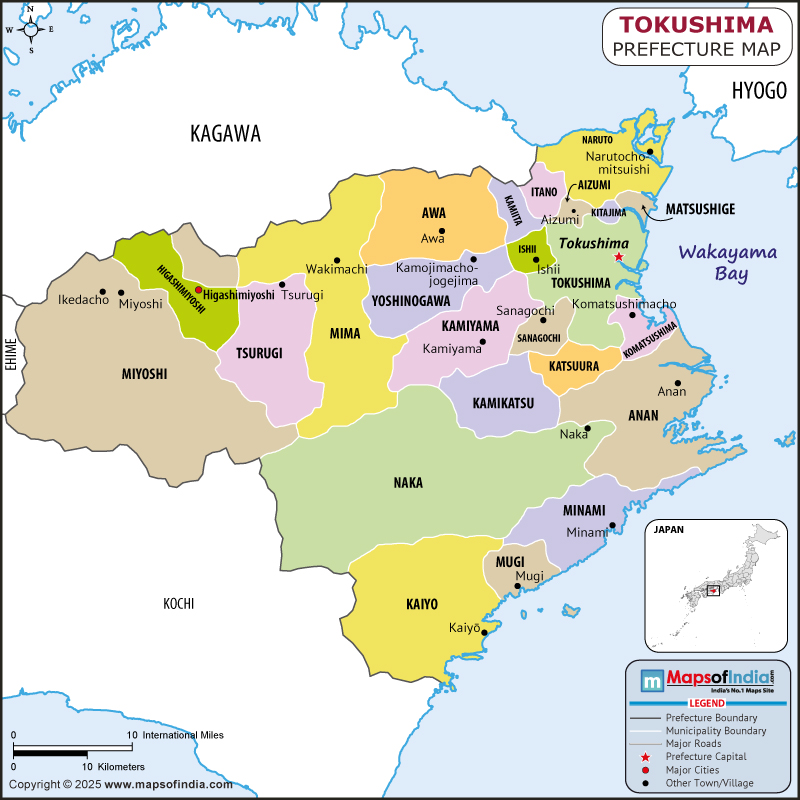



At the eastern side of the Shikoku Island, the Tokushima Prefecture is a part of Japan, merging natural landscapes of dramatic beauty with an ancient tradition and a very rich culture. Tokushima is an arguably impressive story of determination, creativity, and soul that is frequently sacrificed to the metropolitanism of ports. The Tokushima whirlpools add to the flight of dumb waiters are Naruto, and the Japanese dance rhythm of the Awa Odori adds to the whole, becoming Tokushima, the world where the harmony of nature and history fuses with each other.
The city of Tokushima (greater Tokushima is its capital city) is the cultural and administrative centre of the prefecture. It is bordered by Kagawa to the north, Ehime to the west, and Kochi to the southwest and is separated by the Kii Channel from Wakayama Prefecture in Honshu. The prefecture covers about 4,146 square kilometres, and this is where more than 680,000 people reside. In spite of a rather modest population, Tokushima has a rather rich background of experience to boast of, both the geographical diversity and historical importance.
History
Tokushima was historically called Awa Province, and the name of this province can be heard to this day in literary allusions like the Awa Odori festival. The historical development there is closely connected with the further development of the administrative system of Japan in general. Tokushima experienced a succession of territorial mergers and dismays since the Meiji Restoration in the late 19th century. It originally belonged to Myodo Prefecture but incorporated parts of Awaji Island and present-day Kagawa Prefecture, and eventually became Tokushima Prefecture in 1880. These approximations were Abolition cynical of the new Japan and its intervention in modernising and centralising the government at a very fast pace.
The history of Tokushima also has the contribution of the Shikoku pilgrimage, which is a sacred spiritual voyage composed of 88 Buddhist temples that surround the island. The pilgrimage is set to have been started in the 9th century by the monk, Kobo Daishi and has 24 temples in the prefecture. Not only has this tradition of spirituality had an effect on the religious life of this region, but it has also helped generate a sense of continuity and reverence that has made its way to the lives of the locals. Domestic and foreign pilgrims walk through the placid walks of Tokushima and come in contact with a history of devotion and soul-searching.
The other strength that Tokushima holds is the indigo dyeing industry, or the suku that is commonly referred to as sukumo in the area. The planting of indigo in the area can be traced to the Muromachi era (1336-1573) and the Edo and Meiji era, when the Hachisuka clan was generous in supporting the farming of indigo. The alluvial ground in the river Yoshino, which was replenished by seasonal floods, was worthy of growing the indigo plant.
The Tokushima Domain A Tokushima thrived throughout the Edo rule of the Hachisuka clan. The clan has been crucial in coming up with the infrastructure and economy of the area, especially by educating the indigo farming and the transporting of rice to different areas via the river, the Yoshino River. The construction of Tokushima Castle by Hachisuka Iemasa in the late 16th century became a symbol of the power of the clan, and today it is one of the historical sites. The castle grounds and museum, reconstructed in spite of the Meiji Restoration and World War II destruction, have a lot of information on the feudal period, despite the fact that most of the original structure was lost thanks to the events.
Culture
Perhaps the Tokushima area is seen as a culturally rich place due to the vibrant dance festival called the Awa Odori that takes place annually in August. Awa Odori is celebrated in the streets of Tokushima City as the place of a grand parade in which its history dates back more than 400 years. They perform together in well-synchronous yet jovial movements, singing with shamisen, taiko drums, flutes and dancers dressed in traditional costumes. It is also symbolised by the famous chant of the festival: The dancers are fools, the watchers are fools, so why not dance?. Although debate exists on the origins of Awa Odori, many suppose that Awa Odori started as a spontaneous celebration after the Tokushima Castle was finished in the late 16th century. The festival has more than one million visitors every year today making it a living witness of the cultural vibrancy of the region.
Toshiban Awa Odori is actually not the only part of the Japanese cultural landscape that has been enriched in Tokushima through the customs of the traditional crafted and gastronomic delicacies. The artistic sensibilities of the region are reflected in some of the small vessels through the ware named Ogota. Japanese handcrafted paper is called Awa Washi, and it is highly valued in terms of both durability and beauty, and purported to be used in calligraphy and ornamental arts, etc. Awa Sho-ai Shijira weave is a fine, creased, indigo-dyeing kind of textile that is a product of Tokushima, bridging the gap between practical and aesthetic. These artworks are not dead fossils of the past but are living traditions that are being perpetuated by local providers and cultural organisations.
The culture and farming of Tokyo also reflect the cultural richness and food richness of Tokushima. Soba-gome zosui, hearty se-wheat porridge, de komawashi, grilled skewer with local potatoes and soba dumplings, as but two of the other dishes that reveal the rustic side of the local taste. It is home to brand-name chicken, Awaodori, and a unique ramen that serves pork bone broth, soy sauce and sweet spicy pork toppings. A small citrus that is indigenous to Tokushima, Sudachi gives a fresh taste to various food varieties and is surrounded by a legendary reputation for its food multiplicative approach.
Besides, Tokushima boasts of celebrated festivals and crafts;s his cultural life is heavily informed by performing arts and storytelling. A type of puppet theatre, known as ningyo Joruri, that is accompanied by narrative chanting and shamisen music, survived in a rural setting in the town of Tokushima and the village of Kamikatsu. They tend to recreate stories about history, moral messages or personal myths and are performed in small venues that affect communal participation.
Language
In Tokushima, like in much of Japan, the focus of language is standard Japanese, but local dialects contribute a touch and a flavour to local communication. The Tokushima dialect belongs to the Shikoku dialect, and it contains some intonations and vocabulary peculiar to it that it does not share with the Tokyo standard. The dialect is not as popular as the Kansai and Tohoku dialects, yet it is an aspect part of the creation of the region. The attempts to protect and safeguard the native languages can be seen in community activities and in schools. In the case of non-Japanese speakers, Tokushima provides multilingual information via a prefectural government site, which, however, is subject to machine translation and might not be accurate. It is, however, open and welcoming to foreigners, particularly in cases of international events.
Geography
The extreme nature of the terrain and the picturesque landscape put Tokushima in its distinctive geographical perspective. About eighty per cent of the prefecture area is mountainous, with its landscape being controlled by the Shikoku Mountain. The second-highest mountain in Shikoku is called Tsurugi, and it is 1954 meters tall and is a good mountain top to be hiked by hikers and nature lovers. The mountain is located within the Tsurugi Quasi-National Park and has a shrine on it, which is reached through hiking trails and a chairlift. Mt. Smaller peak, Bizan, that serves Tokushima City, is a place with a panorama of the Seto Inland Sea and the separated island of Awaji. It is a favourite landmark whose soft hills and symbolic exclusion have found many mentions in other local melodies and literature.
One of the most isolated areas in the prefecture is the Iya Valley, which can be found in the western region of the prefecture. Iya Valley is known as having high gorges, vine bridges, and forest mist that are covered with mist that creates a feeling of antiqueness and confidentiality. One other strong representation of old craftwork and a relationship with nature is the Oku-Iya Niju Kazurabashi, which is a two-vine suspension bridge. Its rough topography and the small number of people have saved the valley from its clean natural environments, making it an eco-tourist and cultural alternative.
The climate of the prefecture would be the humid subtropical, and it has hot summers and cool winters. The greatest amount of rainfall is received during the June rainy season and the late summer typhoon. The situation is that snowfall is caused mostly in the mountainous Western climes, especially in places such as Miyoshi and Mima. It is located in an average annual temperature that is estimated to range from 17.6 degrees Celsius, which has added to a relatively warm and favourable climate. La Sylphide can embrace a number of agricultural activities such as planting of sweet potatoes, citrus fruits and indigo plants.
Tokushima is well-accessible in terms of infrastructure, although this area is mountainous. The prefecture boasts of a good fibre optic network and is home to the LED and pharmaceutical industries. The Tokushima Airport provides services to Tokyo and Fukuoka, and the Komatsushima Port to assist in international trading with other countries and style, like China, Korea, and Thailand. All these processes can be associated with the long-term aim of Tokushima to reconcile the sphere of tradition and innovation, and become the city of culture and a developmental region at the same time.
Quick Facts
| Official Name | Tokushima Prefecture |
| Area | 4,146.80 km² |
| Population | 682,439 (As of 2025) |
| Religion | Shinto and Buddhism |
| Language | Japanese |
FAQs
Q1: What makes Tokushima’s indigo dyeing tradition special?
Tokushima’s indigo dyeing, known as “Awa Ai,” uses natural fermentation techniques and locally grown indigo plants, producing rich hues prized across Japan.
Q2: Why is Tokushima the starting point of the Shikoku Pilgrimage?
The pilgrimage begins in Tokushima because it’s home to Temple No. 1, Ryōzen-ji, marking the spiritual gateway to the 88-temple journey.
Q3: What are the Naruto whirlpools, and when can they be seen?
The Naruto whirlpools are powerful tidal phenomena in the Naruto Strait, best viewed during spring tides when water flow is strongest.
Q4: What is unique about the Iya Valley’s vine bridges?
The Iya Valley’s Kazurabashi bridges are made from woven mountain vines and were historically used by locals to cross deep gorges.
Last Updated on: April 15, 2026

