


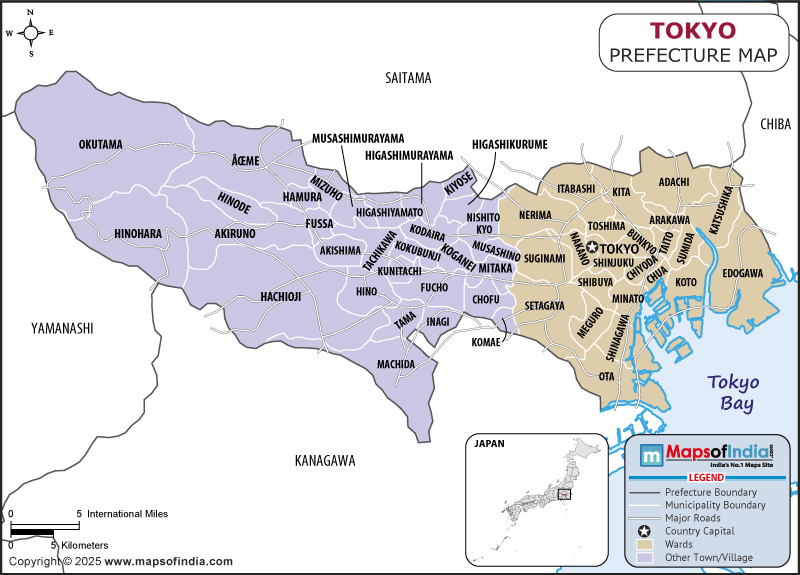



Tokyo is officially known as Tokyo Metropolis and is Japan’s bustling capital. It is home to more than 14 million people and stands as the world’s largest and the most densely populated urban area. Tokyo is the epicenter of Japan’s political, economic and cultural life which seamlessly blends cutting edge skyscrapers and vibrant business districts. It is situated at the head of Tokyo bay on Honshu island's central coast. There are 23 special wards Likely commuter towns and remote islands governed by a metropolitan administration rather than a traditional City Council. The neighborhood offers increasingly distinct experiences with the youth culture Ginza dazzles with luxury shopping and Asakusa reserves centuries old shrines and festivals. The public infrastructure in Tokyo is world renowned with a rail network and service system connecting every corner of the city and making travel efficient. From artistic heritage showcased and renowned museums to innovation in robotic and digital entertainment Tokyo is a city where tradition and futurism coexist. It offers visitors and residents alike an unparalleled journey through Japan’s living history and contemporary vibrance.
History
Tokyo has a remarkable history, merging from a humble fishing village named Edo into one of the world’s most influential global capitals. The evolution of the city has been shared by periods of transformation, disaster , innovation and recovery with each era leaving a distinct mark on the character identity. The area where Tokyo lies has supported human habitation since at least 5000 years ago as archaeological remains revealed. It's first mentioned in historical records and in the 12th century, a period when it was just a small settlement on the Musashi plain surrounded by marshes and rivers. The Edo clan established their seat here naming the settlement after themselves.
Edo’s strategic location by the Sumida River And Tokyo Bay laid the foundation for its eventual prominence. In 1457 the warlord Ota Dokan constructed Edo castle which became the nucleus of the city's political and military power. With the help of frequent feudal contact the area became a ground for warlords competing for influence.
A turning point arrived when Tokugawa leyasu after his victory at the battle of Sekigahara in 1600 chose Edo as his new headquarter. When leyasu assumed the title of Shogun in 1603 the city effectively became the seat of government and Tokugawa shogunate capital to the emperor continued to reside in Kyoto. Under Tokugawa rule the city flourished. Peace order and a strict social hierarchy defined life in Edo. The population exploded, exceeding 1,000,000 by the 18th century and making Edo the largest city in the world by 1720. it became a cultural hub home to kabuki theater and a vibrant merchant quarter.
The sankin kotai System required regional landlords to spend alternate years in Edo further stimulating urban growth. Despite several disasters such as the 1657 great fire of Meireki that killed over 1,00,000 people, civic resilience and reconstruction always followed which led to further development.
The long arrow of peace ended in the mid 19th century when Commodore Matthew Perry’s black ships forced Japan to open its port to foreign trade in 1853. This external pressure intensified internal conflict culminating in the Bosnian war and the fall of Tokugawa shogunate. In 1868 imperial power was restored and Edo was renamed Tokyo, meaning eastern capital. This symbolized the shift from Kyoto as an imperial seat. The emperor moved to Tokyo and the city became the heart of modernizing Japan.
During the subsequent Meiji era Tokyo underwent rapid westernization railways and telegraphs were installed, educational institutions were founded and the city’s administrative divisions were reorganized. As the capital of Japan, Tokyo attracted industry, government and intellectual life fueling swift urban expansion. Most of the modern transformation of Tokyo was repeatedly challenged by catastrophe, first of which the great kanto earthquake of 1923 devastated the city. Over 1,00,000 people died and much of Tokyo was left in ruins. The disaster however was the catalyst for planners to rebuild Tokyo with better infrastructure introducing its first subway system and modern amenities.
Not long after Tokyo was heavily damaged during World War II. Allied air raids, particularly the incendiary bombing of March 10 1945 obliterated a large section of the city and killed another 1,00,000 residents. By wars and over half of Tokyo's population had died or fled. After the surrender of Japan, Tokyo was occupied by the elite forces until 1952. The occupation area saw the implementation of political social and administrative reform including the establishment of 23 special wards that define central Tokyo to this day.
The post war decade was marked by extraordinary economic growth. Tokyo is a symbol of Japan's economic miracle transforming from ruin into a city known for efficiency innovation and sprawling Urban Development. Hosting the 1964 summer Olympic further accelerated infrastructure projects and solidified the status of Tokyo as a global metropolis. The city became interconnected by ever expanding subway train and Expressway network accommodating millions of commuters daily. By the 1980s Tokyo’s real estate and financial sectors were among the world’s most dynamic.
Tokyo’s ascent was tempered by the 1990s lost decade when Japan’s economic bubble burst causing stagnation and financial crisis. Despite this, Tokyo continued to expand and influence, boasting a population of over 13 million in the city proper and more than 37 million in the metropolitan area by 2018 making it the world’s largest metropolis. Recent years brought new challenges like COVID-19 pandemic which impacted daily life and forced the 2020 Olympics to be scaled back. Yet Tokyo has persisted as a center of commerce technology and popular culture blending ultra modern innovation with deep historical tradition.
Culture
The culture of Tokyo is rich and is woven from timeless tradition, cutting edge creativity and vibrant urban life. The city harmoniously balances ceremonial custom with a modern pulse. It offers a unique blend of historical heritage and contemporary dynamism. Festivals like the kanda matsuri and mukuru festival bring centuries old tradition to life featuring parades, music, dance and the spectacle of portable shrines which transform the local St. into lively communal spaces. This reveals the city’s deep roots in Buddhist tradition. The neighborhood's cultural contrast in asakusa, the aromatic sensoji temple and rows of lanterns echoes Japan’s spiritual core while shibuya and harajuku are epicenters for youthful fashion anime pop art avant-garde trends. Partitions and workshops connect visitors to philosophy of imperfection and calligraphy celebrating craftsmanship handed down for generations. At the same time interactive digital art installations reflect Tokyo's embrace of innovation and sensory engagement. It draws millions who seek immersive experiences. Gastronomy is both heritage and frontier with Michelin star restaurants and street food market Tokyo is recognized as a culinary capital. It sets a trend that ripples the world. The culture of Tokyo is a living dialogue between past and future where spiritual practices, creative subculture and transformative experiences shape the daily rhythm of the cosmopolitan community.
Language
The primary language spoken in Tokyo is Japanese with the local dialect known as Tokyo Ben forming the basis for modern standard Japanese nationwide. Tokyo Ben is considered neutral and very formal especially when compared to other regional dialects across Japan. While most daily conversation officials image and media are in Japanese the cosmopolitan character of Tokyo means English is widely understood in business tourism major hotel and restaurant particularly in central district frequented by international visitor first of many science and public places transportation system and airport offer multilingual translations including Chinese, Korean and increasingly Southeast Asian languages to accommodate the diverse visitors. In expatriate communities English and other international languages are used more frequently which enable foreign residents and business travelers to communicate with ease. Schools in Tokyo provide English education translation services for non Japanese speakers. Despite the multilingual accessibility Japanese culture values polite communication so even simple greetings in Japan are greatly appreciated and fostered a deep connection with locals.
Geography
The geography of Tokyo is as dynamic as the urban life situated at the head of Tokyo Bay on the Kanto plain in Honshu. It has an area of about 2194 square kilometers and is bordered by Saitama, Chiba, Yamanashi and Kanagawa prefectures. The Pacific Ocean lies to the southeast of Tokyo. There are 23 special wards at the core which form the highly urbanized metropolitan center surrounded by suburban districts. The landscape is predominantly low lying with generally undulating hills and rivers like Sumida and Tama which weave through the neighborhood while western Tokyo rises towards the forested mountains that offer escape into nature. Tokyo’s proximity to water shapes the harbour and influences the humid subtropical climate changed by warm summer mild winter and frequent rainfall. Despite the dense population and vertical expansion the city maintains green spaces which provide a vital pocket of tranquility amid the urban density. It contributes to the reputation of Tokyo as a city of both relentless energy and peaceful retreat.
Quick Facts
| Official Name | Tokyo Metropolis |
| Area | 2194 km² |
| Population | 14254039 |
| Location | Head of Tokyo Bay |
| Language | Japanese |
FAQs
Q1: When did Tokyo host the Summer Olympics?
Tokyo was the first Asian city to host Summer Olympics and Paralympics in 1964 and then in 2021.
Q2: What is the climate of Tokyo?
Tokyo has a humid subtropical climate with hot, humid summers and mild to cool winters.
Q3: Which species are found in Tokyo?
One may find Japanese macaque, red-crowned crane, Japanese giant salamander, sika deer, Japanese marten, Japanese serow, Japanese spider crab, Japanese raccoon dog (tanuki), crested kingfisher, Japanese pond frog, Japanese bobtail squid, Japanese grass lizard, tanuki, Japanese marten, red fox, Japanese rat snake, and Japanese forest rat snake in Tokyo.
Last Updated on: June 22, 2026

