


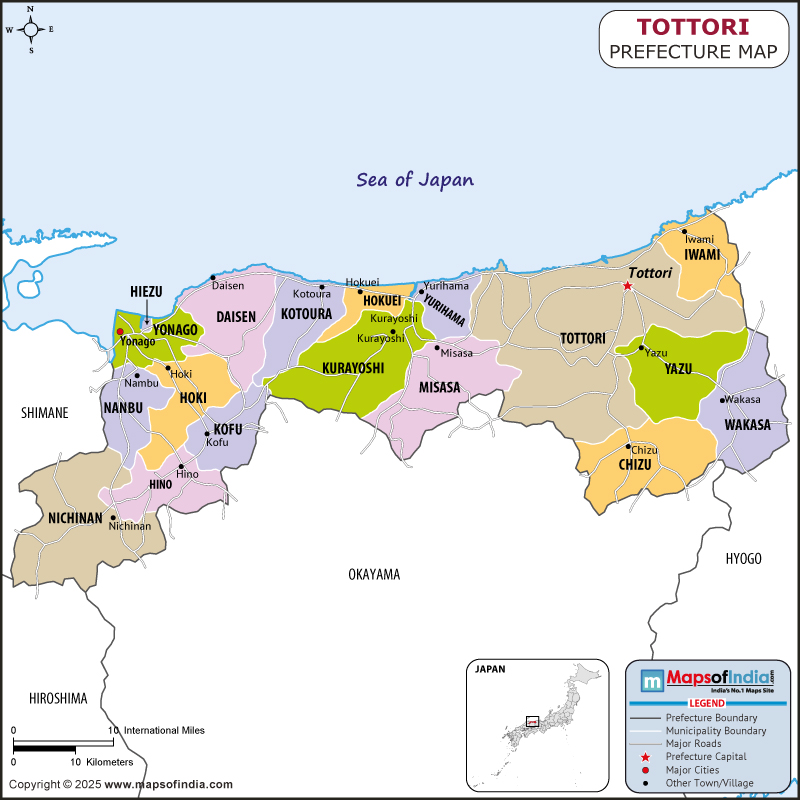



One of the most unique but lesser-known parts of Japan, Tottori Prefecture is located in the Chugoku region of the western Honshu region by the Sea of Japan. It is the 41st biggest among the 47 prefectures of the country of Japan in terms of its total area of 3,507 square kilometres. However, it is the sparsely populated prefecture in the country with the smallest amount of land, about 208,000 square kilometres, which contains its population of slightly over half a million persons, as of 2023. Its capital is the city of Tottori, and additional cities of great significance are the cities of Yonago, Kurayoshi as well and Sakaiminato. Tottori is most favoured by her natural beauty, specifically the Tottori Sand Dunes, which is the largest dune network in Japan and the highest mountain situated just inside the Chugoku mountain called Daisen mountain.
History
The Tottori Prefecture has its history dating back to the earliest times of human settlement of humans in Japan. It was archaeologically proven that the area was also inhabited in the period of the Jomon (14,000-300 BCE), as many artefacts and remains were found throughout the prefecture. The following Jason period (300 BCE-250 CE) saw the emergence of one of the largest known settlements of the time within the foothills of the Daisen mountain; the Mukibanda Yayoi site was founded by this time. This location, which spans over 170 hectares, demonstrates a society which was complex and practised the rice trade and advances in metallurgy.
Tottori was also influenced by the Kofun period (250-538 CE), as there were numerous burial mounds all over the area. Such tumuli show the accumulating strength of local chieftains and how they became a part of the larger Yamato state. By the Nara and Heian periods, Tottori had been part of the provinces of Inaba and Hoki, which essentially comprise the modern prefecture.
The mythology of Tottori is very much related to the earlier writings in Japan. In the earliest surviving collection, the Kojiki (and the first to be compiled) in 712, there is the famous story of the "White Hare of Inaba " in what is now eastern Tottori. It is the legend of a hare wounded by crocodiles (or sharks), but which was healed afterwards, by the god Okuninushi, who won the trust of a princess. This myth is entrenched at Hakuto Shrine, and it is one of the most common pilgrimage sites.
Tottori is a region that was extremely disputed during the period of direction towards the Sea of Japan, and as a result of its strategic positioning as a pebble sea. Throughout the duration of the Muromachi the Yamana clan had ruled a large portion of the region before transforming into a fighting field between the Mori clan and the Oda clan in the Sengoku period. The Siege of Tottori Castle in 1581, in which the defenders of the castle were besieged by a bloodthirsty campaign led by the instructions of Oda Nobunaga, who ordered soldiers to starve them, became one of the most famous sieges.
During the Edo age, Tottori was placed under the rule of the clan, the Ikeda clan, who ruled Tottori Domain at the Castle of Tottori. The Ikeda family stayed in power till 1868, with the Meiji Restoration, followed, the feudal system and the modern prefecture system was established. In the year 1888, Tottori Prefecture was formally established, the one that was composed of the old provinces of Inaba and Hoki.
The modern world came with its problems and evolution. Tottori was greatly damaged during World War 2, especially following air attacks in 1945. The Tottori earthquake hit Tottori City in 1943 and killed more than a thousand workers, as well as the destruction of most buildings in the city. The prefecture, however, received a boost with reconstruction after the war, coupled with investments in agriculture as well as forestry and light industry. Tottori is today balancing its past with the present economics and cultural life.
Culture
The culture of Tottori is a fusion of local performing arts, religious traditions, as well as ancient mythology. The most distinct cultural sites are actually the buildings of Mitokusan Sanbutsu-ji Temple, which was established in 706 by an ascetic known as En no Ozunu. It features its Nageire-do Hall, which is considered to be the most dangerous national heritage in Japan, being legendarily located on a cliffside escarpment that may only be accessed through a very steep climb. The temple is connected to Shugendo, which is a syncretic religion, a confluence of Shinto, Buddhism and honouring the mountain.
There are also unique festivals and performing arts, which can be found in the prefecture. Kirinjishi or Lion Dance is a ritualistic performance whereby the dancers adorn the costume of a lion in order to drive off evil and create fortune. This is that dance, unique to Tottori, that is connected to folk elements.
The mythology still forms the cultural identity of Tottori. Inaba and Hakuto Shrine are not the only places where the White Hare is celebrated, but also in the literature and local festivals. The novel has emerged as a beacon of goodness, strength, and heavenly goodness.
Modern-wise, Tottori is known for giving birth to some voting manga artists. Shigeru Mizuki (the creator of GeGeGe no Kitaro) was born in Sakaiminato. The Mizuki Shigeru Road is located with bronze statues of characters in his yokai (spirit) series. Another producer of Detective Conan is the creator Gosho Aoyama, who was born in Tottori, and his work is commemorated by the Gosho Aoyama Manga Factory museum in the prefecture. It is these cultural exports that have brought the culture in Tottori a distinct identity in the modern pop culture of Japan.
Another significant feature of the culture is the cuisine of Tottori. The Nijisseiki pears that are crispy and juicy are also known to be famous in the prefecture, having left a significant mark on the region. Seafood also forms the centre point, and snow crab (Matsuba crab) is a winter special. The plains are used to yield rice, and the mountains yield wild vegetables and wild game. These factors combine to form a cuisine that is a representation of the land and the sea.
Language
In Tottori, the Japanese language shows its geographical exclusivity and historical progression. The main dialects in use are derived from of San'in dialect and form part of the larger Chugoku dialect. There exist differences in the dialect of Tottori, with the Inshu dialect (used in the eastern section, which represents what was formerly the Inaba Province), a Kurayoshi dialect in the middle section, and a West Hoki dialect in the western section.
Geography
Tottori Prefecture covers an elongated and narrow geographical area estimated to be 125 kilometres along the coast of the Sea of Japan. It borders Shimane Prefecture in the West, Hiroshima in the southwest, Okinawa in the south and Hyogo in the east. The land of the prefecture is heterogeneous, which includes plains of the coast to mountainous areas.
The north of Tottori is opposite the Sea of Japan and is surrounded by sandy beaches, fishing ports, and is well known with the Tottori Sand Dunes. These dunes are the most massive dunes in Japan and attract a high number of visitors to the beach, due to their area, which stretches about 16 kilometres along the coastline. The dunes are remodelled due to wind movement and are formed by the Shikoku Mountains carried downslope during the course of thousands of years, combined with a river named the Sendai River. Not only is it a natural wonder, but also a cultural heritage, visiting which tempts literary works, art, and rides on camels.
The Chugoku mountains cover the inland. The highest mountain in the region, with a height of 1,729 meters, is Mount Daisen, which is a sacred mountain of Shinto as well as Buddhism. One of the attractions to hikers, pilgrims and also skiers, it is a component of Daisen-Oki National Park. Dairy farming is also an activity that is sustained by the volcanic, fertile soil of the mountain; hence, Tottori is a major producer of milk and dairy products within western Japan.
Tottori Greens are also noteworthy sea shores. The Sea of Japan is a treasured fishing ground, and such places as Sakaiminoto are considered very important ports within the fishing industry. Specifically, Sakaiminato is one of the most successful ports of crab, tuna, and seafood landing in Japan. The interaction of the sea and the mountains has contributed to the economy, as well as the cultural identity of the prefecture, cuisine, festivals, and folklore of which are closely interwoven with the natural environment.
The isolation with respect to its development is also influenced by the fact that the prefecture was rather separate. In lieu of an adjacent Okayama that opens to the Seto inland sea and has long been a transportation centre, the mountainous topography of Tottori and its place on the sea of Japan traditionally restricted its links to the traditions of the interior of Japan. This spatial aspect is one of the reasons for maintaining a small population alongside a slower rate of industrial development than the other prefectures. Nevertheless, it has become more accessible due to a modern infrastructure (San'in Main Line train and highways), and Yonago Kitaro Airport and Tottori Airport make the region accessible to Tokyo and other large metropolitan areas.
Quick Facts
| Official Name | Tottori Prefecture |
| Area | 3,507.13 km² |
| Population | 538,525 (As of 2023) |
| Religion | Shinto and Buddhism |
| Language | Japanese |
FAQs
Q1: Why is Tottori famous for sand dunes?
Tottori is home to the Tottori Sand Dunes, Japan’s largest dune system, formed over thousands of years by sediment from the Sendai River and reshaped by coastal winds.
Q2: What is the significance of the White Hare of Inaba myth?
The White Hare of Inaba is an ancient legend set in Tottori that symbolises kindness and divine favour, and it remains central to the region’s cultural identity.
Q3: Which mountain is considered sacred in Tottori?
Mount Daisen, the highest peak in the Chūgoku region, is revered in both Shinto and Buddhism and is a major site for hiking, skiing, and pilgrimage.
Q4: Why is Tottori called Japan’s “manga kingdom”?
The prefecture is the birthplace of famous manga artists like Shigeru Mizuki and Gosho Aoyama, celebrated through museums and character-themed attractions.
Last Updated on: April 15, 2026

