


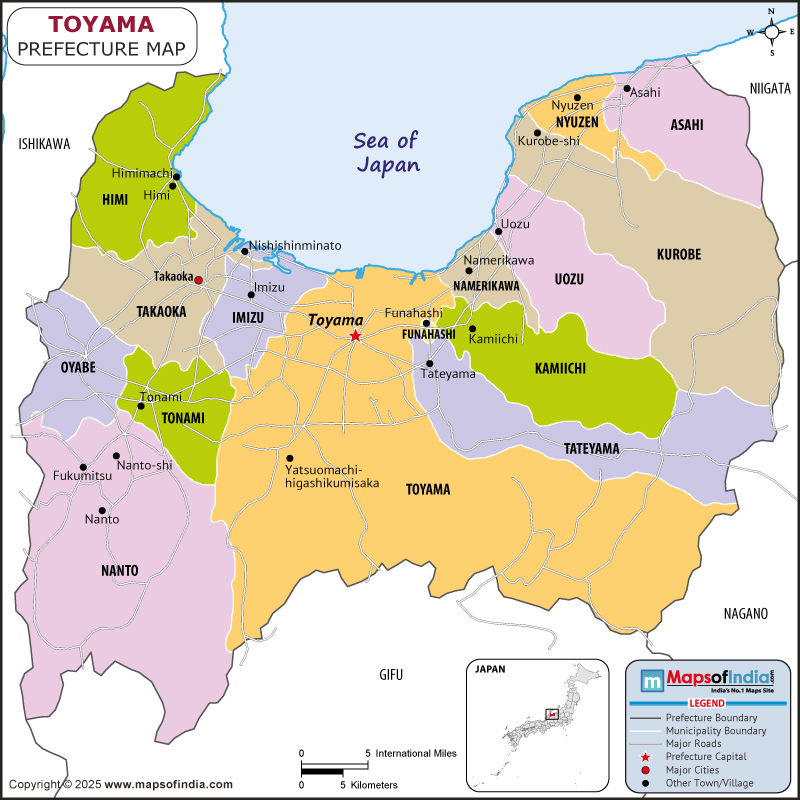



Toyama is one of the most beautiful prefectures located in Japan's Chubu area, bordering the Sea of Japan and surrounded by enormous mountains. Toyama is renowned for its natural landscape, cultural heritage, and hospitality of the locals. The prefecture is harmoniously combining the modern way of living and respect for the past and nature. Toyama has existed as a region of trading, culture, and local business, which influenced the lifestyle of its residents. Today, Toyama invites visitors to its breathtaking landscapes, hot springs, traditional festivals, and local cuisine.
History
The history of Toyama in Japan is primarily connected with its geographical position in the centre of the sea and mountains. People never migrated as the area is enriched with resources. Archaeologists are of the opinion that early people settled along coastal areas close to rivers and seashores where they hunted, fished, and grew rice. Cultivation of rice rose tremendously in Toyama because of the clean water flowing from the Tateyama Mountain Range. Soon enough, agriculture started to impact daily life and culture among people of this region.
In the Heian and Nara eras, Toyama was affiliated with the Kyoto court. Trade routes gave the Toyama people the tools to barter rice, fish, and handicrafts with other individuals. Culture and traditions from the capital also flowed into Toyama at this time, affecting its festivals, music, and local religion. The geographical location of Toyama placed it at a crossroads, although it was distant from the political capital.
During feudal times, Toyama was ruled by influential clans. Castles were constructed to guard the area and secure important trade routes. Among the most famous is Toyama Castle, which remains today as a testament to history in the area. Castles were not only fortresses but also were the centres of culture where art, craftsmanship, and scholarship were nurtured. Toyama society during those periods was governed by compliance with the ruling families, agricultural traditions, and community closeness.
There is also a unique feature of Toyama's past relating to medicine. As early as the Edo era, Toyama was renowned throughout all of Japan for the production of traditional medicine. Toyama traders would enter other areas selling tiny packets of medicine and gaining the trust of local people. This is known as the "Toyama medicine trade" and is now a valued tradition. It enabled Toyama to achieve respect and make connections with individuals in distant locations.
The Meiji period brought change to Toyama, as it did to the rest of Japan. The government modernized, and Toyama gained fame for metal work, glass making, and other crafts. The rail transportation system also linked the prefecture to Tokyo and other big cities and facilitated travelling and trading. Farming and fishing were still prevalent despite modernisation in keeping the family in the region.
Toyama also had difficult times in the recent past. Toyama city was heavily bombed in 1945 during World War II, and it was ruined. The people remade the city with strength and perseverance. Toyama was a post-war modern city but kept its history. Today, Toyama is known best for its strength and respect for its history.
Culture
The Toyama culture of Japan developed from its land, tradition, and history. Toyama citizens live between seas and mountains. Festivals, food, handicraft, and customs are nature and season influenced. Toyama citizens possess communal life, respect for customs, and simple things achieved through effort and family.
Perhaps the most famous aspect of Toyama culture is its tradition of medicine. Toyama merchants travelled for centuries peddling bundles of traditional medicine throughout Japan. The merchants instilled the trust of families by calling on them at home and leaving them medicine prepaid later. This instilled a culture of compassion and integrity, and Toyama remains thought of in Japan as a hub of health and medicine.
Festivals are also a highlight in Toyama culture. One of the best is Owara Kaze no Bon. It is held every September in the Yatsuo district of Toyama city. Gradually, straw-hat dancers move to the pace of shamisen and folk music. The festival is performed to pray against storms and for a good harvest.
Food plays an important role in culture, too. Because Toyama is situated with the Sea of Japan facing it, seafood is the main attraction. Toyama Bay is referred to as a "natural fish tank" because it is a prolific catching ground. Spring firefly squid and winter yellowtail are special delicacies. Toyama sushi is also extremely popular throughout Japan. In addition to this, rice cultivation in the extensive plains has provided the area with some of the finest sake in Japan. Sharing fresh food and beverages is a daily norm and unites people.
The second treasure of Toyama is traditional handicraft. Metalware, glassware, and lacquerware are the specialities of this place. Takaoka city has been producing copperware for centuries, and its statues and bells are found throughout Japan. Contemporary glasscraft is also in vogue, and now Toyama is reputed as the "city of glass." This kind of craft depicts how the people of Toyama admire skill and beauty equally.
Nature too is involved in cultural existence. Tateyama Mountain Range is holy, and the people have gone there to worship and seek meditation in the mountains for centuries. Sea, rivers, and mountains are not just resources but metaphors in the narratives, songs, and images of the area. Nature is highly revered in Toyama's culture.
Even now, Toyama combines modern life and tradition. Children participate in traditional festivals, families toil on farms, and artisans continue their craft. At the same time, new art forms, music, and cultural pursuits are emerging. This balance allows Toyama's culture to remain alive and hospitable.
The Toyama culture is simple yet deep. It reflects the way human beings relate to nature, believe in honesty, and honour history. From festival tunes to just-landed seafood flavour, and from the beauty of handicrafts to holy mountains, the Toyama culture is a vibrant element of Japan's heritage.
Language
The official language spoken in Toyama is Japanese. But the locals also have regional dialects of their own which provide the region with a distinct flavour. The Toyama dialect contains its own words and pronunciation which differ from standard Japanese. Though young adults can use standard Japanese at the workplace or school, locals still use their regional dialect at home or if they are hanging out with friends.
Since Toyama is becoming a destination for an increasing number of tourists from all over the globe, English is also increasingly found at tourist sites, hotels, and in public transport. Town entrances and signs at prime destinations are mostly both Japanese and English, which is very useful to visitors. Yet, the welcoming nature of people assures that communication remains courteous even when one is bad at Japanese language.
Language in Toyama is not only words. It also conveys the culture, history, and lifestyle of the locals. The dialect shows how the people used to live near the mountains and sea, which influenced expressions peculiar to the area.
Geography
The geography of Japan's Toyama is determined by mountains as much as it is determined by the sea. Toyama is situated on the northern coast of Honshu, and it opens up to the Sea of Japan while it has high mountain ranges on the other side. This type of situation provides the area with fertile land as well as abundant water, and in Toyama, nature heavily impacts an individual's daily routine.
In the middle of Toyama lies the Toyama Plain, where the majority of inhabitants reside. The plain is broad and cultivated and was created by rivers like the Jinzu, Sho, and Kurobe. The rivers provide water from the mountains to the ocean, providing support for agriculture and daily life. The plain is said to be one of Japan's finest rice-farming locations, and it contains a number of villages and towns. The plain terrain also facilitates transportation and commerce, linking the coastal regions to inland routes.
To the west lies Toyama Bay which drains into the Sea of Japan. The bay is occasionally referred to as a "natural fish tank" due to its dense marine biodiversity. Its depth accommodates numerous species of squid and fish. The sea provides Toyama fishermen with yellowtail, white shrimp, and firefly squid, among others, that are in high demand nationwide. The sea is also economically valuable as Toyama has utilised its coastal location for long years to engage in trade with other areas.
Toyama also has valleys, hot springs, and forests in its geography. The Kurobe Gorge is a popular tourist attraction, with deep valleys and clean rivers lined with green during summer and colours during autumn. Most tourists visit it through the Kurobe Gorge Railway to witness its splendour. Forests cover enormous parts of the mountains and give wood and clean air to the area. Hot springs are found in many places, and they offer relaxation and a bridge between nature and humanity.
Toyama's weather is actually influenced by its geography. The winters are snowy, particularly along the mountains and central region. The heavy snows give Toyama some of the country's highest snowfall in the nation. The summers are steamy and hot and make the plains green and fertile. The contrast between seasons is extreme, and the inhabitants have regulated their existence according to the climate.
Quick Facts
| Official Name | Toyama Prefecture |
| Area | 1242 km² |
| Population | Approximately 1,020,000 |
| Currency | Japanese Yen (JPY) |
| Religion | Shinto and Buddhism (major), Christianity and others (minor) |
| Language | Japanese (official), local dialects also spoken |
FAQs
Q1: What is Toyama known for?
Toyama is known for fresh seafood from Toyama Bay, traditional medicine business, the Tateyama Kurobe Alpine Route, and exquisite crafts such as copperware and glasswork
Q2: What are the chief festivals of Toyama?
The most popular one is the Owara Kaze no Bon festival in Yatsuo. It is an elegant dance festival in September to pray for good harvests and storm protection.
Q3: Is Toyama suitable for agriculture?
Yes, there are broad plains and fertile land, so Toyama is one of Japan's finest rice-growing areas.
Last Updated on: April 15, 2026

