


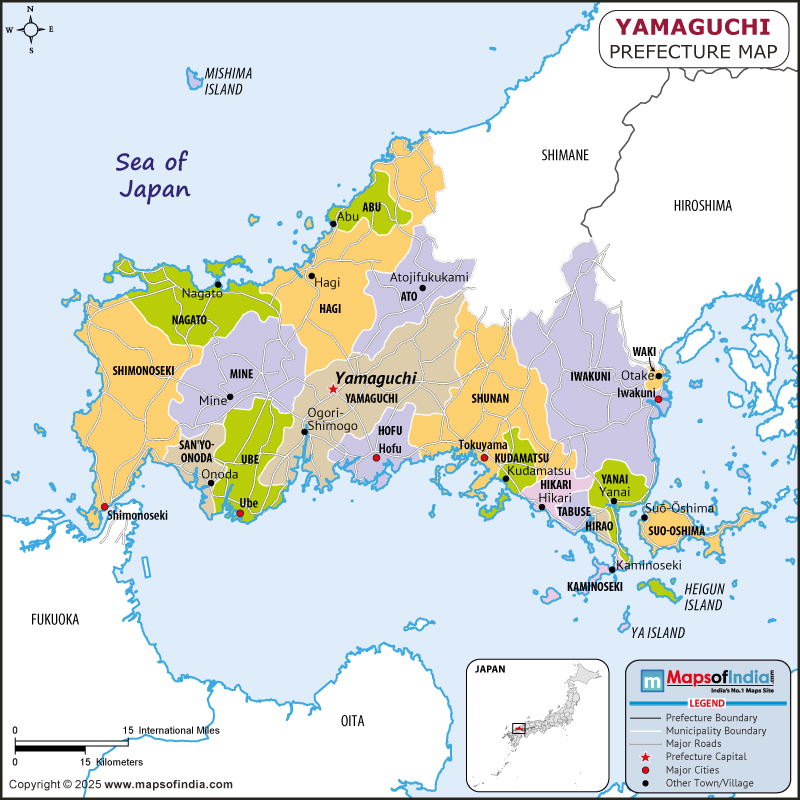



Yamaguchi prefecture is located in the western externality of Honshu Japan and is known for its scenic landscape and historical significance under cultural influence dating back centuries. It is known as the Kyoto of the West and not only has elegant temple and lush gardens which echo its prosperous past but also celebrates deep connection to the important event in Japanese history.The tranquil ambiance enriched by natural wonders and celebrated Hot Spring district sets it apart as a region blending tradition with legacy of modernization. The synthesis of ancient heritage architectural ingenuity and influential figures make it a unique destination. It is a place where the winds of history and culture meet.
History
The origin of Yamaguchi traces to the merger of the ancient provinces of Suō and Nagato. The Heian and Kamakura periods witnessed the emergence of powerful warrior families notably the Ouchi family in Suō and Koto family in Nagato. During the Muromachi era Ouchi Hiroyo consolidated over both provinces, initiating city planning inspired by Kyoto’s refinement. This foresight transformed Yamaguchi into a well organized and beautiful town with structures and streets designed to mirror the cultural sophistication of the imperial city.
Ouchi Hiroyo descendants expanded their influence and reached Yamaguchi through cultural imports and robust trade with Korea and Ming dynasty China. Their reach led Yamaguchi to be recognized as Japan’s most prosperous cities and a hub of art, religion and international exchange first of the cultural assets like ruri Koji temples 5 story pagoda and significant shrines stand at the reminder of the golden age.
Known as the Kyoto of the West, Yamaguchi thrived from the 14 to 16 century drawing scholars and aristocrats fleeing Kyoto’s turmoil during the Onin war. Intellectuals and missionaries found refuge spurring a flourishing era for art and spiritual pursuit. Christianity made early inroads here with missionaries from Spain and Portugal welcomed by the Ouchi clan who valued innovation and cultural integration. The city’s reputation even garnered praise from figures as prominent as Francis Xavier who deemed it the most advanced town in Japan at that time.
A period of internal conflict saw the destruction of the Ouchi Family betrayed by retainers who coveted powerful sub controls shifted to the Modi family notable feudal Lords who after losing extensive land post Sekigahara battle in 1600 retreated to Suō and Nagato centred at Hagi. Despite the decline in the broader influence this drove to strengthen the local economy with initiatives like the three whites campaign focusing on salt rice and paper production.
Throughout the Edo period Yamaguchi became a somewhat secluded, quiet mountain town while Hagi acted as the domain's political seat. However the remoteness of Hagi eventually led to the Choshu clan to relocate administrative offices to Yamaguchi, setting the stage for its emergence as a strategic hub.
The pivotal role of Yamaguchi in the Meiji restoration cannot be overstated. Visionary leaders hailed from the region inspired an innovative movement and catalyzed the downfall of the tokugawa shogunate. The city and its intellectuals were instrumental in reshaping the governance in Japan's sparking modernizing reform which resonated nationwide.
After the major governments' establishment modern yamaguchi prefecture took shape. New socioeconomic systems were introduced fostering industry while agriculture remained important for decades. The advent of Taisho. Shop shipbuilding chemical machinery and metal working industries flourish in harbour towns such as the seto inland sea. After World War II, Yamaguchi developed major petrochemical complexes, helping it become one of Japan's most industrialized prefectures.
Yamaguchi remains a cultural and academic nucleus home to significant historic structures and Rurikoji Temple shrines such as Imahachimangu and FurukumaThe remnants of aristocratic grandeur and memorials of the major restoration. The enduring legacy of samurai clan reformist thinkers and artisans is woven into the city’s model landscape.
Natural attraction harmoniously blended with centuries old architecture from sprawling gardens to the tranquil Chomonkyo canyon And ancient Hot Springs at Yuda onsen Cherished for over 800 years. Culinary tradition, local festivals and handicraft preserve the identity of Yamaguchi as a place where both ancient and contemporary Japanese culture thrives.
From a strategic bulwark during the samurai's ascendancy to the engine of industrial and intellectual progress Yamaguchi has continually shaped the historical trajectory of Japan. Its cultural asset rich legacy of transformation and lasting influence on the country’s modernization underscores why Yamaguchi remains an important source of fascination and reverence in Japan.
Culture
Yamaguchi culture reflects a rich blend of historic aristocratic influence resilient local tradition and profound appreciation for natural beauty and craftsmanship. Often known as the Kyoto of the West, Yamaguchi cultural identity is both elegant and deeply rooted in the customs developed by the prominent clans and the ordinary residents over centuries.
The cultural foundation established during the rule of the Ouchi clan modeled the city after Kyoto and imported many aspects of courtly aesthetics. Distinctive festivals like the 600 year old Yamaguchi Gion festival inspired by Kyoto’s famous Gion matsuri showcases the aristocratic flavor.
Traditional rituals like the dance of the hidden ritual commemorate the city’s deep spiritual ties. The Tanabata Lantern festival illuminates Yamaguchi streets every August with thousands of bamboo lanterns, a custom dating back centuries. These events unite communities and keep ancient rituals alive in the modern era.
Yamaguchi is celebrated for the vibrant folk tradition and performing art that remain an important component of the local identity. notable examples include heike odori, a somber dance passed down since the era of the Heike clan to honor ancestors who perished in the battle. Kagura, a sacred Shinto performance featuring narrative music and elaborate customs, is regularly held at local shrines and the festival maintains continuity with the prefecture's spiritual heritage. Other art forms include puppet theatre and comic plays which highlight the creativity and the variety of traditional culture in Yamaguchi.
The coastal environment and the agricultural abundance has fostered unique culinary customs. Dishes like the puffer fish sashimi from shimonoseki are known throughout Japan with the area historically responsible for lifting the national ban on fugu consumption in the late 19th century. Local samurai culture also inspired the luxurious dishes such as the pressed Iwakuni sushi and elaborate stews like itoko-ni, while sweets like Hagi’s natsumikan-gashi and yamaguchi styled uiro remain additionally treasured flavors. Many specialties are associated with rituals, seasonal events and temple life which symbolize the interconnected culinary and spiritual heritage of Yamaguchi.
Centuries of artistic patronage by feudal lords fostered the distinctive handicraft including Hagiyaki pottery, one of Japan's most esteemed ceramic traditions. The art in the region extends to paper making carpentry and textile work with many Craftsmen keeping ancient techniques alive. These crafts are often displayed in local museums and at annual fairs which serve as a lasting symbol of Yamaguchi's artistry and communal pride.
Temples and shrines serve as community centres anchoring the Temples and shrines serve as community centres anchoring the regions social and religious activities. Annual festivals draw residents together creating a strong sense of local identity. The tradition of celebrating nature and honouring ancestors underscores daily life and both Buddhist and Shinto influences are woven into the rhythms of seasonal observances and gastronomy.
Language
The main language spoken in Yamaguchi prefecture is Japanese with a distinct local variety known as the Yamaguchi dialect or Chōshū-ben. The dialect is considered part of the Chūgoku dialect group which spans much of the western Honshu. The Yamaguchi dialect features some differences in vocabulary and grammar from standard Japanese most notably the use of “ja” as a copula instead of “da” and special sentence endings like “ken” instead of “kara” for “because”. The progressive and perfect aspects in verbs are expressed with “-yoru” and “-toru”/” -choru” respectively.
Pitch accent in Yamaguchi is generally close to that of standard (Tokyo) Japanese, though everyday speech reveals regional variations that can be challenging for outsiders. Certain phrases are unique to the area such as “Oidemase” meaning “welcome”. While major towns like Iwakuni have some English or Korean due to foreign communities, rural areas mainly use only the Yamaguchi dialect, highlighting the locality’s strong linguistic heritage.
Geography
Yamaguchi prefecture is located at the western tip of Honshu in the Chūgoku region, is bordered by the sea on three sides: the Sea of Japan to the north, the Seto inland sea to the south, and the Kanmon straits separating it from Kyushu to the west. Its coastline stretches for approximately 1500 kilometres and features over 240 scattered islands providing a vivid contrast between the gentle Seto Inland Sea shores and the rugged eroded coastline facing the sea of Japan.
The prefecture is traversed by the western Chugoku mountain range running east west which results in diverse topography with mountain hills and valleys. Notably forests occupy about 70% of Yamaguchi land area and the region is famous for Akiyoshidai Japan's largest karst plateau known for striking limestone landscape and the vast Akiyoshido Cave system.
Yamaguchi can be divided into three geographic zones: The seto inland sea coastal zone marked by urbanized cities and ports such as Shimonoseki, Ube and Iwakuni, the mountain zone lush and forested home to scenic spots and fertile agricultural valleys, and the sea of Japan coast with dramatic sea cliffs, fishing villages and smaller towns.
With a mild climate and relatively low risk of earthquakes or storms, Yamaguchi offers pleasant living conditions and supports robust agriculture, fishing and heavy industry concentrated along its coasts. The natural beauty of Yamaguchi, including its beaches, islands, karst plateau, and national parks-anchor its reputation as one of Japan's most scenic and diverse regions.
Quick Facts
| Official Name | Yamaguchi |
| Location | Western tip of Honshu |
| Area | 1023.23 km² |
| Population | 191, 470 |
| Language | Yamaguchi dialect |
FAQs
Q1: What is the climate of Yamaguchi?
Yamaguchi has a humid subtropical climate characterised by hot, humid summers and mild winters.
Q2: When is the best time to visit for cherry blossoms?
The time to visit for cherry blossoms is spring. Many temples and historical sites also provide beautiful sakura views.
Last Updated on: April 15, 2026

