


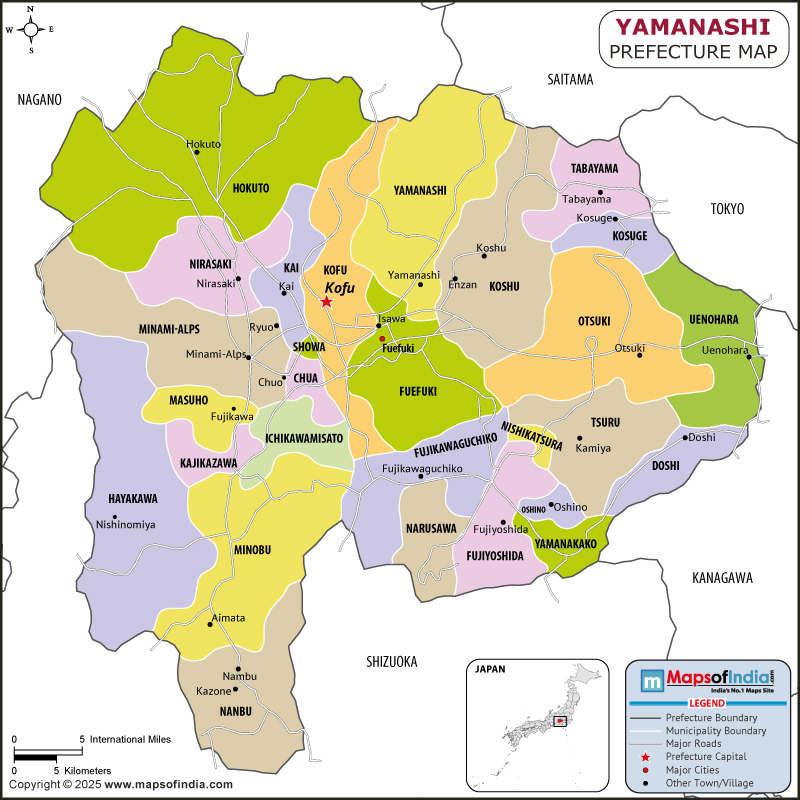



Deep in the core of Honshu, the largest of the mountainous Japanese islands, the Yamanashi Prefecture is a confined area whose mountain scenery embraces brave cliffs, plentiful basins and rich cultural roots. Yamanashi is a part of the Chubu region and more particularly the Koshin'etsu region with Tokyo, Saitama, Nagano, Shizuoka, and Kanagawa as its neighbours to the east, northeast, northwest, southwest, and southeast, respectively. Its capital, Kofu, is in the central Kofu basin in the fertile plain that is surrounded by the great peaks, including the popular Fuji mountain that stands on the border between Yamanashi and Shizuoka.
Yamanashi is a prefecture among the eight Japanese prefectures that have no coastline, but the natural beauty is undeniable. Approximately one-fourth of the total area of this country is defined as a Natural Park, self-reliant of clean forests, alpine meadows, a volcanic lake, and rugged mountain ranges. Fuji mountain, Fuji five lakes and the southern Japanese Alps are also the key aspects of the place that bring east Asian tourists, which makes the region a hikers, pilgrims and nature enthusiasts. Outside its scenery, Yamanashi is known as a fruit producer--particularly grape, peach, and plum growers--and as the pioneer of Japanese wine.
History
Yamanashi dates back to prehistory, where archaeological data indicate the existence of human beings dating back to the Palaeolithic age. The ruins of the Umenoki and Kinsei keep the memories of how hunter-gatherer tribes lived in the region during the Jomon period (c. 14,000-300 BCE). Artefacts of this period can be found at the Shakado Museum of Jomon Culture in Yamanashi, which has decorated pottery and stone tools, and gives a glimpse of the way of life of the earliest inhabitants of the region.
Around 300 BCE-300 CE, the Yayoi period, rice farming and metallurgy remodelled the local society and the development of organised settlements. By the Kofun period (3rd-7th centuries CE), mounds of burial sites were scattered across the area: one example is the Maruyama and Choshizuka kofun in southern Kofu. These keyhole-shaped tombs that are mostly surrounded by haniwa clay figurines are a pointer to the existence of strong local chieftains and a hierarchical social structure.
During the Heian period (794-1185), the area was renamed to Kai Province, which was its name until the end of the 19th century. The medieval period marked the emergence of powerful warrior families, Takeda being the most powerful family. Kai Province was one of the forces to reckon with in the Sengoku, or Warring States period, under the rule of Takeda Shingen (1521-1573). Shingen was famous as a man of military genius, especially as a cavalryman, and the rivalry with Uesugi Kenshin of Echigo Province is still the stuff of legends about samurai. The role of the Takena clan was not confined to war; they also engaged in developing infrastructure and irrigation, and the construction of castles, which left an indelible mark on the development of the region.
After the Takeda had fallen in 1582, the Kai Province was under the dominion of different warlords, and it later became a part of the centralised rule of the Tokugawa shogunate in the course of the Edo period (1603-1868). The Koshu Kaido was among the five highways of the Edo period that connected Edo (modern-day Tokyo) and Shinano Province (Nagano) through Kai, allowing trade and cultural interaction. Post towns such as Daigahara Shuku thrived as a transit place of travellers, merchants and officials.
The reforms that were introduced by the Meiji Restoration in 1868 resulted in the abolition of the feudal han system and the restructuring of Japan into prefectures. In 1871, Kai Province became the Yamanashi Prefecture. The late 19th and early 20th century was the time of industrial diversification, as silk manufacturing became one of the key driving factors of the economy. Viticulture was also welcomed in Yamanashi, so the Koshu grape variety became the main focus of the wine production in the country.
The mountainous landscape of Yamanashi made it a significant strategic position in World War II, but it was not destroyed on a large scale like many other urban centres. The reconstruction after the war was aimed at modernisation of the infrastructure, development of the agriculture and the tourist business. Yamanashi is both a historical heritage and an outdoor recreation centre today, and it balances its history and modern-day innovation.
Culture
The culture of Yamanashi is a rich mosaic made of its feudal ancestry, farming customs and its attachment to nature. Takeda Shingen is determined to participate each year in one of the largest Japanese historical reenactments of the Shingen-ko Matsuri. The festival is held in Kofu every April, and it includes thousands of actors dressed in samurai costumes with a reconstruction of the splendour of military parades of the Sengoku era.
Religious beliefs are also very eminent. The spiritual continuity of the region can be traced in the ancient Shinto shrines, namely Kanazakura Shrine, which dates back about 2,000 years ago and Takeda Hachimangu Shrine, built in 822 as the protector's Shrine of the Takeda clan. There is an abundance of Buddhist temples, most of which are located in the mountains and allow peaceful rest and can be used to witness the centuries-old architecture.
Yamanashi has a cuisine influenced by its agricultural bounty. Japanese grapes and peaches are grown in Hokkaido prefecture, where its vineyards yield award-winning wines made of the native Koshu grape. Hoto, hearty noodle soup prepared with flat udon-style noodles, pumpkin, and seasoned vegetables, is a favourite local food, commonly eaten after a day of skiing or hiking.
Yamanashi also flourishes in the arts (washi paper-making, indigo dyeing, as well as modern art galleries and music festivals). Nature in the area has given birth to the innumerable creations in the arts, especially paintings of Fuji mountain, which has been eternalised in ukiyo-e woodblock prints by painters like Katsushika Hokusai.
Language
Yamanashi predominantly speaks the Japanese language, although there are distinct dialects, many of which are peculiar to this region and cannot be found in other parts of Japan, one of which is called the Koshu-ben or the Yamanashi dialect. This is a subgroup of the larger Eastern Japanese dialect group, and its distinct vocabulary, intonation, and grammatical structures make it different to standard Japanese. As an illustration, there are some verb endings and particles that are different, which are preserved, and the word is not widely used in other regions of the Japanese.
Although historical patterns of settlement and relative isolation of mountain communities are found within the prefecture, sub-dialects like the Gun'nai and Narada varieties are present. Although younger generations, in cities such as Kofu, are more inclined to use standard Japanese because of the influence of the media and schooling, the local dialect is still an identification of the region, especially in rural towns and among older people.
Geography
Yamanashi is included geographically in factors such as mountains, basins, and rivers. Some of the highest mountains of Japan surround the prefecture, including the Southern Japanese Alps (Akaishi Mountains) to the West, the Okuchichibu Mountains to the North and the Tanzawa Mountains to the southeast. The highest mountain in Japan is the tallest feature, Fuji, that had a height of 3,776 meters, dominating the southern horizon, and partly belongs to the territory of Yamanashi.
The main Kofu Basin and the majority of the population live in the form of a fertile plain that is fed by rivers like the Fuefuki and Kamanashi that come together to create the Fuji River. Alluvial soils and good climatic conditions in this basin are ideal for fruit production, making it the region that Yamanashi is known as the Kingdom of Fruits.
Ancient volcanic action forms the Fuji Five Lakes, consisting of Kawaguchi, Yamanaka, Sai and Shoji and Motosu formed the Fuji Five Lakes to the north of Fuji mountain. These lakes are ideal recreational areas where one can engage in boating, fishing and discovering seasonal landscapes, especially Fuji mountain icon reconciling within the calm days. Its highland regions, like the Yatsugatake Mountains located in the north west, used to provide alpine meadows, skiing resorts and even hiking trails, which are a year-round attraction to the place.
The climate around Yamanashi is elevation-dependent. Kofu basin has a hot and humid summer and a cold and dry winter, and the temperature and snowfall obtained in the mountains that office the basin are lower. This richness sustains a diverse ecology, including both temperate broadleaf forest and subalpine conifer. This prefectural belief that it must conserve the environment is reflected in its broad system of protected open spaces, such as Chichibu-Tama-Kai National Park and Fuji-Hakone-Izu National Park.
Quick Facts
| Official Name | Yamanashi Prefecture |
| Area | 4,465.27 km² |
| Population | 787,592 (As of 2025) |
| Language | Japanese |
| Religion | Shinto and Buddhism |
FAQs
Q1: Is the whole of the Fuji mountain in Yamanashi?
No. Fuji Mountain sits on the line of Yamanashi and Shizuoka Prefectures. Its northern slopes, such as prime viewing points such as Lake Kawaguchi, belong to the area of Yamanashi, and the southern areas to Shizuoka. The two sides provide alternative mountain routes and views of the mountain.
Q2: What is being referred to by describing Yamanashi as the Kingdom of Fruit?
This attractive volcanic soil of the Kofu Basin, long periods of sunshine and high day-to-night temperature variations make the place an ideal place for fruit farming. Yamanashi is a grape producer, peach producer and plum producer and the Japanese wine which is produced using the native Japanese grape, Koshu.
Q3: What is Takeda Shingen in Yamanashi? What is the historical significance of him?
Takeda Shingen was a 16th-century warlord who reigned in the province of the Sengoku period called Kai Province (modern day Yamanashi province). Considered a genius in strategy, he designed the irrigation systems, fortified the castle towns and allowed people to enjoy a cultural heritage which they undeniably receive in the decree of Shingen-ko Festival every year in Kofu.
Q4: Is there a dialect of Yamanashi?
Yes. The local term called Koshu-ben is a dialect with its own vocabulary, intonation, and grammar, unlike those of standard Japanese. Although the young people use standard Japanese, Koshu-ben is still used as a form of cultural, notably in rural settings.
Last Updated on: June 22, 2026

