

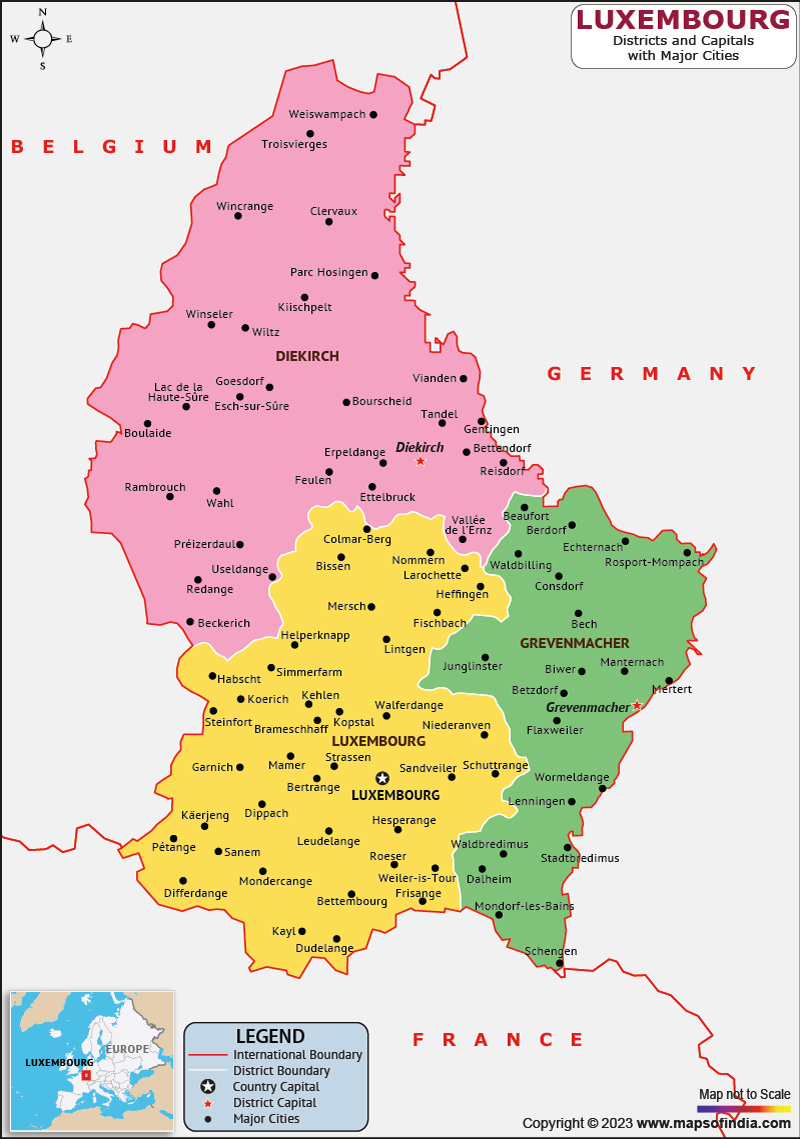





Luxembourg, officially known as the Grand Duchy of Luxembourg, is a small landlocked country located in western Europe. It is one of the smallest countries in Europe, but it is known for its high standard of living, political stability, and diverse cultural heritage. Luxembourg is a founding member of the European Union and is home to numerous international organizations and institutions.
History
Luxembourg has a rich history that dates back to Roman times. The country was ruled by various European powers throughout the Middle Ages and the modern era, including the Spanish, French, and Austrian empires. In 1815, Luxembourg became a grand duchy under the rule of the Dutch king, and it gained independence in 1839. Luxembourg was held by Nazi Germany during World War II, but it was recaptured by Allied forces in 1944. Luxembourg is currently an affluent and powerful country noted for its strong financial sector and political stability.
Culture
Luxembourg is a culturally diverse country with influences from its neighboring countries, including Germany, France, and Belgium. The country has a rich history of art and music, and it is home to several museums and cultural institutions. Luxembourg also has a strong tradition of gastronomy, with local specialties including Judd mat Gaardebounen (smoked pork with broad beans) and Gromperekichelcher (potato cakes). The country celebrates several annual festivals and events, including the National Day on June 23rd, which commemorates the accession of Grand Duke William II in 1841.
Language
Luxembourgish is the majority language of the nation and is spoken by most of the population. However, French and German are also widely spoken, and many Luxembourgers are fluent in several languages. English is also commonly spoken, especially in business and international affairs.
Geography
Luxembourg is a nation situated in the western portion of the Europe, bordered by Germany to the eastern front, Belgium to the western front, and France to the southern front. The country has a total area of 2,586 square kilometers and a population of approximately 625,000 people. Luxembourg is divided into two main regions: Oesling in the north, which is characterized by rolling hills and dense forests, and Gutland in the south, which is a more densely populated area with a diverse economy.
| Official Name | Grand Duchy of Luxembourg |
| Capital | Luxembourg |
| Population | 645397 |
| Area | 2586 km2 |
| Currency | Euro |
| Religion | Christianity |
| Language | Luxembourgish |
| Major Cities | Echternach, Diekirch |
FAQs
Q1.Why is Luxembourg considered a Grand Duchy?
Luxembourg is officially the Grand Duchy of Luxembourg, making it the world's only sovereign country that is a grand duchy. It is a constitutional monarchy headed by a Grand Duke.
Q2.What countries border Luxembourg?
Luxembourg is a landlocked country in Western Europe bordered by Belgium, Germany, and France. Its central location gives it strong connections with neighboring European countries.
Q3.Is Luxembourg a founding member of the European Union?
Luxembourg was one of the six founding countries of the European Economic Community in 1957, which later developed into the European Union. It remains an important centre of EU institutions.
Q4.Why is Luxembourg important as a financial centre?
Luxembourg is a major international financial and investment fund centre, particularly known for investment funds, private banking, insurance, and cross-border financial services.
Q5.What is Luxembourg's famous UNESCO heritage site?
The Old Quarters and Fortifications of Luxembourg City are a UNESCO World Heritage Site. The historic area features defensive walls, fortifications, valleys, and centuries-old urban architecture.
Q6.What are Luxembourg's main geographical regions?
Luxembourg is commonly divided into several distinct landscapes, including the Oesling in the north, the Gutland in the south and centre, and the Moselle Valley along its southeastern border.
Q7.Does Luxembourg have more than one official language?
Yes. Luxembourgish, French, and German are the country's three official administrative languages. Luxembourgish is the national language, while French and German are widely used in public life, education, and administration.
Last Updated on: September 07, 2026

