


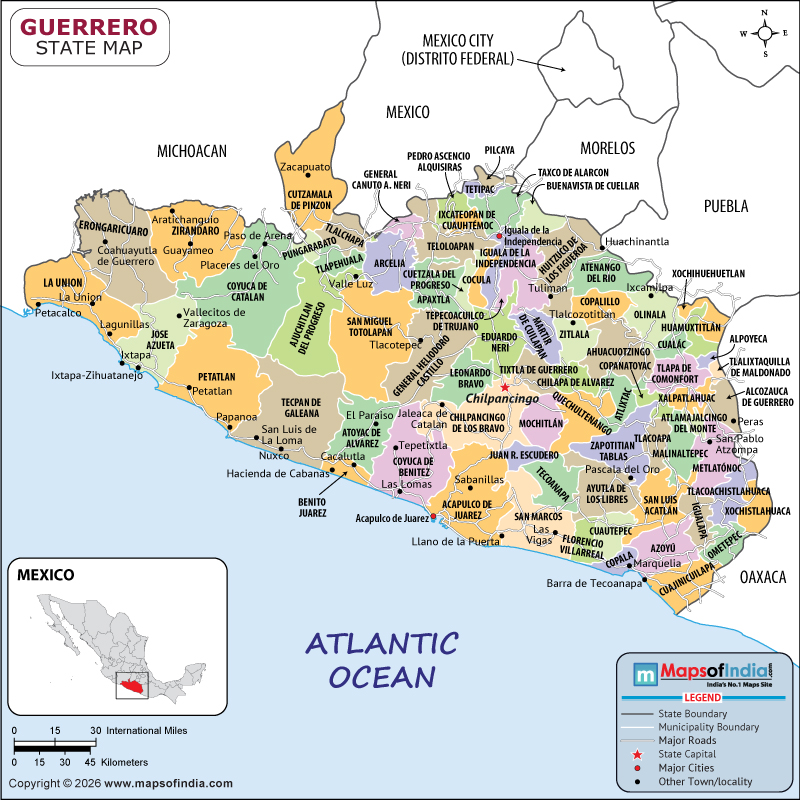



The Free and Sovereign State of Guerrero, or the Estado Libre y Soberano de Guerrero, is a picturesque region of the coast of western Mexico. Bordered by Michoacán to the west, the State of Mexico and Morelos to the north, Puebla to the northeast, Oaxaca to the east and the Pacific Ocean to the south, it covers 63,596 square kilometres of diverse governmental landscape. Its capital is Chilpancingo de los Bravo, a city perched in the mountains, and it has an even larger and better-known urban sprawl in Acapulco de Juarez, with its glamorous bay whose name became an icon of Mexican tourism back in the 1950s.
History
During the span of time long before the Spanish ships made their way to the shores of the Pacific, the Guerrero land, which is now in existence, had hosted a patchwork of aboriginal cultures. The Nahuas, Mixtecs, Tlapanecas, Amuzgos and Cuitlatecs lived in different ecologies and evolved into highly complex societies. They were agriculturalists who grew maize, beans and squash, textile producers through cotton and maguey fibres, heavy traders, etc. Pottery and painted codices were important and of religious and historical significance, as were metalwork, especially gold and silver ornaments. Nearly all of Guerrero was part of the tributary structure of the growing Aztec Empire by the fifteenth century, and coastal and highland communities were required to provide products to the Aztec Empire.
The advent of the Spaniards in the early sixteenth century amounted to an incredible shift. Spaniards met stiff resistance in the rugged interior, but the promise of Pacific overland contact and minerals held Spanish interest. Eventually, the port of Acapulco would become the western end of the Manila Galleon trade route--connecting New Spain with the Philippines across the Pacific. Within these two hundred years of trade, Asian silks, porcelain, and spices came to the Americas, whilst silver was imported back to the Asian continent. Acapulco turned cosmopolitan and competitive and drew storekeepers and engrounded buccaneers, as well as imperial establishments.
Guerrero proved to be an iron land of revolution in the first half of the nineteenth century. Vicente Guerrero was a former mule driver whose father was a peasant, but later came to lead insurgent troops after the death of José Maria Morelos. Engaging in a relentless guerrilla warfare in the inaccessible peaks, Guerrero turned down royal offers of pardon and sought full independence. His union with former royalist Agustin de Iturbide in 1821 led to the end of the conflict through the Plan of Iguala, which enabled Mexico to separate from Spain.
In spite of its pivotal role in becoming independent, Guerrero did not join the state until 1849. It was put together on the basis of parts of Michoacan, Puebla, and the State of Mexico, with its formation rationalised on the basis of the geography, social makeup, and economic interests of the region. Guerrero has had both boom and bust in the twentieth century. The most influential growth was the golden age of Acapulco in the 1950s and 1960s, which made it an international playground of Hollywood celebrities and international junkets, but poor rural regions fell behind.
Culture
The cultural topography of Guerrero is, as is the geography, diverse, with roots reaching back to the indigenous past, Spanish colonial, and the long history of Afro-Mexican populations, particularly in the Costa Chica. Community is characterised by festivals, so they are held throughout the year. Religious festivals like Semana Santa in Taxco combine dark Catholic processions with post-pre-Hispanic iconography. Brilliantly colourful masks, masked dances, and decorated performances can be called the echo of the archaic rite form and meet the requirements of the modern palate.
The towns and villages of Guerrero have thriving artisanal crafts. The silversmiths of Taxco have earned a worldwide reputation of excellence, producing highly ornate jewellery as well as decorative items that have attracted glass collectors the world over. Textile production continues to be an important cultural/economic activity in the rural setting. Huipiles and embroidered blouses that are handwoven and dyed with materials retain a motif and technique that references indigenous cosmologies and histories. The simple folk art of pottery, basketry and wood carving enhances the special tapestry, usually found in the local markets with fresh produce and traditional foods.
Dance and music are the core of social events. Weddings, town fiestas, and political rallies are all energised by styles like the exuberant chilena, which entered the region as maritime contact with the South American region by the Spanish, and the sones of Tierra Caliente. Cooking traditions are regionalised yet similar to the extent of the freshness and local food orientation. Most of the celebratory meals include dishes like pozole verde, which is prepared with hominy and green chile sauce. Seafood is king along the coast, with ceviches, fish stews, steamers, and grilled catches of the day being flavoured with limes, chile and garlic. And on land, hearty moles and tamales are part of a native and colonial heritage.
Particularly notable for the influence of Afro-Mexicans in the Guerrero culture are found in music and dance, such as those of the Danza de los Diablos or the Day of the Dead in the Costa Chica towns. African rhythms combined with indigenous percussion and the Spanish lyrical forms are the narratives of strength, adaptation, and solidarity of the communities. Folktales and ancestral histories are a part of oral culture and are an effective vehicle for transferring cultural information.
Language
The Spanish language is predominant in all parts of Guerrero, but this state stands out as being linguistically. Nahuatl was, and remains, a lingua franca of the Aztecs, so far in central and northern areas it is often spoken together with Spanish. In eastern and southeastern sections of the state, Guerrero is joined to linguistic and cultural networks reaching into Oaxaca and Puebla via systems of related Mixtec dialects.
The Tlapanec pronunciation of which was in honour of the Mountainous region in which they live, whose name is La Montana; they are also known as MePhaa. They live within this mountainous region, and their language has withstood the test of historical attempts at assimilation into other Bands or tribes of Tlapanec. The Amuzgo populations of the Costa Chica retain a language unrelated to, yet associated with, other Oto-Manguean languages. Both of these languages concentrate a reserve of cultural memory and are contained in a song, a narration, a rite, and a toponym.
Attempts to maintain and renew local Aboriginal languages in Guerrero have been rising in recent decades. Bilingual education programs, community-based radio stations and documentation projects are all to transferring the linguistic legacy to subsequent generations. Even as the survival of languages is under threat due to city migration and economic needs, there has been a swelling awareness that languages are not merely used as vehicles of communication, but they form part of identity and perspective about the world.
Geography
The Guerrero topography is characterised by Sierra Madre del Sur, a jagged mountain chain paralleling the coast and demarcating the state into several ecological regions. The elevated terrain protects the cool pine-covered troughs and the remote villages, whereas the coastal lowland opens to coastal beaches and fruitful deltas. This abrupt verticality not only complicates the process of transportation, but also forms a splendid natural spectacle, waterfalls, long ravines and panoramas everywhere.
The state can generally be characterised by a number of natural regions. Barren Tierra Caliente that spans northwestward is defined by the scorching and arid climate and agricultural production of maize, beans, and tropical fruits. La Montana in the northeast is further and highland with predominant indigenous populations that owe their economic livelihood to subsistence farming and crafts. The heartland is located around the capital and the valleys around it, in which it serves as the centre of administrative and trading. Northwest of Acapulco is Costa Grande, which can boast a combination of beach resorts, fishing ports and farmland and Costa Chica to the southeast is notable as home to Afro-Mexican communities and bustling cultural life.
There is significant variation in climatic conditions in these areas. The coastal areas have a tropical climate, temperatures are warm throughout the year, and receive rain during the months of June- October. Conversely, the highlands are at cooler temperatures and temperate. This diversity is well-suited to many species, such as tropical hardwoods and orchid species, as well as the rich wildlife, spanning jaguars and deer to an abundance of bird species.
The Guerrero economy is also supported by natural resources, which lie at the basis of a number of its main economic branches. The West Coast has a viable fishing industry, used both to feed the local people and as export products. Agriculture is still significant, and they grow crops as diverse as staple grains to coffee, coconuts, and mangos. Extractive activities such as mining are still important contributors to the revenues of the state, specifically silver mining in Taxco, which connects the present of the state to its colonial past. Tourism is an important economic force, which is focused on the busy Acapulco, but has spread even to more peaceful places like Ixtapa and Zihuatanejo, where infrastructure investment is encouraged to bring tourists.
Quick Facts
| Official Name | Free and Sovereign State of Guerrero |
| Population | 3,540,685 (As of 2020) |
| Area | 63,596 km² |
| Language | Spanish |
| Religion | Christianity |
FAQs
Q1: What is Guerrero best known for?
It is famous for Acapulco’s beaches, silverwork from Taxco, and its rich indigenous and Afro-Mexican heritage.
Q2: When did Guerrero become a state of Mexico?
Guerrero was officially established as a state on October 27, 1849.
Q3: Which indigenous languages are spoken in Guerrero?
Languages such as Nahuatl, Mixtec, Tlapanec (Me’phaa), and Amuzgo are still spoken in the region.
Q4: Who was Vicente Guerrero, and why is the state named after him?
Vicente Guerrero was a key independence leader and Mexico’s second president, honoured by having the state named after him.
Last Updated on: June 22, 2026

