


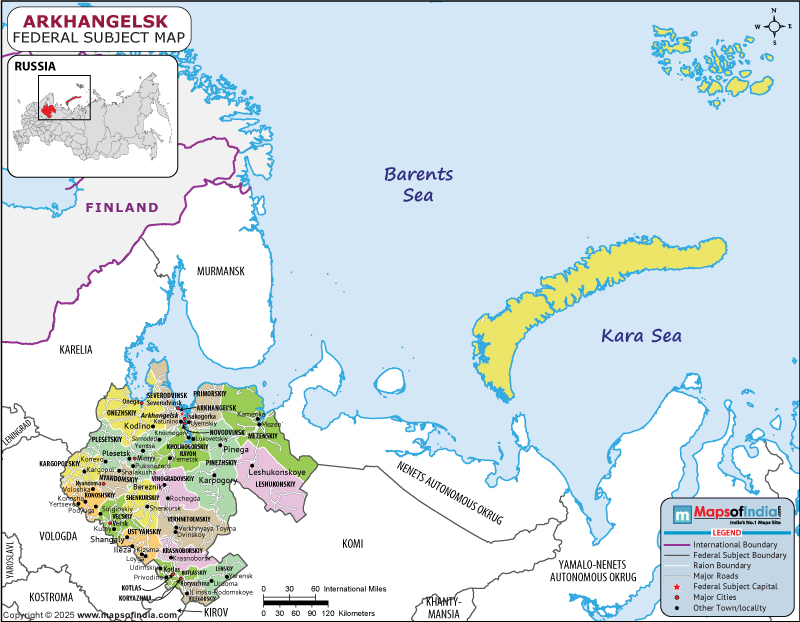



Started in 1584 around the Archangel Michael Monastery, the city developed from an isolated religious fort to being the main port of the western trade to Russia until the beginning of the 18th century. Located at only three meters above the sea level, all types of terrain comprising a rather large area of approximately 295 km² situated on both banks, along with the existence of many of the delta islands, make up Arkhangelsk. It also has an urban landscape that consists of old wooden architecture intermingled with Soviet housing blocks and the new commercial. Arkhangelsk is today a centre of maritime trade, arctic research and regional culture, with a line across 1,133 km south to Moscow and in the air to Talagi and Vaskovo airports.
History
Much earlier than the Russian statehood came to the White Sea, both Scandinavian and Byzantine sources refer to the land as Bjarmaland, a land of fur and salt. Some voyages of merchants to seek trading possibilities are recounted in Norse sagas of travels along rivers of the north in the period around 900 AD, but significant settlement did not come until princes of Novgorod expanded their control in the 12th century. They constructed trading posts and monasteries, among which was the Archangel Michael Monastery on Cape Pur-Navolok. In 1419, the monastery was first written about, and was the centre of a loose association of Pomor fishing and seal-hunting and fur-trading villages that had connections with both Scandinavian traders and towns far to the south in Russia.
Formally, Arkhangelsk was founded in 1584 when Ivan IV (“the Terrible”) made a decision to build the New Kholmogory fortress as a protection of growing foreign trade. Only thirty years before, English mariner Richard Chancellor accidentally discovered his way to the White Sea in 1553, establishing direct contacts between Tsarist Russia and the Muscovy Company. By the early sixteenth century, the English were regularly sending ships up the White Sea to Arkhangelsk, bringing in textiles, firearms, and manufactured goods in exchange for Russian wax, tar, furs, and timber. By the following century, the city of Arkhangelsk prospered as the sole legality-governed port in the whole of Russia, and was able to handle up to 10,000 tons of cargo during peak season.
Peter, I saw the possibility of Arkhangelsk being a naval port and shipbuilding unit. After 1693, the tsarist shipwrights began to launch vessels in state yards on the Dvina. But such severe weather, five months in the year, in a state of ice, hindered regular business. After Peter obtained access to the Baltic in 1703 and established Saint Petersburg, maritime deflection was switched south, and conditions were also imposed on cargo transportation to be organised through Arkhangelsk in 1722. The Western world was forgetting the city, and it went into a long period of relative stagnation.
The later period of the 1800s saw new development with imperial Russia eyeing its huge forests in the north. By 1898, a rail connection (the Arkhangelsk-Vologda-Moscow line) was completed, which significantly reduced the transportation time of timber products and paper products going to Europe. Sawmills, papermaking and pulp-making factories appeared on the banks of rivers, and shipyards mended the ships as they worked on the White Sea and the Arctic Ocean. The fact that an active timber trade had rapidly turned Arkhangelsk into a thriving industrial port is testament to the fact that by the beginning of the 20th century, the volume of cargo passing through the port had already increased to such an extent as to surpass the volumes handled in the Peter the Great times.
In the course of the 1917 Revolution and subsequent Civil War, Arkhangelsk had been kept under the control of the White Army. In 1918, Allied forces had landed in expeditions by the British, the French, the United States and Canada to support anti-Bolsheviks in the north. Although temporary success was experienced, the organisation of coherent command and weakening external support resulted in early 1920 defeating the city back to the Soviet side. During the Bolshevik reign, timber and shipbuilding companies of Arkhangelsk were nationalised, and a basis of subsequent industrialisation was established.
During the post-war decades, the city of Arkhangelsk restored destroyed infrastructure and increased its industrial capacity. There emerged new housing estates and cultural centres in addition to revamped shipyards. Polar research institutes and hydrographic offices were built, solidifying the position of the city in the exploration of the Arctic, and a local university established in 1971 provided expertise in forestry, geology and marine engineering. By the year 1990, Arkhangelsk had more than 400,000, with a skyline comprising Stalinist towers, Khrushchyovka apartment blocks, and smokestacks.
Culture
The history of Arkhangelsk is a combination of centuries-old traditions of the marine culture of Pomor people and the impact of the present-day Russian culture. The Pomors (so-called because they lived (more) on the coast) became a unique maritime culture with a central interest in navigation, fishing, and shipmaking. Their continuum is witnessed through local festivals, handicrafts and foods.
There are three professional theatres in Arkhangelsk: the Lomonosov Drama Theatre, Youth Theatre and Puppet Theatre which presents both the classics of Russian drama and new plays. The Philharmonic Hall of the city holds seasons concerts with symphonic, folk and chorus music. Every year locals celebrate Pomor Days in honor of local chants, dances, and boat-building competitions on the frozen Dvina.
Natural resources have an influence on local food that shows the hard winters and seafaring. Fish pies filled with cod or salmon, surminha (salted fish) and mushroom-and-potato soups are common. Peasants carve wooden toys, make decorative bone products of walrus ivory, the source of which they used to acquire during their expeditions to the Arctic.
During the last decades, Arkhangelsk has cultivated an art community of contemporary art. Central avenues are covered with murals, created by street artists on the basis of Pomor iconography. Modern painting and photography by artists can be seen in galleries like the Northern Art Centre, where they may often take up the theme of isolation, climate change and northern identity. The cultural exchange with Scandinavia and Canada brought international ideas at the same time as encouraging local creativity.
Language
In Arkhangelsk, Russian is used as an official language, dominating educational, administrative and media areas. Nevertheless, the Pomor dialect continues to exist between older generations, retaining archaic terms in connection with the sea and shipping life. Words and phrases that mean ice level, wind directions and the structure of the boats may vary with Standard Russian and even change the wording to maintain the same linguistic connection to the pre-18th-century northern dialect.
In addition to the Pomor vernacular, the oblast includes indigenous people like Nenets and Komi whose languages are seen written in bilingual signage in rural settings. Formal education in these minority tongues is not extensive within the city itself, although cultural centres and language courses on a sporadic basis attempt to preserve the linguistic diversity. Recently, there has also been a rise in English in the hospitality and logistics sector because of the upsurge of tourism and business contacts.
Geography
Typically, its urban area, Arkhangelsk spreads over the tidal delta of the Northern Dvina River with riverine floodlands, flat islands, and deciduous forests of the boreal zone. The geographic location influences transportation, ecology, climate and urban form.
Arkhangelsk experiences a subarctic maritime climate (Kenne Cmd): winters are quite cold and lengthy, and the summers are short and slightly cold. January average temperatures range near the mark of minus 13 degrees Celsius, whereas July averages range plus 16 degrees Celsius. The winter can last until April, with snow covering the ground since late October, and the covering of ice on the Dvina normally starts in November. Between mid-May and late summer, White Nights occur when the sky is covered with darkness during dusk, and this takes place very briefly. The average annual rainfall is 650 mm, quite evenly distributed, except that autumn and early winter are a little rainier.
The taiga around is Scots pine, Norway spruce and the silver birch intertwined with black alder and willow in the wetter zones. Boreal undergrowth consists of blueberries and cranberries, as well as moss species. Wetlands host the migrating waterfowl, such as swans and ducks and forested areas host the likes of elk, foxes, and hares. Dvina and its tributaries provide a home to pike, perch, salmon and whitefish, which are all a part of local fisheries.
Cargo ships are escorted by icebreakers year-round, and ships transport timber, coal, and general cargo. Tourist cruises are run by passenger steamers in summer. The city is served by the Northern Railway, which joins Arkhangelsk to Vologda and Moscow, and the freight, as well as sleeper trains, traverse the tracks. Federal highway M8 (“Kholmogory”) serves as the only road connection with the central part of Russia; it connects the city with the hinterland of the Arkhangelsk Oblast and further. Talagi Airport, 15 km (9.3 mi) northeast of the city centre, provides flights to Moscow, Saint Petersburg and Murmansk. Vaskovo Airfield offers regional commuter flights and chartered flights.
Quick Facts
| Official Name | Arkhangelsk |
| Population | 348,783 (As of 2010) |
| Area | 294.42 km² |
| Language | Russian |
| Religion | Christianity |
FAQs
Q1: What makes Arkhangelsk a cornerstone of Russia’s timber exports?
Its ice-protected port and nearby boreal forests have long enabled Arkhangelsk to ship millions of cubic meters of lumber and paper products to global markets.
Q2: How do White Nights shape cultural life in Arkhangelsk?
The near-24-hour daylight from mid-May to late July fuels outdoor concerts, riverbank festivals, and late-night social gatherings along the Northern Dvina embankment.
Q3: Why is Malye Korely celebrated as a one-of-a-kind open-air museum?
It showcases over 100 authentic 17th–19th-century wooden buildings—from churches to peasant homes—relocated and reconstructed without a single nail.
Q4: How did Arkhangelsk’s port contribute to the Soviet war effort in World War II?
It served as a primary receiving point for Allied Arctic convoys, handling essential Lend-Lease supplies when rail and southern sea routes were cut off.
Last Updated on: June 22, 2026

