


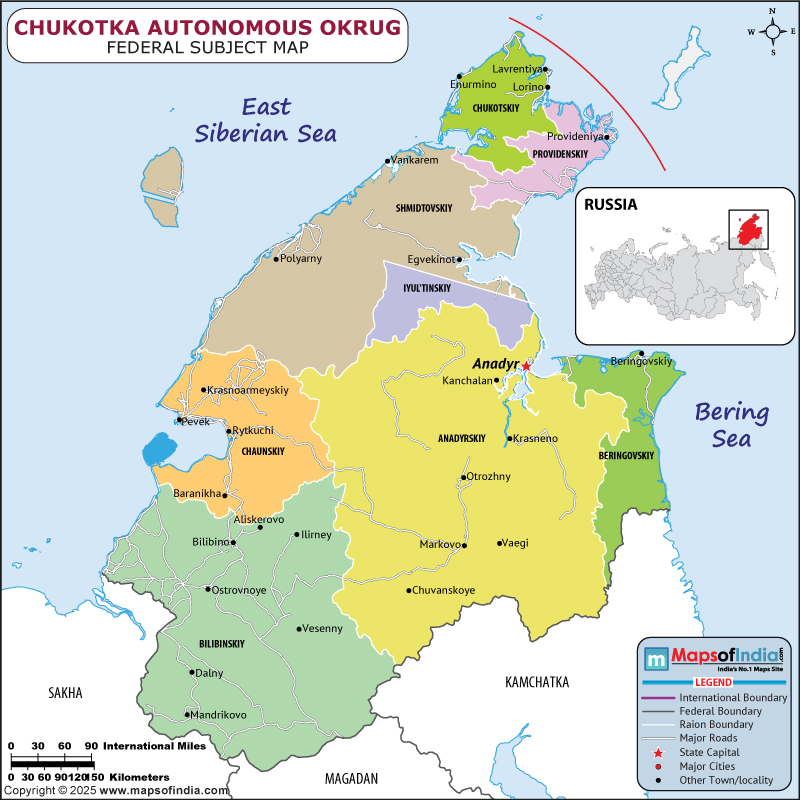



The Chukotka Autonomous Okrug is a remote territory in the far east of Russia. It is the easternmost part of the country and is situated across the Bering Strait from Alaska. People use this to refer to the region most of the time. The area is characterised by its dramatic landscape, native people, cold weather, and history. Russia’s Chukotka Autonomous Okrug is a region located at a distance from major cities, but many consider the land and culture extremely interesting. Whether you are looking for Arctic living, indigenous customs, or somewhere to escape and relax, Chukotka has something for you.
In this article, we will see more about Chukotka Autonomous Okrug’s history, culture, language and geography and answer some of the most asked questions regarding this place to help you get full insights about the place.
History
The people of Chukotka had lived there for thousands of years. Long before any Russian colonists arrived, this Arctic realm was already inhabited by indigenous peoples. They also included the Chukchi, the Yupik, the Even, and other minor peoples. Surviving off the sea and desolate tundra, they hunted seals, walruses, and whales. They also migrated as reindeer herders, and by walking, dog sled, and small boat. Life was simple, but it was hard, and a deep understanding of nature kept them alive.
The era of Russian exploration of the Far East began in the 1600s. They came in search of fur, land, and commerce. The initial encounters with indigenous people were not friendly. There were fights and misunderstandings. The Chukchi in particular fought Russian domination. They knew their territory and didn’t want to part with it. Most of the district was independent for a number of centuries.
The Russians became increasingly interested in Chukotka by the 1700s and 1800s. They had sought control of the seaway and its resources. Some were missions sent to gather taxes or establish trading posts. But many native groups carried on with their old ways and avoided settlers.
In 1922, in the early Soviet period, the Chukotka National Okrug was created. This annexation brought the area into the greater body of the Soviet state. Life began to change in the decades to come. These governments built small towns, schools, and clinics. They introduced the Russian language and new systems. They also encouraged people to move into villages from the open tundra. This impacted the indigenous way of life.
Mining in Chukotka started in the 1930s and 1940s. Gold, coal, and tin were discovered, and workers set up in new settlements. People from other parts of Russia had come to work in these cold and distant regions. Some came voluntarily; others were sent as prisoners in hard times. This chapter of Chukotka’s history remains bittersweet.
The Soviet government invested greatly in modernising Chukotka during the 1950s and 1960s. Highways, airports, and sea lanes were upgraded. Boarding schools were established for children. At the same time, native traditions were dying out in some regions. People were trying to figure out a way to balance old customs with new rules.
Life in Chukotka Autonomous Okrug was even tougher after the Soviet Union collapsed in 1991. Many businesses shuttered while workers left. Some villages were abandoned. But native traditions slowly returned. They started teaching young men old songs, languages, and hunting practices.
Today, the history of Chukotka is a history of survival. It shows how native peoples managed to maintain their way of life despite immense changes. It also reveals how this freezing Arctic land has always formed its people. Museums, books, and local stories now help to keep that past alive for younger generations.
Culture
Chukotka’s culture is intricately related to the land, sea, and weather. Residents here inhabit one of the coldest and most isolated corners of Russia, yet they’ve persisted in living by their traditions for hundreds of years. There are many indigenous peoples in this area, such as the Chukchi, Yupik, and Even. They live the life of respecting nature, strong family bonds, and simple living.
Reindeer herding is also an integral part of the culture of the autonomous okrug. Many families still track the tundra with their herds. They dwell in tents of reindeer skin and cook on open fires. The reindeer provide them with food, clothing, and tools. Everything about the animal is used, and nothing is wasted.
Hunting in the sea is also practiced, mainly in villages situated on the coast. The Yupik and Chukchi peoples depend on the hunt of walruses and seals, and sometimes whales. They involve only a few people, hunting with handcrafted boats. When you share the catch with the entire village, it is about honour and coming together. The meat is dried and kept and eaten through the long winter.
Crafts are another strong tradition. Bone and ivory are carved by local artists into small animals, sea creatures, or human figures. Women do beautiful beadwork, sew fur clothing and decorate boots and gloves with colourful designs. The items are used at home or sold in the village markets and fairs.
In towns like Anadyr or Bilibino, residents still work to preserve their traditions. Some schools teach indigenous songs, dances, and language. Culture centres run classes that teach crafts or acting in traditional shows to kids. Museums also play a part by displaying old tools, clothes, and pictures of village life.
And yet, modern life has infiltrated. People are on phones, wearing factory-made clothes. But they continue to go hunting, wear fur in winter, and speak their native language at home. This mixture of past and present shapes Chukotka's culture today.
What is most notable is the kindness and respect between people. In a place so cold and so still, friendship and support are everything. Neighbours look out for each other, and families stick together. The resilient spirit is what drives the culture of Chukotka Autonomous Okrug.
Language
In Chukotka Autonomous Okrug, the primary language is Russian. Russian is spoken in schools, offices, stores, and medical clinics. Young people are taught to converse in standard Russian and frequently speak it quite well. Visitors traverse Chukotka with Russian phrases or translation apps.
But native languages remain. The Chukchi language is still used by the elderly and a few children in their homes. Yupik and Even languages are also found along the coast or rivers. These indigenous languages carry traditional songs, stories, and placenames from elders to younger generations.
Government schools teach a little of the native language and songs. Public events feature drum singing in Chukchi. Despite the fact that Russian is the language of daily life, the mother tongue is a central aspect of one’s identity.
Geography
The geography of Chukotka Autonomous Okrug is both special and tremendous. This area is located in the extreme northeast of Russia. It is the easternmost section of the country and sits across the Bering Strait from Alaska. The Russian region of Chukotka reaches both the Arctic Ocean and the Pacific. It is defined by water, ice, and completely open land.
The countryside in Chukotka Autonomous Okrug is largely wild and untouched. You won’t find a big city here. Instead, there are small towns and villages. Most of the region is tundra, so the ground is frozen most of the year. It also has low mountains, rocky coasts and large rivers running through valleys.
Green moss and grass cover the land in summer. Colourful wildflowers are in full bloom, and birds flock from near and far to nest. But summer is short. It is cold much of the year, buried under snow. Winter temperatures can go as low as –40°C to –50°C, and it can be quite windy. The sun doesn’t rise for weeks in the North. We call this lengthy period of darkness the polar night. In summer, the opposite happens. The sun does not set all day; this is called the midnight sun.
Animals are a major player in geography. A group of reindeer is on the move across the tundra under the leadership of herders. Out on the sea, you will find seals, walruses, and even whales. Far to the north, there are also polar bears. People rely on these animals for food and goods. The land, the sea, and the sky provide them with all they require.
There are also such mountain systems as the Koryak Highlands and the Anadyr Plateau. They are not as high as the Alps there, but are cold and snow-covered nearly all year. Rivers like the Anadyr and Kolyma travel across the landscape, bringing fresh water and fish with them. With its cliffs, bays, and frozen beaches, the coastline is long and jagged.
Natural resources exist underground. Gold, coal, and other minerals had been mined in the past. The occasional small mining town still remains in some areas of Chukotka. But there are still lots of quiet places, untouched by machines.
Chukotka Autonomous Okrug is a land of hardship and beauty due to its geographic location. The vast open land, frozen seas, and high skies are a peaceful place. Local people integrate sensitivity, common sense, and understanding with living and learning from nature. The land teaches them patience, sharing and care.
Quick Facts
| Official Name | Chukotka Autonomous Okrug |
| Population | Around 50,000 |
| Area | Approximately 721,500 km² |
| Currency | Russian Rouble (RUB) |
| Religion | Russian Orthodox, Indigenous beliefs |
| Languages | Russian (official), Chukchi and other indigenous languages spoken |
FAQs
Q1: Who are the native people of Chukotka?
The area is inhabited by America's peoples, including the Chukchi, Yupik, and Even people. They have been mining there for thousands of years.
Q2: How do people make a living in Chukotka?
Some of them work in reindeer herding, sea hunting, fishing, or small mining jobs. Some also work in schools, clinics, or local stores.
Q3: Is Chukotka safe to visit?
Yes, it’s safe, but be ready for chilly weather and restricted transport. If you can, go with a guide or a local contact.
Last Updated on: April 15, 2026

