


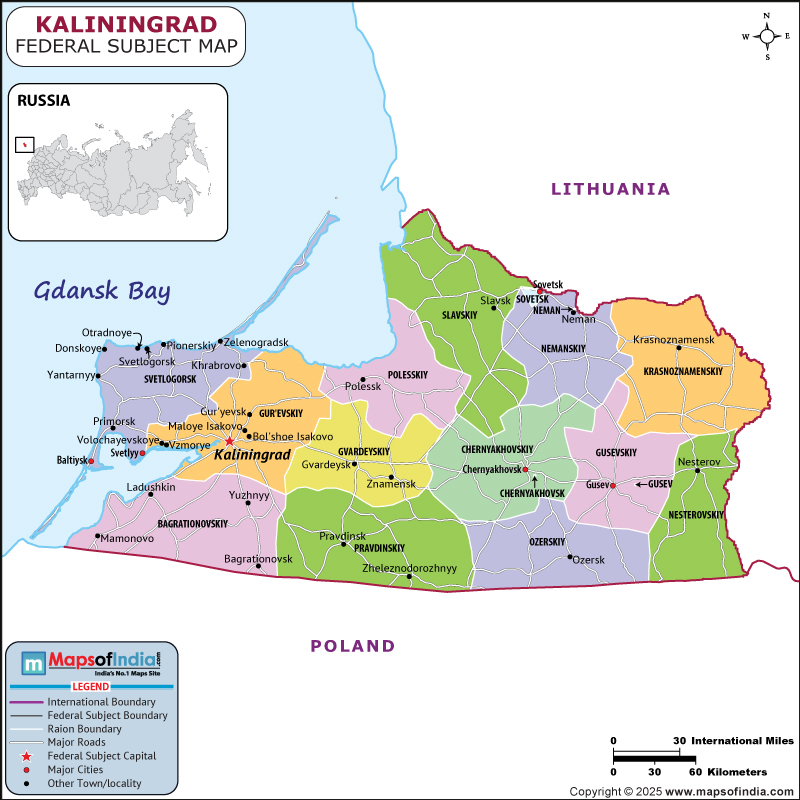



Kaliningrad is a Russian exclave located between Poland and Lithuania in the Baltic Sea. It was in Germany until the Second World War when the Soviet Union annexed it, previously called Königsberg. It is still geopolitically influential today because of its geographical position and adequate military forces. Still thoroughly Russian, the region has been greatly showing a special combination of German, Soviet and Baltic influence. Its history, architecture, and coastal scenery draw curious tourists and even those who are more interested in history. Although it is severed with mainland Russia, it remains a critical determinant in the politics of the region and it is still advancing as a contemporary urban settlement.
History
The Teutonic Knights founded a fortified settlement in 1255 on the territory of the Old Prussian village of Twangste. It came to be called Königsberg (King s Mountain in German) after Ottokar II of Bohemia, and became a strategic fortress, one of the major port-cities in north Germany. In 1724, the three authentic districts including Altstadt, Kneiphof and Lobenicht were united under Prussia, as well as the East Kling government shifted the city as a seat of East Prussian government and Coronations such as that of Frederick I in 1701.
It became rich in the era of the Hanseatic League (from 1340) due to the trade in grain, furs, flax and timber, primarily with Russia, Britain and Central Europe. The establishment of Albertina University in 1544 made it to be considered as an intellectual world because it had thinkers such as Immanuel Kant, Johann Herder, E.T.A. Hoffmann and David Hilbert.
The city survived the turmoil of the Napoleonic Wars and Treaty of Vienna and stayed faithfully in Prussia. Modern fortifications were constructed in the late 19th century and the early 20th century. It used to be a prominent German naval base and economical window for miles and ocean ports.
There was not such significant destruction in WWI, although WWII carried a big devastation. The old city was destroyed by allied bombing in 1944 and by a Soviet siege in April 1945. Surrounded and caught up after a fierce battle with ring defenses dating back to the 19th century, a German garrison, numbering between 60,000 to 130,000 soldiers, got trapped. The city itself was damaged more than 80 percent with tens of thousands of civilians and soldiers left dead or captured.
During the Potsdam Conference in 1945 the northern half of East Prussia (and the city) passed to the Soviet Union. In 1946 it was renamed Kaliningrad in honor of Soviet official Mikhail Kalinin and became a part of the Russian SFSR as an oblast. The rest of the German population was deported in 1947 and settlers were resettled in the region across the USSR, in almost all of its ethnic groups, the most of them being Russians and Belarusians and Ukrainians.
It cleared up the old urban fabric massively. The apartment buildings of the Soviet kind were constructed, and the remnants of monuments connected with the German past were destroyed, including the castle ruins in the 1960s. New industrial and military infrastructure appeared. This structure was left unfinished and was a brutalist architecture called the House of Soviets which was constructed over the site of the castle and was a famous symbol of the time. The foreign access was very limited until the collapse of the Soviet in 1991.
Since 1991, the region was once again opened to the outside world but the region was facing economic problems, as it depended on transiting other countries, with a poor economy based on border trade. The special economic zone status had an incentive but there were still logistic and political barriers.
Culture
The important museums like the Kaliningrad Regional Museum of History and Arts, Amber Museum, state art Gallery and Museum of the World Ocean preserve and display the varied heritage of the region.
Amber, sometimes termed as Baltic gold, has a significant role culturally and towards the economy. The Amber Museum boasts of thousands of objects in terms of its artistic and geological importance with ancient inclusions and precious jewelry among them.
Cultural life is not cut off from music, theatre, and modern art. The regional Philharmonic and Symphony Orchestra, several choirs and chamber ensembles and experimental sound-art groups operate in the city. Another German connection to the city is manifested in the post-Soviet theatre group; a German language troupe. Regional Drama Theater and puppet theatre are also established and cooperation with national art institutions still further enriches the cultural environment.
Annual festivals bring both the Russian and foreign artists to the Baltic Seasons Art Festival. The Planet of Arts festival and Baltic Legend youth cultural festival are the notable events which help to promote the artistic exchange among children and teenagers of the different countries.
Disparate times are put in juxtaposition in Kaliningrad in an architectural way. Work is still in progress on the reconstructed Königsberg Cathedral, which was first started in the early 1990s; and it is flanked by buildings of Soviet construction and more recent development. In one district, such as the Amalienau and Maraunenhof, German villas that are pre-war and cobbled doors provide the upturn to the past of the city.
Local customs are very strong. One of them is the marriage bridge ceremony: couples go over bridges holding hands, lock padlocks as a sign of a couple, and then they discard the keys into the river, which is a romantic gesture related to the maritime tradition in the city.
There is also a blending of culture in cuisine. The local menu consists of Russian, Baltic and sea-food, German influenced dishes like Königsberger Klopse, and a great selection of international cuisines. Amber sale and handicrafts are still highly demanded both by foreigners and by local citizens.
Language
Russian is the native and the official language of the immense majority of inhabitants of the Kaliningrad area. It has remained the most powerful language in every respect of life such as education, government, media and day to day communication. Following World War II, the population speaking German was clearing out, and the area was resettled, mainly with Russian-speaking immigrants of different origins in the Soviet Union. These developments led to linguistic turnover to almost full Russian.
The area has extensive historical links with the history of German language and German culture, but no longer uses German dialects as their native languages. High Prussian and Eastern Low Prussian are dialects of East Prussia, extinct or (for example, in a very small diaspora) surviving only elsewhere. Nowadays, German can be learned in school or college as a foreign language yet German does not play any important role in communal life.
Historically, Polish and Lithuanian (they were close in geographic and cultural terms) are now spoken by small minorities. These languages are at times used in schools or said by families of Polish or Lithuanian ethnic origins. Nonetheless, they are not the common ones in social places or in normal talk.
Geography
Kaliningrad is a Russian enclave on the south eastern Baltic coast, and is sandwiched between Poland towards the south and Lithuania towards the north and east. The state geographically is located in mainland Russia and is the westernmost part of the country. This land forms a strategic value to Russia militarily and economically since it forms the main access point to the Baltic Sea and it is the center of trade and other transit links of the European continent.
The Curonian Spit is one of the most significant geographic aspects in the region as it is a narrow and long peninsula as a sand dune extending 98 kilometers to separate the Curonian lagoon as well as the Baltic Sea. This UNESCO World Heritage site is also shared with Lithuania and can be characterized by the peculiar eco system, migration routes of birds as well as the great sweeping sands dunes. One more important coastal element is the Vistula Spit and Vistula Lagoon as emerging characteristics of the southern maritime borders of the area.
Kaliningrad is characterized by a soft maritime climate, which has the effect of the Baltic Sea. The winters are non-severe as compared to most parts of Russia and swing around the freezing mark with summers being cool to warm with average highs between 20 and 25 degrees Celsius. Precipitation is moderate, distributed evenly throughout the region and so with a fairly mild climate, there is a wide variety of foliage in both mixed forests as well as coastal vegetation.
The area has been crossed by a number of rivers with the most significant being the Pregolya river which passes through the Kaliningrad city and drains to the Baltic Sea. There are other major watercourses, the Neman and Lava rivers resulting in the agricultural potential and diversity of the ecosystem of the area.
Quick Facts
| Official Name | Kaliningrad |
| Country | Russia |
| Founded | 1 September 1255 |
| Population | 431,402 |
| Area | 223.03km2 |
FAQs
Q1: What is the location of this?
It is a Russian exclave on the Baltic Sea, which is between Poland and Lithuania. It is politically detached to mainland Russia.
Q2: Why was it included in Russia?
It was formerly a German city (East Prussia) by the name of Königsberg till the end of World War II. The soviet union renamed it after annexing it in 1945.
Q3: Is there anybody speaking Russian there?
Indeed, the official and the most widespread language is Russian.
Q4: Does it belong to the European Union or NATO?
No. despite being surrounded by members of both the EU and NATO is governed by Russia and has not become a part of any of the organizations.
Last Updated on: June 22, 2026

