


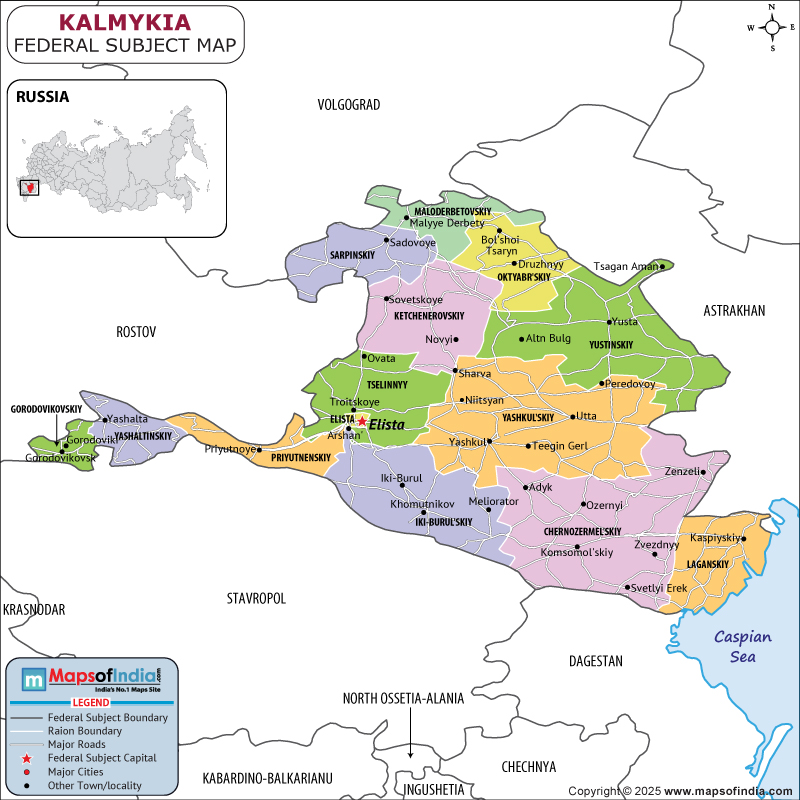



The Kalmykia Republic in south-east Russia is a huge chunk of territory, with a size of around 74,700 square kilometres, lying across the lower portion of the Volga River and northern edges of the Caspian Sea. In rolling steppes, semi-deserts, salt flats, and flood plains, most of its lands are below sea level in the Caspian Depression. Such distinctive physiography is linked to some of the harshest continental climatic conditions in the Russian Federation, whereby summer temperatures are often above 40°C in such cities as Utta, with winter temperatures being just below 5 °C.
History
The territories which make up the present-day Kalmykia have been used forever as transit points, as well as transitional pastures by a number of successive nomadic civilisations. Early Indo-Europeans are attested by Bronze Age kurgans dated t°Ca. 3000 BCE, and the Scythians and Sarmatians of the first millennium BCE left us well-decorated artefacts of gold and the fortified hill-forts found in their territory. During the early medieval period, Turkic Khazars controlled the lower Volga basin and built cities with activities in trade and promoted Islam as well as pre-steppe beliefs. It was paved by the rupture of the thirteenth-century Mongol conquests in the region, which created some space for migration movements.
Conflict coupled with Qing growth in Dzungaria in the early seventeenth century drove the then Western Mongol or Oirat tribes, Torgut, Buzava and Derbet, to seek asylum to the west of the Urals. Moving immense distances across the Kazakh steppe, these Oirat groups displaced the Nogai nomads, founding the Kalmyk Khanate with the leadership of Kho Orluk. Within the next century and under such rulers as Ayuka Khan (1669-1724), the khanate increased its sphere of influence by means of alliances with Tsarist Russia, supplying the cavalry in exchange for grazing rights and political independence. Caravans of traders connected the khanate with the markets of Siberia, Persia, India and Tibet, diplomatic envoys distributed gifts to the Dalai Lama in Lhasa and established Buddhism as the core of a Kalmyk identity.
The autonomy of the khanate was undermined in the mid-eighteenth century by the imperial policy of settling Russian colonists of peasants in the rich pastures and the. Policy of administrative reforms. Another 200,000 Kalmyks staged the famous Great Return to Dzungaria in the year 1771; disease, hunger, and border fights on the route killed off over half the migrants. In the post-war era, Catherine the Great officially annexed the khanate and absorbed the last territories of Kalmyks by the imperial provincial order. During the Tsarist regime, Kalmyks preserved their semi-nomadic pastoralism; however, they lost most of their political independence.
The twentieth century was the period of revolutionary upheaval. The Kalmyk Autonomous Oblast was formed out of the RSFSR in 1920, and promoted to the title of the Kalmyk Autonomous Soviet Socialist Republic in 1935, by order of the victory of the Bolsheviks in 1917. German forces occupied large parts of Kalmykia throughout late 1942-early 1943 in the course of World War II. Charged with collectively colluding, almost 100,000 Kalmyks were rounded up and exiled to Siberia and the rest of the Central Asian republics in December 1943; almost 40 per cent of them died of exposure, disease and malnutrition.
The rehabilitation started in 1957, and the republic was restored in the year 1958; however, by this time, the Russification policies during the Soviet period had worked well and cut off many of the cultural and linguistic associations. After the breakup of the USSR, in 1992, Kalmykia proclaimed itself a republic in the Russian Federation and, in 1993, elected its first leader and began long-term plans of studying its cultural roots and remodelling its economy.
Culture
Kalmyk culture is a contemporary fabric that is composed of traditions of nomadism, the spirituality of Buddhism, and the post-Soviet renaissance. The depth of religious life is in Tibetan-style Vajrayana Buddhism, which cracked in the seventeenth century. Throughout the steppe are dotted monasteries, or datsans, where monks who have trained along Gelug and Kagyu lines lead communities in prayer and education and perform healing and other rituals. Europe, The Golden Abode of Buddha Shakyamuni in Elista is the largest Buddhist temple complex in Europe, consecrated in 2005, with its gold-duplicated roof lines and white stupas representing a sign of the rebound of faith that had been shut down during decades of oppression.
The festivals strengthen and revive ties among individuals and celebrate the cycles of seasons. The lunar New Year, which occupies late winter each year, is called Tsagan Sar, and it is a festival of family reunions and long meals, featuring borts (air-dried meat), bortsog (fried dough), and kumis (fermented mare milk), and is legitimized by long sessions of horse racing, archery, and wrestling, all reminiscent of the battle maneuver of the ancestral horsemen. Kalmyk carpets are widely sold along with silver filigree jewellery, lacquer painting and contemporary sculpture at the Golden Autumn arts fair held in October. There are traditions of music and dancing, centred around the morin khuur (horsehead fiddle), the plucked yatga zither, and epic ballads, like Jangar, reminiscent of the sounds of the steppe, the stories of heroic kings.
Over and above the concrete arts, Kalmykia's urban landscape also records its cultural aspirations. Broad streets of Elista are broken between the parks, dedicated to Chess, with giant chess sets and giant statues of chess masters such as Karpov and Kasparov, symbolising the adoption of chess in the republic as a symbol of mind game and peaceful challenges.
Buddhist motifs are combined with geometric modernism in public murals, and plays on both the Kalmyk and Russian languages are performed in community theatres, discussing themes of exile, identity, and environmental transformation. In the meantime, there exist approximately 30,000 Kalmyk Cossacks who are organised into traditional hosts and remember the days of the cavalry regiments that defended the Russian frontiers, upholding their own horseback martial arts as well as ritual music and the unique papakha hats.
Language
Kalmyk, or (halmg keln), is a Western branch of the Mongolic languages. It developed out of the dialects of the Western Mongol tribes and was first documented in written form employing the Clear (Todo) Script, which the Gelugpa monk Zaya Pandita had designed in the seventeenth century to translate Buddhist texts into Tibetan.
Kalmyk followed Soviet language reforms in the 1930s with the orthography switching briefly (1937) to a Latin alphabet, before settling on a Cyrillic orthography in 1940, now extended by six letters to represent its different vowel and consonant sounds. Whereas there are approximately 178,000 people who consider themselves to be ethnic Kalmyks, the native speakers of the language only number about 110,000, and this number can be attributed to Stalinist deportations, the school closures of the mid-twentieth century and the influence of Russian as an official language as well as in educational and media spheres.
Geography
The geography of Kalmykia is characterised by a huge Caspian Depression, one of the largest flatlands in the world, and the gently rolling hills of Yergeni Hills and Salsk-Manych Ridge. The republic is largely below sea level, and the low level is almost 30 meters below the average level of the Caspian. Its growth is determined by the fertile chernozems of the Yergeni Hills in the west (rising to 560 feet) upon which grain and sunflower growing depend, and the lowland semi-deserts and solonchak flats to the east, where few plants can grow, though saxaul, wormwood and feather grass do. Narrow northeastern fertile strip near the Volga river gives important irrigation water and access to river transport, but the river itself is somewhat limited to its narrow stretch in the present Kalmykia, especially before it enters other neighbouring regions.
The Yegorlyk, Kuma, and Manich rivers cut shallow watercourses through the plains, which irrigate vegetable gardens, orchards and small fisheries outside Elista. The largest lake, Manych-Gudilo, lies on the southern border and belongs to an ecological region between the Black Sea and the Caspian Sea; migratory birds and rare fish specimens inhabit the brackish waters of the lake. This delicate biodiversity is ensured by two key protected territories: the Chyornye Zemli Nature Reserve is the habitat of the critically endangered saiga antelope and bustard species, and the Bamb Tsetsg National Park, located on the islands of the Manych Depression, which stores endemic wild tulips and desert shrubbery.
Kalmykia does go through a harsh continental climate. January averages temperatures are around -5 °C, and July averages temperatures are close to 24 °C, with temperature records rising higher than 45 °C. Average rainfall decreases to the eastern plains, where it is as little as 170 millimetres, with the greater part of precipitation concentrated in heavy rains during spring and autumn, which leads to flash floods. Winters are dry but cold, and the aridity is continuous; thus, water management has become an important issue.
There are underlying artesian aquifers accessed by the wells used in livestock and small-scale irrigation, yet over-exploitation and secondary salinisation are also threatening the long-term future of water security. Subdued oil and gas reserves offshore in the eastern depression present revenue sources, but exploration has to be a mixing of economic gain with ecological protection, in this harsh, beautiful landscape of the Caspian Sea.
Quick Facts
| Official Name | Kalmykia |
| Population | 267,133 (As of 2021) |
| Area | 74,731 km² |
| Language | Kalmyk, Russian |
| Religion | Christianity |
FAQs
Q1: Why is Kalmykia known as the “Chess Republic”?
In 1998, former President Ilyumzhinov made chess the national sport, with open-air parks and annual festivals where locals play throughout school.
Q2: What makes Kalmykia Europe’s only Buddhist region?
Over 60% of Kalmyks practice Tibetan-style Vajrayana Buddhism—the highest concentration of Buddhists in any European polity.
Q3: When do wild tulips blanket the Kalmyk steppes?
Each spring, from late April through the first week of May, red wild tulips carpet the semi-desert plains.
Q4: Which Kalmyk settlement holds Russia’s all-time heat record?
The village of Utta reached 45.4 °C on July 12, 2010, making it the hottest place ever recorded in Russia.
Last Updated on: June 22, 2026

