


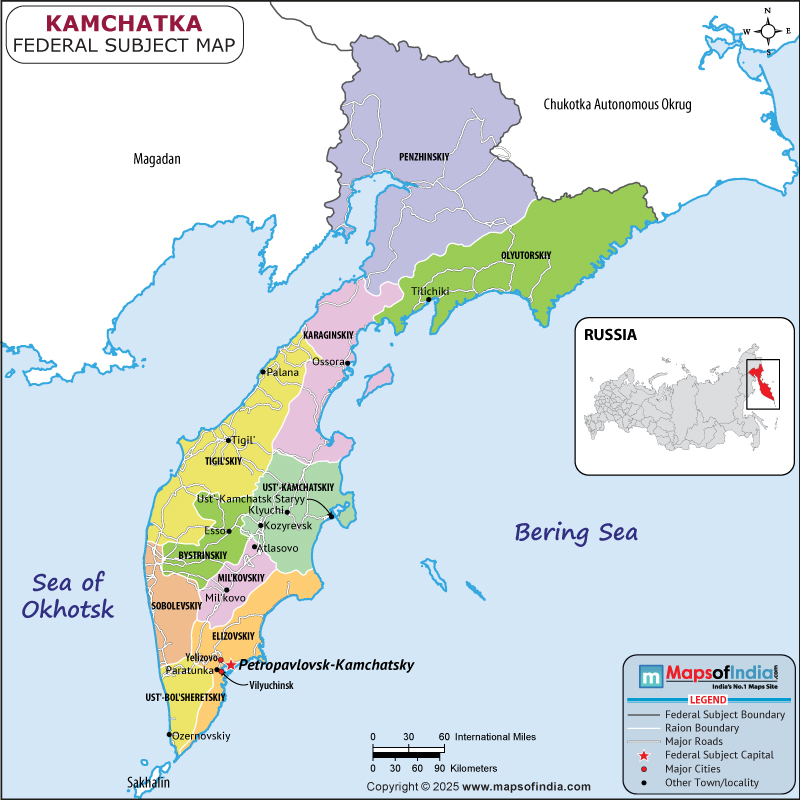



Kamchatka Krai sits on the far eastern frontier of Eurasia, a huge area where mountains of volcanoes collide with the cold waters. It was formed July 1, 2007, by uniting Kamchatka Oblast and Koryak Autonomous Okrug and stretches, in approximately 464,300 square kilometres, bigger than Sweden but with a population of less than 300,000. It has its administrative centre, Petropavlovsk-Kamchatsky, on the Pacific coast that leads to the wilderness characterised by the smoky geysers, thick taiga lands and villages that lie scattered and could only be reached by air or steep land treks.
History
Many centuries before the appearance of Russian flags over its coastline, Kamchatka was crowded with Paleo-Asiatic people in river valleys and on peninsulas. Itelmens made boats out of driftwood; Koryaks, reindeer herders, and Chukchi hunted sea mammals in their kayaks, and Evens hunted on the tundra using dog teams. The generation of their ancestors performed shamanic music, ritual dances, and stories of mythic origin that discussed volcanic giants, sea spirits and salmon that made their way and determined the destiny of humans.
Late in the 17th century, Russian ambitions extended to Kamchatka. In 1697, Cossack explorer Vladimir Atlasov commanded convoys of fur traders north, asserting Tsarist rule and establishing the initial ostrogs of the Kamchatka River. European eyes tracked: in 1741, Vitus Bering sailed around the coasts of the peninsula and proved that there was a way by land to the frozen shores of North America. Fur grew by leaps and bounds, attracting Siberian nobles and merchants who wanted sable, sea otter and walrus ivory.
Kamchatka was coded as an oblast of Imperial Russia in 1849. The railways never arrived, but steamships started to connect Petropavlovsk with Vladivostok and further. Reorganisations ensued: in 1932, Kamchatka was made part of Khabarovsk Krai, but succeeded again in becoming an oblast in 1956. Following the reign of Stalin, the military plants established as well as closed and locked cities were set up to keep an eye on American activities on the Bering Sea. It stayed closed even to border guards, submarine crews, and nuclear-armed silos that were camouflaged under innumerable forests.
The Soviet period provoked the discovery as well. Moscow/Leningrad academicians set up research stations focusing on volcanology, seismology, glaciology and marine biology. UNESCO declared the World Heritage campsite of Kamchatka volcanoes in 1996 because of its geysers, calderas and endemic flora and fauna species. During the collapse of the Soviet Union, the ice roads also suddenly melted in Kamchatka and opened up the villages, which were previously covered up by military secrecy. Tourism slowly crept in, attracted by the beautiful scenery and brown bear safaris.
A referendum in 2007, which united Kamchatka Oblast and Koryak Autonomous Okrug, formed the modern krai with self-government of indigenous people in assigned districts. Thereafter, the regional initiatives have been based on sustainable development, whereby issues of mining concessions have been equally balanced with efforts that resulted in the protective nature of the reservations. New pipelines, power lines, and fibre-optic cables also cut through permafrost as the goals are to connect the communities with minimal ecological footprints.
Culture
The culture of Kamchatka has as many layers as its stratovolcanoes, with traditions of being indigenous and exposed to Russian colonialism, Soviet modernism and more. Grandmothers of coastal villages continue to sew fish-skin boots and cut driftwood masks in traditional patterns, whereas their grandchildren watch video games on the Internet. Seasonal rituals involving shamanic drums, hitherto banned by Orthodox missionaries, celebrate the runs of salmon and migrations of the reindeer and are a reaffirmation of the connection to the invisible spirit beings of the land and sea.
The demographic counterpart, named ethnic Russians, was able to introduce the Russian language and the Orthodox Christianity, as well as the European agricultural methods. The settler culture introduced rye bread, herds of dairy animals, and wooden churches with Orthodox iconography paintings. Soviet planners introduced communal halls and Komsomol brigades and consciously instituted applying arts studios where ceramicists and painters were experimenting with motifs created based on local legends. Heroic fishermen, volcanic eruptions and snow bears on northern lights are painted on huge mosaics erected in city squares.
Festivals have a connection to today and yesterday. The February World of Reindeer Herders festival brings Koryak families together to compete in sledge dog racing as well as sliding into the frozen rivers on wooden sledges. In summer, the Kamchatka Salmon Festival downtown on the Petropavlovsk waterfront holds cooking contests and folk music, and the Geyser Valley Marathon, one of the most remote road races on the planet, passes through canyons steaming with sulfurous vapours. In sporadic film screenings, the local documentarians film shaman apprentices and bear-humans and there are artisan markets full of beadwork, bone jewellery, and embroidered parkas.
Food culture is still closely connected with gathering and fishing. Sea urchins and kelp are gathered by ice divers offshore. During spring, hunters search for brown bears and brown foxes and bring their tongues and hides that are used as delicacies and clothes. Its indigenous stews are cooked in the heads of fish using the wild onions and edible shoots. Contemporary cooks combine these tastes with French procedures, mutating salmon mousse with indigenous herbs or serving sea cucumber sashimi together with sable pate. Those innovations indicate the restless imagination and desire to have a cross-cultural discourse in Kamchatka.
Advanced art galleries and theatres in Petropavlovsk-Kamchatsky are scenes where a new breed of artists is bred. Artists paint volcanic explosions in expressionist swirls; the sculptors pour steel bears as signatures of climate change. Musicians combine electronic beats with the technique of throat singing, taken from the Siberian neighbours. In all of its media, Kamchatkans are in the process of negotiating identity, relying on ancestral soils and on world currents to create narratives that ring true well beyond the confines of this isolated peninsula.
Language
Russia occupies government halls, classrooms and television screens, but only a few native languages remain in villages scattered in the tundra and forest. Chukotko-Kamchatkan Koryak only has a few thousand speakers. Its Cyrillic orthography, which was introduced in the 1930s, has suffered in the Soviet homogenization, although recent classes in the community strive to make the young generation fluent again. Stories of Raven and Bear are documented by linguists and preserved in the annals.
At one time, Itelmen was the chief language of the peninsula, but today it is taught by a handful of dedicated teachers in three small villages. The mobile language labs are sponsored by local councils, and they travel by helicopter to be able to establish workshops in reindeer camps. Older people who used to speak pure Itelmen felt proud in their native language when their offspring started to write poems at the school contests. Actual orthographic reforms of the 1990s fixed at last on a common spelling, tipping both Latin and Cyrillic mixtures of letters to represent archaic phonemes.
Chukchi and Even are fairly strong north of the line of settlement, where they have bilingual kindergartens, opening with the traditional songs as well as the nursery rhymes in Russian. Commander and Karaginsky Islands Aleut and Siberian Yupik continue on the coast in fishing cooperatives. The broadcasting of weather reports in minority languages is an indicator of respect towards them, and the restoration of place names is an example of gradually replacing colonial place names with their indigenous ones.
Geography
The geological and biological dynamism of Kamchatka Krai is shaped by the elements of fire, ice, and the ocean, forming the region of tremendous geological activity. There are two great chains of mountains which run nearly parallel. The peninsula is halved by the Sredinny Range, which runs north/south, and is covered in tundra and permafrost. To the east, the younger Eastern Range follows the Pacific coast with steep flanks clad in spruce and cedar forest in such immense quantities that they cascade to the sea with black-sand beaches as their bottom.
Movement: More than 300 volcanic structures are fed by the subduction of the Pacific Plate under the Eurasian Plate, of which close to 30 are still active. Klyuchevskaya Sopka has an elevation of 4750 meters and becomes the highest active volcano in the Eura-Asian region, with ash clouds that circle the world. The Prince Geyser and Giant Geyser of the Geyser Valley erupt simultaneously in pulses, though, contrastingly, the Valley of Ten Thousand Smokes, a monument to the Novarupta eruption of 1912, also sets sight over ash plains shaped by the glacier runoffs.
Hydrology is no less spectacular. More than 14000 rivers and streams run through the volcanic rock and can carry nutrient-rich silt to sustain the salmon population, which is important to the ecosystem and the economy. Kamchatka River, 758 kilometres of the wild water serpentine through old lava flows to the Kamchatka Gulf, and Penzhina River, a 713-kilometre run of wild water rushing to the Penzhin Bay to create one of the tallest tides in the world. The peat bog and alpine lakes have carbon storage, which balances greenhouse effects and sustains migratory waterfowl.
Climates change abruptly: it is subarctic in the interior (as winter average temperatures fall below -35 °C) and maritime in the southern coasts (where heavy snowfalls cover forests and spring thaws make rivers come alive). So West and North Coast fogs and cold fronts that cross the Bering Sea, and produce sudden showers, and inland valleys enjoy a fluctuation of clear skies of unusual brilliancy, and shrub-growth and insect hatches polarise.
This stratification of tundra plateaux, boreal forest, river flood plains and coastal marine is very rich in flora and fauna. Brown bears, which number more than 10,000, are congregated on river shores where they feast on salmon spawn. The giant sea eagles or Steller sea eagles are the largest raptors in the world, nesting on sea cliffs and have a wingspan of close to three meters. Sea otters breed in the kelp beds and snow sheep tramp the rocky passages among cirque glaciers.
Quick Facts
| Official Name | Kamchatka Krai |
| Population | 291,705 (As of 2021) |
| Area | 464,275 km² |
| Language | Russian |
| Religion | Christianity |
FAQs
Q1: What type of federal subject is Kamchatka Krai?
Kamchatka Krai is classified as a krai, one of the administrative divisions within the Russian Federation.
Q2: What is Kamchatka Krai’s administrative centre?
Petropavlovsk-Kamchatsky serves as the administrative centre and largest city of Kamchatka Krai.
Q3: Which UNESCO designation recognises its volcanic sites?
The Volcanoes of Kamchatka are inscribed as a UNESCO World Heritage Site.
Q4: Which large mammal is synonymous with Kamchatka’s wilderness?
The brown bear is the large mammal most emblematic of Kamchatka’s wild landscapes.
Last Updated on: April 15, 2026

