


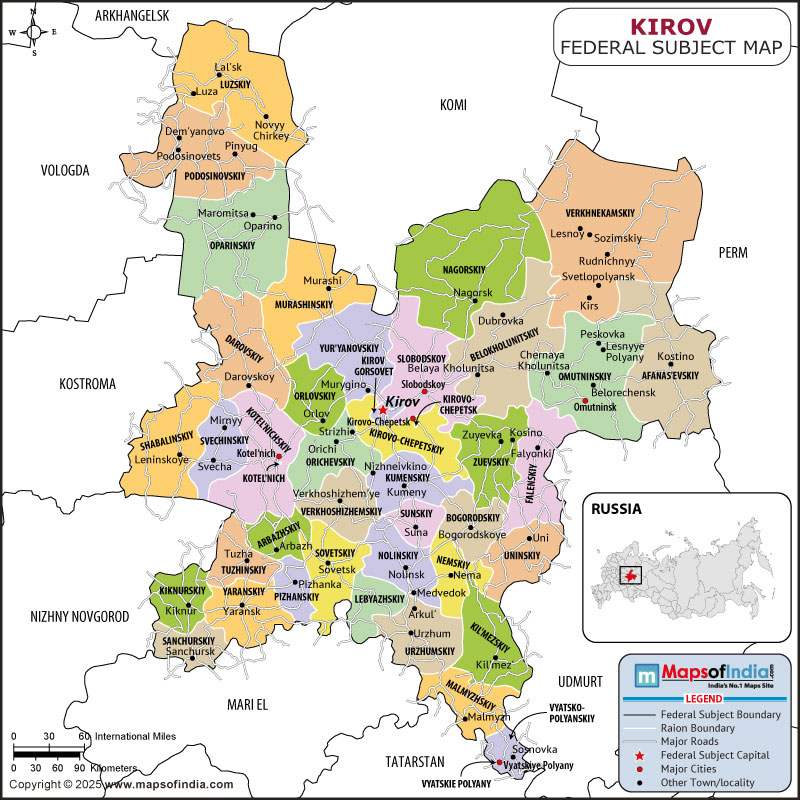



Kirov City is located along the Vyatka river in western Russia and stands as a Testament to resilience, cultural richness and historical evolution. It has a legacy which stretches back over 8 centuries.
The region has borne many names and identities beginning as Khlynov later known as Vyatka and renamed in 1934 in honor of Soviet leader Sergei Kirov. The strategic location and dynamic spirit has made it an important node in Russian history, trade and Industry.
It was founded In 1181 by traders from Novgorod. The city initially flourished as an element of commerce and certification. Early governance by the public assembly gave it a touch of republican independence. It withstood various pressures from surrounding principalities and emerged as a resilient frontier. Over centuries Kirov transformed from a defiant outpost into a recognized administrative center under the Russian empire.
By the time of the Soviet era it had become an influential industrial hub. During World War II wartime evacuation spurred rapid growth in the region. The factories' defence production educational institutions laid the foundation for modern cityscape. Today it has a population of over 5,00,000 and serves as the administrative center of Kirov oblast.
History
The city of Kirov is located on the Vyatka River in western Russia. It has a rich and complex history which spans over 8 centuries. originally founded as Khlynov in 1181 by traders from Novgorod. It became the center of Vyatka Lands. It was a region settled by Russians during the middle age. The area was initially inhabited by Finno Ugric tribes such as Udmurta and Komi and gradually absorbed the slavic settlers.
Khlynov Developed as a fortified settlement and was first mentioned in chronicles in 1374 when the Novgorodian ushkuyniks raided it en route to Bolghar. The city was governed by a public assembly similar to those of Novgorod and Pskov reflecting its earlier republican character. Throughout the 14th and the 15th century it maintained a degree of autonomy and often resisted external controls.
It supported Yury of Zvenigorod during the Muscovite Civil War. This led to military campaigns by Vasily II to subjugate the city. In spite of these efforts the region retained its independence for a time and even became an ally with the Khanate of Kazan in 1469.
Moscow finally annexed the region in 1489 after several failed attempts. Khlynov was integrated with the Grand Duchy of Moscow. The annexation marked the end of self -governance in the region.
Khlynov Transitioned from a military outpost to a commercial hub in the 17th century. In 1657 the Vyatka Diocese was established and the city saw construction of significant religious architecture. This included the assumption cathedral in 1689.
The merchant Spiridon Lyanguzov organized the first trade caravan from Moscow to China in 1694. This further enhanced the reputation of Khlynovas as a trade center. By the end of the century the town had become known for its clay statuette and whistles. This laid the foundation of the famous Dymkovo toys..
In 1780 Empress Catherine the Great renamed the town as Vyatka. She made it a seat of Vyatka governorate The period marks the cultural renaissance with the establishment of school printing presses and pharmacies.
Vyatka also became a place of political exile, hosting notable figures like Alexander Herzen and Mikhail Saltykov Shchedrin. Their presence contributed to the city’s intellectual and cultural development.
The October revolution of 1917 was initially resisted in Vyatka. They declared the Bolshevik uprising illegal and remained loyal to the provisional government. However by December 1917 Soviet power was established. In 1934 the city was renamed Kirov in the honour of Sergey Kirov, a prominent leader who was assassinated that year.
During World War II it became a key industrial centre due to the evacuation of factories from Moscow and Lenin Grand. The city's economy shifted toward machine building metallurgy and defence production.
This laid the foundation for post war industrial identity. In the 1950 and 16 the region underwent rapid urban development. Brick housing replaced old structures, roads were powered and social and first structures such as schools and hospitals expanded. In 1962 the first bridge over the Vyatka River was built. This improved the connectivity and facilitated the further growth.
In 1967 the population exceeded 3 lakh and in 1970 it was designated as a historic City. Cultural institutional plans which included the opening of Kirov Circus in 1977. The city continued to grow as a regional centre.
In post soviet Kirov maintained its status as an important and economic hub full service City became known for its scope craft specially toys and wood carving. It also hosted numerous festivals and cultural events including the golden calf international short film festival.
In 2024 Kirov celebrated at 650th anniversary with over 100 events including concert firework and exhibition. The festival highlighted the cities historical legacy and the modern aspirations. Despite the soviet name there have been movements to restore the city's original name. Being succeeded. Many institutions till we are the historical name. This reflects the city's connection to the past.
Culture
Kirov has a rich and vibrant culture that is woven from centuries of history, regional traditions, and artistic expression. It has been a centre of folk art and craftsmanship.
The Dymkovo toys are the most iconic contributions. They are brightly painted cloudy figures traditionally made by hand in the nearby village of Dymkovo.
These whimsical creations often depict women in crinolines, horseman and animals are celebrated across Russia and symbolise the region's artistic heritage.
Music and folklore play an important role in Kirov’s cultural identity. The city is known for accordionists and chastushka performers whose humorous and rhythmic songs have earned accolades at national festivals. Local ensembles and youth orchestras continue to preserve and reinterpret these traditions. They blend them with contemporary styles.
Architecturally Kirov boasts a mix of baroque churches and buildings and restored monastery. The Trifonov monastery founded in the 16 century remains a spiritual and historical landmark. Cultural institutions such as museum theatres and concert halls support a thriving art scene, hosting exhibitions and performances and literary events.
The cultural life is also shaped by its diverse population whose customs and languages in which the regions festivals and chooses. Whether through folk art musical multi cultural traditions the culture of the region reflected deep connected to it passed while embracing modern creativity.
Language
Kirov is a city in western Russia and predominantly speaks Russian as its official and most widely used language. Russian is the medium of education, government and daily communication throughout the region.
However the linguistic landscape of the region is more nuanced because of its historical and cultural diversity. Kirov has been home to divorce ethnic groups including the komi people whose language Komi is a member of the Uralic language family. It is spoken by a minority in surrounding areas of Komi Oblast.
Komi has several dialects like Komi Permyak and Komi Zyrian. Even though they are not commonly used in the urban areas they remain important in rural community and cultural preservation efforts.
Apart from this historical migration patterns have introduced German Island directly to the region particularly among the descendants of Russian Germans who settled in isolated communities. These dialects have a word uniquely and blend elements of German with Russian vocabulary and syntax because of prolonged contact and bilingualism.
All these dialects are now rare and mostly spoken by the older generation; they represent an important facet of the linguistic heritage of the region. The city's educational institutions and cultural centres occasionally support studies and exhibitions which highlight these minority languages and dialects.
Russian dominates public life but the presence of other minority languages reflect the region's layered history and ethnic diversity. It contributes to the identity of the place not just as a hub of industrial culture but also as a place where linguistic traditions intersect and evolve.
Geography
Kirov is located on the Vyatka river in European Russia. It is the largest city and the administrative centre of Kirov oblast Russia. The city and the surrounding oblast are part of the Central European Russian landscape. It is characterized by rolling planes which arise from the river valley to limestone upland in the north and east.
The region is heavily forested with coniferous and mixed with land covering about half its territory and expensive peat bogs and swamps which add to the ecological diversity. The climate is temperate continental marked by long cold winters and short mild summers. The annual temperature is around 1.75 degree Celsius and precipitation ranges from 500 to 680 mm.
Hydrographically the area is rich in water bodies featuring over 19000 rivers and streams. There are around 450 lakes, many of which are of glacial origin. These waterways support agriculture, fisheries and transportation.
The region also contains mineral resources like phosphorites and iron ore which contribute to the industrial base. The geography not only shapes the economy dominated by forestry agriculture and mineral extraction but also influences the settlement pattern. Most of the population is concentrated along the river valley.
Quick Facts
| Official Name | Kirov |
| Location | On the Vyatka River |
| Population | 507155 |
| Area | 757 sq. km |
| Languages | Russian and Kimo |
FAQs
Q1:What is the climate of Kirov?
Kirov has a temperate continental climate. It has long and cold winters. The summers on the other hand are short and mild.
Q2: How many languages are spoken in Kirov?
Russian and Komi are the two languages spoken in Kirov.
Q3: What are some of the places to visit in Kirov?
One can visit the Spasskaya Street, Holy Uspensky Trifonov Monastery, Alexander Garden, Vyatka Museum of Paleontology, Chocolate History Museum "Criollo", Museum of History of Ice Cream "Artico", Dymkovskaya Toy Museum, Embankment of Grin, and House of Merchant Bulychev in Kirov.
Last Updated on: April 15, 2026

