


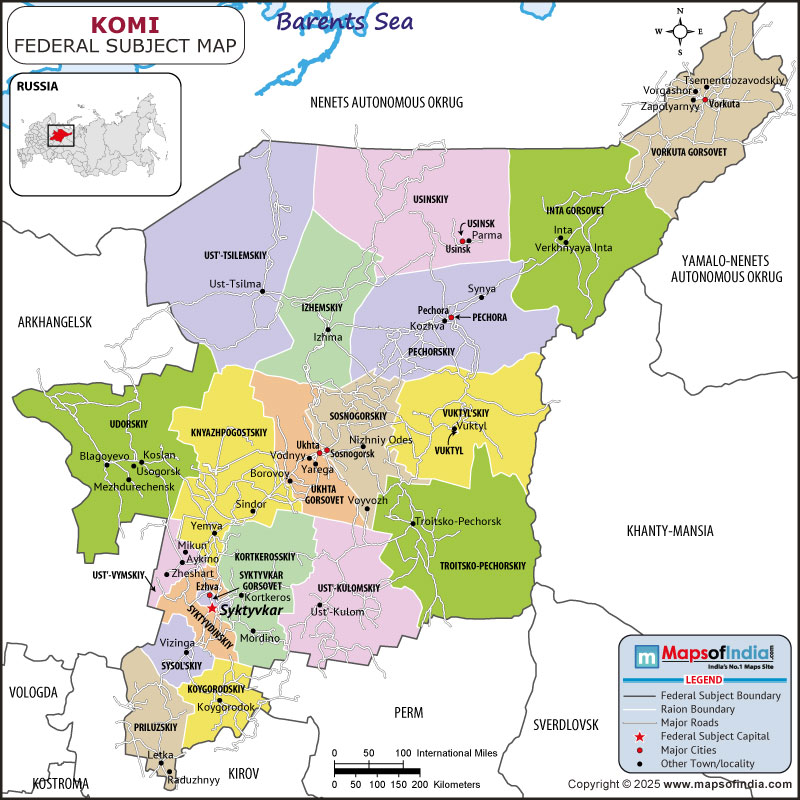



Komi republic is a federal subject of Russia and is located in northeastern part of European Russia. This region is rich in natural resources like oil, gas , coal and timber. It has played an important role in Russia’s economic development.
The region is also home to Komi people. They are a finno-ugric ethnic group with a distinct language and cultural heritage. The history of the place is a complex tapestry of indigenous traditions, Russian colonization, Soviet industrialization and modern socioeconomic challenges.
History
The Komi people trace their origin to the Permian branch of finno ugric tribe. They are closely related to the Udmurts and more distantly to Estonians and Hungarians. Archaeological findings suggest that the region was inhabited as early as the Mesolithic era with hunter gatherer communities living along the Pechora, Vychegda and Mezen Rivers.
By the Middle Ages these communities had transitioned to a more settled way of life engaging in agriculture hunting and fishing. Trade connections with the volga bulgars and later the Novgorod Republic introduced the region to Slavic influences. This set the stage for future interactions with the Russian settlers.
The grand duchy of Moscow began expanding into komi lands in the 14th century. He was motivated by the lucrative fur trade and the strategic importance of the northern territories. In 1366 the komi lands were formally annexed by Moscow. This marked the beginning of Russian dominance.
An important figure in this was Saint Stephen of perm who was a Russian missionary. He created the old premic script to translate Christian text into the komi language. This led to the christianization of komi people.
However many retained elements of their Pagan traditions. Under Russian rule the komi were gradually integrated into the muscovite administrative system with many assimilating into Russian culture while others migrated further North East to escape taxation and forced labor.
During the 18th century the Komi region was incorporated into the Vologda governorate and later the Arkhamgelsk governorate. The area remained sparsely populated with most Komi people engaged in subsistence farming, hunting and fishing. The 19th century brought the first signs of economic change.
The Russian empire began using the remote region as a place of political exile sending dissidents and prisoners to its harsh climate. Small scale mining and logging operations also emerged though the region remained underdeveloped compared to central Russia. Despite these changes the Komi people maintained their cultural identity with oral traditions and folk-art preserving their culture.
The Russian Revolution of 1917 and the subsequent civil war brought dramatic changes to the Komi region. In 1921 the Komi Zyryan autonomous oblast was established as part of the Russian Soviet federative socialist Republic and in 1936 it was upgraded to Komi autonomous Soviet socialist Republic. The period saw both rapid industrialization and severe repression.
One of the darkest chapters in the history of Komi was its role in the gulag system. Under Stalin the Republic became a major Center for forced labour camps particularly in the Vorkuta and Inta where prisoners mined coal and built infrastructure under brutal conditions. Thousands of political prisoners of intellectual and ethnic notice perished in these camps. It left a lasting scar on the region’s history.
Despite the repression the Soviet era also brought significant industrial development. The discovery of coal and workouts in the 1930s transformed the region into a key mining hub. Oil and gas extraction began in yukata and the timber industry expanded.
This made Komi one of USSR leading producers of wood. This industrialization led to the population boom. Workers from across the Soviet Union migrated to the region. However the influx of Russians and other ethnic groups reduced the Komi people to a minority in their own Republic accelerating the cultural assimilation.
The collapse of the Soviet Union in 1991 brought both opportunities and challenges to the Komi Republic. The 1990s was marked by economic decline as Soviet era industries struggled to adapt to market conditions.
Many coal mines in Vorkuta were closed which led to unemployment and out migration. Environmental degradation from decades of industrial exploitation also became a pressing issue. In 1992 the region was renamed Republic of Komi within the Russian Federation. The post Soviet period saw efforts to revive Komi language and culture.
The Komi language was reintroduced in schools and cultural festivals celebrating traditional music, dance and craft. The national organization worked to preserve Komi heritage but challenges remained. By the twenty 20s about 23% of the Komi people spoke their native language fluently. This reflects the ongoing assimilation pressure.
Today the Komi Republic remains an important energy and mining region of Russia. Major companies like Lukoil operate here extracting oil and gas. The timber industry continues to play an Important role.
However the Republic faces depopulation as the younger generation moves to larger cities in search for better opportunities. The region is known for its natural beauty. Yugyd Va National Park is a UNESCO World Heritage site which is located here and the stunning Manpupuner rock formations are also found here. These landmarks attract tourists and highlight the need for sustainable development.
Culture
Komi republic is rich in culture which is a vibrant blend of indigenous phenom ugric tradition and Russian influences. It has been shaped by the remote northern environment and rich history. The komi people have preserved the unique folk customs including mythology centered around nature spirits such as forest God and water spirit.
Traditional komi music features hunting polyphonic singing and instruments. Folk dance often performed in colorful embroidered costumes mimic animals and seasonal rituals which reflect close ties to the natural world.
The komi language, though endangered, remains a cultural cornerstone. There are efforts to revive it through literature education and media. The Republic hosts festivals which celebrate Komi folklore which is a music craft and remnant of ancient ritual.
Woodworking and textile art are highly developed with intricate Birch bark weaving and patterned woolen garments which symbolize the identity of people. Russian orthodoxy introduced by Saint Stephen of perm in the 14th century coexists with remnants of pre Christian shamanism particularly in the rural areas.
Soviet industrialization brought a wave of Russian settlers which diversified the cultural landscape by diluting the Komi traditions. At the same time today the urban centers blend modern Russian culture with Komi heritage while the remote villages keep older ways alive.
Language
The Komi Republic is a linguistically diverse region where several languages are spoken. This reflects the ethnic composition and the historical influences over the region. The primary languages are Komi and Russian with Russian serving as the dominant language of administration education and daily communication.
This is because of centuries of russification and Soviet era policies. The Komi language belongs to the Permic branch of finno ugric language family and has two main dialects komi zyrian, the literary standard used in media and education and komi permyak spoken primarily in the neighboring Perm Krai.
Despite efforts to preserve the language through schools programs and cultural initiatives its usage has declined with only 20% to 25% of the ethnic Komi population speaking it fluently today. Additionally minority languages like Nenets spoken by indigenous reindeer herders in the north and Ukrainian or Tatar brought by Soviet era migrants can be heard in some communities.
Russian remains the lingua franca though recent revitalization projects aim to strengthen language education and media presence to safeguard this important element of the region’s cultural heritage.
Geography
The Komi Republic is located in the far northeast of European Russia and spans an area of over 4,15,900 square kilometers. The terrain is diverse and features timber rich taiga forest of the West, the marshy tundra plains of the north and the Ural mountains in the east. It includes the striking man opener rock formations.
The region is crisscrossed by numerous rivers with the Pechora being the most significant. It stretches 1800 kilometres and serves as an important waterway for transport and industry. Other major rivers include Vychegda, a tributary of northern Davina and Usa which flows through the Arctic north.
The climate here is subarctic with long harsh winters where temperatures can plunge below -40°C and short cool summers averaging 15 to 20°C. Parma frost dominates the northern tundra while the southern taiga zone experiences heavy rainfall and high humidity.
The republic's vast wetland and denser forest contribute to the ecological importance. It hosts protected areas like the Yugyd Va National Park which is a UNESCO World Heritage site. Despite its challenging climate the region’s natural resources oil, gas, coal and timber have driven the economy. However exploitation has also raised environmental concerns in recent times.
Quick Facts
| Official Name | Komi Republic |
| Location | Northeast Russia |
| Population | 37853 |
| Area | 416774 |
| Major Languages | Russian and Komi |
FAQs
Q1: What is the currency of the Komi Republic?
The currency of the Komi Republic in Russian Ruble.
Q2: What flora can be found in the Komi Republic?
One can find Siberian spruce, Scots pine, Siberian fir, dwarf birch, Arctic willow, cloudberry, lingonberry, bilberry, reindeer moss, peat moss, marsh Labrador tea, northern horsetail, and Ural mountain ash in the Komi Republic.
Q3: What is the Fauna of the Komi Republic?
One can find brown bear, reindeer, wolf, lynx, Arctic fox, elk, sable, beaver, otter, Siberian flying squirrel, capercaillie, hazel grouse, golden eagle, osprey, salmon, grayling, and the endangered West Siberian river lamprey in the Komi Republic.
Q4: What is the climate of Komi?
The climate here is subarctic with long harsh winters where temperatures can plunge below -40°C and short cool summers averaging 15 to 20°C. Parma frost dominates the northern tundra while the southern taiga zone experiences heavy rainfall and high humidity.
Last Updated on: April 15, 2026

