


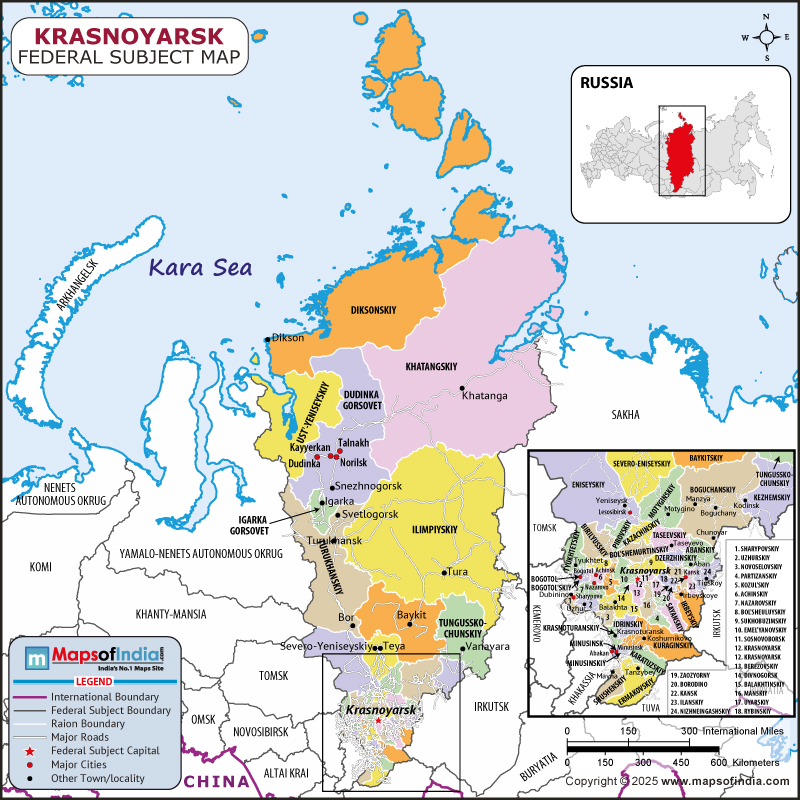



Krasnoyarsk Krai is a wide federal territory of the Russian Federation occupied by the bulk of central Siberia, the length of which is about 2,366,800 square kilometres. It is the second largest federal subject of Russia by area, and the third largest first-level administrative division in the entire world. Administrative centre is the city of Krasnoyarsk, sitting on the banks of Yenisei River and acting as a primary regional centre of industry, transportation, science, and culture. In spite of the fact that it comprises about 13 per cent of the total land mass of Russia, the krai is only populated by a figure of around three million people, which makes this region one of the least densely populated regions of Russia.
History
The Palaeolithic campsites and stone tools found on the terraces of rivers testify to the presence of human history in the modern territory of Krasnoyarsk Krai tens of thousands of years ago. The settlements of the Andronovo cultural horizon became scattered by the Bronze Age, leaving behind mounds of burial and tips of pottery. Nomadic and semi-nomadic peoples started seeing these lands much later, in the first millennium BC, with nomads and semi-nomads, commonly referred to by classical authors as Scythians, wandering the lands and leaving behind the kurgan burial mounds and early metalworking technology.
The initial permanent Russian settlement started at the start of the 17th century as Cossack detachments advanced eastwards along the Siberian frontier. Krasnoyarsk city dates to the year 1628 when the ostrog (fortified stockade) of Andrij Dubensky was set on the right bank of the Yenisei River. Over the decades, traders, explorers and convicts filtered in to kill sable cells and take out timber and furs, which were to form the staple of the Siberian fur trade. Located along the mighty rivers, the isolated hunting grounds were connected by the main highways to the developing European Russia markets.
The later era of the 19th century marked a revolutionary period following the building of the Trans-Siberian Railway. Built in phases between 1890 and 1916, the rail line brought the swift development of the economy as the new railroad brought the extraction of timbers and minerals near the processing plants and Atlantic seaboard towns. Railway junctions grew around towns such as Kansk, Ilansky and Achinsk, and the population was diversified as engineers, labourers, and merchants flocked into the region.
The largest natural phenomenon in the history of the region ever recorded was an absolute blow in the form of a huge explosion estimated at 10-15 megatons, flattening as it occurred over 2,000 square kilometres of taiga terrain in a place connected to the name of the Podkamennaya Tunguska River, and happened on June 30, 1908. The Tunguska flattened forests in the form of a ring, and it became the largest impact event on Earth in modern epochs. The distant origin and the craterlessness have made it the source of scientific argument and popular interest since the late nineteenth century.
The consolidation of the administration after the Bolshevik Revolution and the formation of the Soviet Union occurred. In 1934, Krasnoyarsk Krai was officially created and combined the land that was torn out of larger West Siberian and East Siberian krais. It subsequently included the Evenk Autonomous Okrug and the Taymyr Autonomous Okrug, and the Khakas Autonomous Oblast. During the Great Patriotic War, the local industry was used to support the front, and after the war, reconstruction led to an even further development of mines, hydroelectric dams and metallurgical work.
Culture
The cultural construct of Krasnoyarsk Krai can be traced to the science of convergence of the aboriginal traditions and Russian urban institutions. In Krasnoyarsk city and regional capitals (such as Minusinsk), exhibitions of local history and modern creativity may be observed in museums, theatres, and art galleries. Krasnoyarsk State Opera and Ballet Theatre presents not only classical repertoires and modern theatre productions but also has Vasily Surikov Art Museum, with the works of one of the most well-known painters in the 19th century in Siberia.
Among the Evenki, Nenets, Dolgan, Nganasan, Enets, Ket, and a number of other ethnic groups, indigenous heritage flourishes in the communities. The cultural practices still involve seasonal migrations in reindeer herding, fishing and hunting. Shamans conduct rites which are used to enhance harmony between people and spirits of taiga and tundra. Artisans make fine colored embroidered clothes, fur-trimmed boots, and wood carvings that are a mix of utility and religious or symbolic work.
Festivals are a tantalising look into living traditions. Maslenitsa of the Slavs, a prelenten pancake week, turns in Siberia to a sledging, snow-sculpturing, blini-baking carnival in squares and in clearings of towns as well as villages. The Yenisei Ukha Festival welcomes people to make huge soups out of fish and cook them on open fires along the banks of the river, enjoying the treasures of the Yenisei and traditions of sharing. Evenks Storytelling Nights gathers the elders together around the campfires and listens to their folklore and epic tales, solidifying longevity in generational ties.
Historical building marks the scenery. The onion-shaped domes of the wooden churches built in the 18th century in the Minusinsk Hollow are maintained as museum-reserves with intricate fretwork. Yeniseysk Kremlin is the most northern stone kremlin in Russia and a monument to the initial Cossack forts. Witnesses to darker pages of the regional history are the Soviet-era monuments, such as those erected to the political prisoners sent into Gulag camps.
In the last few decades, ecotourism has been on the rise. The Stolby Nature Reserve, situated at a backdrop of volcanic rock pillars in the periphery of Krasnoyarsk city city attracts climbers and photographers due to its granite pillars. Other hiking tracks in the Putorana Plateau pass through basalt plateaus and unspoilt lakes, as well as secret waterfalls. The spa resorts along the reservoirs have traditional Russian banyas mixed with forest therapy, and they take advantage of the conviction that landscapes of Siberia are healing.
Language
The lingua franca of Krasnoyarsk Krai is the Russian language, which reigns over administrative work, higher and secondary education, media and interethnic communication. But there is still a rich tapestry of the native languages, the various speakers comprising smaller groups, each a different concept and a different wisdom of the ecosystem gathered over millennia.
Evenki is a Tungusic language that used to carry shamanic worldview, hunting terms, and flora and fauna data. Nenets, belonging to the Samoyedic branch of Uralic family, condenses the pastoral nomadic society of reindeer herders in the northern tundra. Dolgan and Nganasan, which also belong to the Samoyedic tongues, also reflect contact with the Turkic and Tungusic neighbours both in the lexicon and in the oral forms.
In rural areas, educational programs may include classes in native language as well as workshops on cultural learning and maches in summer immersion observed by local non-governmental organisations. Such initiatives are done to foster the intergenerational conveyance that has frequently been upset by the dominance of the Russian and out-migration of young generations to cities. The linguistic survival is tangled with general cultural renewal movements, which communities all over Siberia are seeking to establish themselves in the present-day Siberian context.
Geography
Some 3,000 kilometres in length, stretching across the southern Sayan Mountains to the Arctic coastline, Krasnoyarsk Krai covers an absolutely staggering diversity of climate, topography, and biozone. It is bounded by Sakha Republic (Yakutia) and Irkutsk Oblast to the east, Tuva to the south and Khakassia, Kemerovo, Tomsk and West Siberian plain to the west and frozen waters of the Laptev and Kara Seas to the north.
The southern border borders on the Western and Eastern Sayan ranges, marked by rugged mountains apparently over 3,000 meters, glaciated cirques and alpine meadows. Moving lower to the north, one sees Central Siberian Plateau, which is really a patchwork of humps, deep drops in rivers, and large taiga forests dotted by Siberian larch, cedar, and birch trees. The scenery also changes to tundra along with the arctic deserts north of the 66th parallel, with permafrost supporting cold water soils and tough low shrubs.
The hydrographic network of Krasnoyarsk Krai is formed by the great river of the Yenisei, today one of the longest freshwater systems. Its source streams merge at Iymitsy to form a water course flowing northwards to form canyons and to inundate extensive lowlands. The southern mountains and plateaus are drained by major tributaries such as the Kan, Angara, Podkamennaya Tunguska and Nizhnyaya Tunguska. There are literally thousands of lakes, some large lakes, such as Beloye and Lama and even the smaller glacier tarn lakes, which serve as fish spawning areas, waterfowl nesting areas and even a source of local fisheries.
There is a severe difference in climate with respect to latitude and altitude. The southern foothills have a humid continental climate: hot summer with an average temperature of July at 18-20 °C and cold winter at -18 °C. More to the north, the winters get colder, at -30 °C and below, and summers get shorter than 40 days at 10 °C. Perpetual permafrost, midwinter polar nights and midnight sun in midsummer are found along the Arctic coast.
Quick Facts
| Official Name | Krasnoyarsk Krai |
| Population | 2,856,971 (As of 2023) |
| Area | 2,366,797 km² |
| Language | Russian |
| Religion | Christianity |
FAQs
Q1: Which famous impact crater is situated in the Krai?
The Popigai crater in northern Krasnoyarsk Krai is one of the largest and best-preserved meteorite impact structures on Earth.
Q2: Which UNESCO World Heritage Site does Krasnoyarsk Krai host?
The Putorana Plateau, inscribed in 2010, features dramatic basalt plateaus, deep canyons, and unique Arctic flora and fauna.
Q3: What is Russia’s northernmost permanent settlement within Krasnoyarsk Krai?
The village of Dikson, at the mouth of the Yenisei River on the Kara Sea coast, is Russia’s northernmost inhabited locality.
Q4: Where is Russia’s tallest waterfall found in the region?
Talnikovy waterfall, plunging nearly 700 meters, is the highest waterfall in Russia and lies deep in the Putorana Plateau of Krasnoyarsk Krai.
Last Updated on: April 15, 2026

