


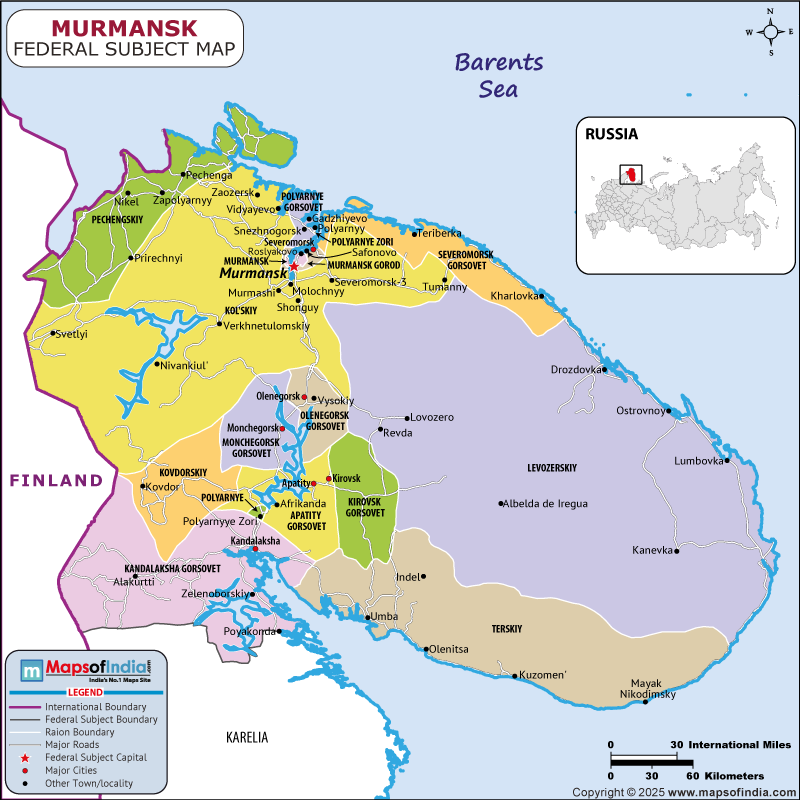



Murmansk is a city on the coast of far northern Russia, close to the Arctic Ocean. It’s located on the Kola Bay and is one of the largest cities in the north of the Arctic Circle. The city is unlike warmer places; it has cold winters, cool summers, long summer days, and long winter nights.
This article describes why Murmansk is significant. That’s why we’re going to tell you about the history of the city, life in and around the area, the culture, the language spoken, the geography, and address some frequently asked questions about this place.
History
The history of Murmansk began in a time of war. Russia constructed this city during World War I in 1916 near the Arctic Ocean. The logic was simple: Russia required an ice-free seaport. The majority of other northern ports were frozen in winter. But due to a warm current from the Atlantic, Murmansk remained ice-free. This caused it to be a good place for ships to bring food, tools, and other supplies from other countries.
The town was originally named Romanov-on-Murman. It took its name from the royal House of Romanov. But the name was changed to Murmansk after the Russian Revolution in 1917. It soon became an important centre of trade and transport.
Foreign troops sailed into Murmansk in Russia during the Russian Civil War (1917 to 1920). British and other Western armies went there to fight against the newly formed Soviet government. After the war, the city remained under Soviet control. Slowly, it began to grow.
The real test for Murmansk came in World War II. It was one of the largest cities used to bring weapons, food, and supplies from the United States and Britain across to the Soviet Union. These were referred to as the “Arctic Convoys.” Consequently, the city was a German target. It was bombed repeatedly, and great swaths of the city suffered extreme damage. But the people of Murmansk wouldn’t quit. They rebuilt the city and kept supplies flowing to the rest of Russia.
At the end of the war, Murmansk became a bustling place once more. New buildings went up, ships filled the port, and factories opened. The city soon would serve as a headquarters for Russia’s navy. Many went there for work in fishing, shipping, and industry.
Life was strictly regulated in Murmansk in the Soviet era. The state provided jobs, and many things were communal. People became accustomed to life in the cold, short days and bright nights of winter and then, in summer. They built a strong community.
Murmansk had a little bit of a tough time after the Soviet Union dissolved in 1991. Jobs were lost, and prices went up. Still, the people stayed. They work hard to keep the city alive.
Now the history of Murmansk is remembered with pride. There are war monuments, museums, and stories handed down from generation to generation. The Alyosha monument looks down from a hill in tribute to the heroic citizens who fought and worked during the war.
Culture
The city's culture is very much defined by its cold, icy weather and northern location, along with its people. Life is not always easy here, but the people are warm, welcoming, and love and appreciate their city. Living so far in the north, they’ve learnt to rely on one another and enjoy simple pleasures like music, food, family, and tradition.
An important part of the culture of Murmansk in Russia is the sea. Fishing is not just work; it’s a local identity. Families have been working at sea for generations. Even now, locals still go down to the port in the morning to buy fresh fish. Local homes all have seafood dishes such as boiled crab, pickled herring, or smoked salmon.
Murmansk is also deeply attached to its history. The city was hit pretty hard in World War II, so they honour this every year. Flowers are laid at war memorials; people come together to pay their respects and take part in remembrance services to honour those who have fought. The large statue of a soldier, known as Alyosha, is a powerful symbol. It looks down on the city from a hill and serves as a reminder to all of the courage and fortitude of the people of Murmansk.
Murmansk's culture is also home to several festivals and public events. In winter, when the sun doesn’t appear for weeks, the city organises light shows, music nights, and ice sculpture displays to brighten the dim winter darkness. In the summer, there are White Nights; there are weeks when the sun never quite sets. Families picnic, play music outside, and walk along the sea until midnight.
Art and music are also important. Local theatres play Russian-language plays, specialising in stories of life in the Arctic. The music school of Murmansk educates young people in piano, violin, and singing. Folk music, which involves simplistic instruments such as flutes and drums, is popular with many inhabitants. These are often songs about the sea, love, and winter.
Religion is a quiet but strong presence in everyday life, too. The Russian Orthodox Church is the most prevalent. People go to church, light candles, and celebrate holidays, Christmas, and Easter in the traditional way.
While Murmansk is cold most of the year, the people here keep their culture warm and lively. They eat meals together, respect nature, and keep family and friends close. Whether you’re a first-time visitor or a long-term resident, the culture of Murmansk is one of kindness, pride, and some sense of belonging.
Language
The official language of the city is Russian. People speak clearly and simply. When you visit Murmansk, it will be very useful if you know a few words in Russian. The locals are friendly, and most of the signs are in Russian.
You may also encounter northern variations, influenced by nearby Finnish, Karelian, and Sami languages. Some of the elders of the villages know Sami or Karelian really well. These are unusual, but they tell us something about the older history of the northern lands.
Standard Russian is taught in schools to children. Some of the migrants speak English or Norwegian as a second language and reside near the border. Russian is the language of daily life in shops, in offices, and in schools.
Geography
One of the most curious things about Murmansk is its geography. Murmansk lies in extreme northern Russia, beyond the Arctic Circle, on the Kola Peninsula. Located on the east bank of Kola Bay, it is a port and the railroad station of Murmansk. This sea is ice-free due to the warm ocean current flowing from the Atlantic Ocean. That is why Murmansk is one of the rare northern ports.
Murmansk is situated among rocky hills, cold forests, rivers, and little lakes. The land is primarily tundra, with short plant life and moss instead of tall trees. There are some forests nearby, but they are not dense. In spring, the rivers open up and the land turns green.
Climatic and geographical conditions in Murmansk are closely interrelated. The winters are long, dark, and freezing. The sun never rises above the horizon between late November and mid-January. People call this the Polar Night. Days are overcast and short, and people depend on street lights and home lights through most of that time. It can get down to –30°C, and it often snows. The roads frequently are a sheet of ice, but life goes on.
In summer, the opposite happens. From late May to mid-July, Murmansk has the “White Nights,” when there are almost 24 hours of daylight. The sun does not set, and, at midnight, the sky appears like early evening. It is a festive moment for the locals. Temperatures become warmer, somewhere between 10 and 20°C.
The city is constructed on hilly terrain. Streets rise and fall on hills, and many buildings look out over the water. There are many parks and walking paths and open spaces where you can see the ships in the harbour. Murmansk, too, is near nature, with silent places just beyond the city where people can fish, hike, and pick berries and mushrooms in the warmer months.
The geography of the city makes it a little harder to get around than in other places. It is not full of roads leading to other big cities. The majority come by air or sea. The Murmansk port is very important. It deals in cargo, fuel, and fish and also provides a base for navy ships and research boats.
So, the geography of Murmansk reflects a cold, silent, and somehow beautiful land. It also teaches how to live with nature, to push back against the cold, and to find peace in open skies and snowy hills.
Quick Facts
| Official Name | Murmansk |
| Population | Around 270,000 |
| Area | Approximately 170 km² |
| Currency | Russian Rouble (RUB) |
| Religion | Mostly Russian Orthodox |
| Language | Russian |
FAQs
Q1: What is Murmansk famous for?
Murmansk is famous for its Arctic port, the Northern Lights, its war history, and a strong sense of community.
Q2: How is the culture in Murmansk?
Murmansk culture is based on the sea, hard labour, the family, and local traditions. Since people like music, dancing, and winter festivals.
Q3: Is Murmansk safe for tourists?
Yes, Murmansk is generally safe. People are polite and helpful. And like any city, it’s always best to remain alert and keep your belongings secure.
Q4: When is the best time to visit Murmansk?
If you want to see snow and the Northern Lights, you should visit between November and March. If you like sun and mild weather, that would be during the months of June to August.
Q5: Is it possible to view the Northern Lights in Murmansk?
Yes, you can spot Northern Lights in the skies around Murmansk from late autumn to early spring.
Last Updated on: April 15, 2026

