


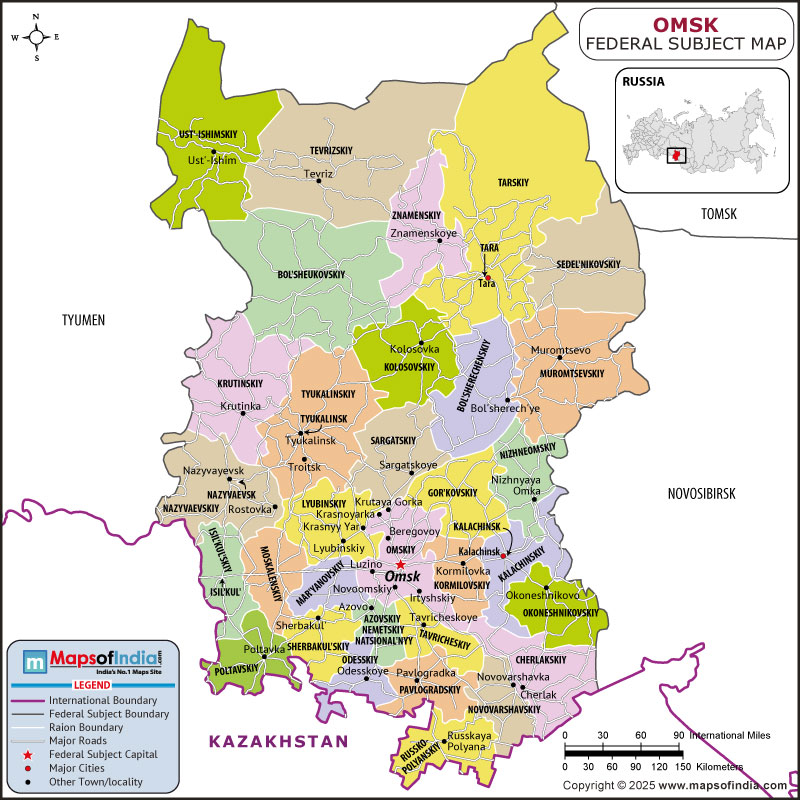



Omsk is one of the most vibrant cities of Siberia and is located at a very strategic place, as there is a confluence of the river Om and the Irtysh. Taken in 1716 as a Cossack fortress, it turned into the central administrative unit of Omsk Oblast and currently has a population of about 1.12 million people and covers a territory of 567 km². It gives Omsk the status of the third (behind Novosibirsk and Krasnoyarsk) major city of Siberia, and the twelfth (in the entire nation) largest one in Russia.
During its 300-year history, Omsk has been one of the transport hubs on the Trans-Siberian Railway and also a river port on the Irtysh that connected European Russia and Kazakhstan, China, and other countries. The industrial backbone of the city, in petrochemicals, machinery, and food processing, rides next to a robust academic environment composed of ten institutions of higher learning. Historical, cultural, and beautiful, Omsk is a bright example of Siberian steel and aspiration.
History
The history of Omsk started on 2 August 1716 when a detachment of Cossacks commanded by Lieutenant Colonel Ivan Buchholts founded a wooden fortress on the Om River. The fort was commissioned by Peter I as part of fortification measures he had put in place to secure the expanding Russian frontier against the incursion of the nomadic people and to provide protection to the budding trading routes to China. By 1782, Omsk became officially established as a town in Tobolsk Governorate and in 20 years, it became the centre of the Governor-General of Western Siberia. During the reign of Tsar Alexander I, the settlement obtained stone fortifications, Orthodox temples and a palace of the governor, becoming a city, the capital of the region.
The coming of the Trans-Siberian Railway at the beginning of the 1890s was a jump in the industrial modernity of Omsk. Laid on the riverfront were rail yards, workshops and warehouses that drew merchants, engineers and labourers. The population increased between 1825 and 1897 from 37,300 to 9,000, and in 1914 it had some 135,000 inhabitants. Banking houses, grain elevators, flour mills bore witness to a thriving economy of agriculture and metal working and cultural societies as well as press organs began to define an urban middle-class.
Omsk served for a short time in 1918 as the capital city of the White movement under Admiral Alexander Kolchak, when Russia shook with the 1917 Revolution, June 1918-November 1919. The Kolchak government took the governor's mansion and guarded the imperial store of gold, and Omsk was a bastion of anti-Bolshevism. Following the conquest of the Red Army, the factories and the administrative structure of the city were restarted under Soviet rule. In 1925, Omsk was named one of the primary new heavy machinery design bureaus, with heavy-industry plants important to the new Five-Year Plans.
The fall of the USSR in 1991 meant economic trouble: defence firms declined, joblessness increased, and the city was overcome with inflation. But the late 1990s and the early 2000s have brought Omsk back to life with new strategic investments in oil refining, petrochemicals and construction materials. The result was new private-sector efforts in both woodworking and food processing, and foreign liaisons led to the modernisation of machinery plants. By the 2010s, Omsk was again a chief manufacturer of tractors, engines and polymer products, and its population was settling at the one-million point.
Culture
Omsk has a rich performing-arts culture, with its centre, the Omsk State Academic Drama Theatre, among the oldest provincial theatres in Russia. It has been performing classical Russian drama, works of the day and foreign productions. The Omsk State Music Theatre opened in the 1970s and presents operas and ballets, and the Harlequin Puppet Theatre amaze children with magical shows. The Philharmonic Hall features orchestra concerts, chamber music recitals and a yearly organ festival which summons virtuosi around Europe.
The lucky museum buff will discover a plethora of treasures: the fine art of the Vrubel Museum, with its favourite Russian avant-garde artists, and porcelain of life size, at the Regional Museum of Local Lore located in the old governor's mansion. The second documents the history of Siberian archaeology, Cossack traditions and the history of political deportation. To the military history lovers, the Victory Memorial Complex on the bank of the river Irtysh is in honour of the role of Omsk in the Great Patriotic War and the post-war period.
The cultural calendar of Omsk is bloated with cultural festivals marking events in as little as music of the streets to music of the classics. The White Nights Festival illuminates summer nights with their evenings of opera, jazz and dancing in their historic squares. The Snowflake Festival turns city parks into the land of ice sculptures in winter. Book fairs, folk-music festivals and outdoor theatre-performance productions also enhance the image of Omsk as the cultural capital of Siberia, and nurture home-grown talent and performers based in Moscow and St. Petersburg.
The plates of traditional Siberian cuisine, like pelmeni (meat dumplings), stroganina (frozen slice of fish) and substantial buckwheat porridge, appear in both taverns and in high-end restaurants. Tatar pies, Ukrainian borscht and German potato salad pay tribute to the immigrant communities who came ready to settle in the 19th and early 20th centuries. Food festivals feature hand-made cheeses and smoked meat, and wild-berry jam gathered along the taiga and river shores.
Language
The ordinary and official language of Omsk is Russian; it is used by governmental and educational institutions, as well as mass media. The local dialect is close to the Standard Russian, though it has loanwords from both the Turkic and Uralic languages due to centuries of interaction with Siberian Tatars, Khanty, and Mansi people.
A number of universities in Omsk specialise in linguistics, translation studies, regional languages. Research centres study Siberian toponymy, bilingual education and city migration sociolinguistics to make sure that the language diversity is one of the living constituents of the city.
Geography
The city of Omsk is also located at 54°59′ N latitude and 73°22′ E longitude range in the SW side of the West Siberian Plain. It lies within its urban fabric on both sides of the Irtysh River just below the point where it turns into joining the Om, returning a mosaic of flood plains, sand bars and higher terraces. These natural features affect the designs of neighbourhoods, parks, and flood-control works, among other things.
The climate in Omsk is very continental with long, cold winters and short, warm summers. The average mean temperatures are -18 °C in January and +25 °C in July, with rare extreme temperatures falling to below -45 °C or rising to highs of more than +35 °C. Rainfall averages about 350 mm annually and falls in summer storms, with an essentially dry and clear winter atmosphere. These forests are taiga growing on the fringes of the city and riparian wetland, and enclosures of meadows in the floodplain that house a wide range of birds, mammals, and aquatic species. The quality of air is best when spring arrives, as there are instances of inversion in winter trapping the pollutants in the winter, which trigger action within the municipal range of clean fuels and green spaces.
The Irtysh River continues to be an important part of the city of Omsk as well as its logistics. May to October: grain, timber and construction material brought upstream to downstream ports in cargo ships. The city has a number of river terminals, each with cranes, storage ponds, as well as winter-pier yards. The southern and northern branches of the Trans-Siberian subsequently meet at Omsk-Passazhirsky station.
The freight yards unload the commodities in large quantities that go to East Asia, whereas the normal suburban trains connect Omsk with nearby towns. Roads There is a network of federal highways linking the city with Novosibirsk (about 680 km in the west direction) and Tyumen (890 km to the northwest). The Tsentralny Airport (Domodedovo-class) provides flights to Moscow, St. Petersburg and the capitals of the regions every day.
The city of Omsk has a mix of Soviet-era apartment buildings, imperial-style mansions, and multi-storey apartment complexes. The historic centre, which is characterised by the Cathedral of the Assumption, the wooden House of the Merchant Vasiliev and the green August Catharina Street, is lifted up over low districts which are subject to spring flooding. In alleviating inundation, engineers built levees and overflow channels back in the 1960s, and this saved the residential areas as well as waterfront parks.
The year-round recreation takes place in green lungs like Victory Park, Rechnoy Vokzal embankment and the Dubrava arboretum. The natural topography of the city has been exploited through jogging routes, cycling tracks and boating amenities, with the winter configuration of ice rinks and ski tracks slicing through the islands in the rivers. Collectively, these facilities are the base of the reputation of Omsk as a city combining urban and natural life.
Quick Facts
| Official Name | Omsk |
| Population | 1,154,116 (As of 2010) |
| Area | 566.9 km² |
| Language | Russian |
| Religion | Christianity |
FAQs
Q1: Why is Omsk nicknamed the “Venice of Siberia”?
Its web of islands, floods and more than 60 bridges over the Om and Irtysh rivers gives it a distinctly Venetian feel.
Q2: What makes Omsk the only city to boast a Dostoevsky museum?
Fyodor Dostoevsky served four years in the Omsk prison, and the city now preserves his cell and personal artefacts in a dedicated museum.
Q3: Which wooden landmark in Omsk best exemplifies the Siberian Baroque?
The early-19th-century Merchant Vasiliev House, with its intricate fretwork and onion-dome motifs, stands as a rare wooden Baroque gem.
Q4: What light phenomenon can visitors enjoy during an Omsk summer night?
From late June through July, the city’s high‐latitude position produces “white nights” where full darkness never quite falls.
Last Updated on: April 15, 2026

