


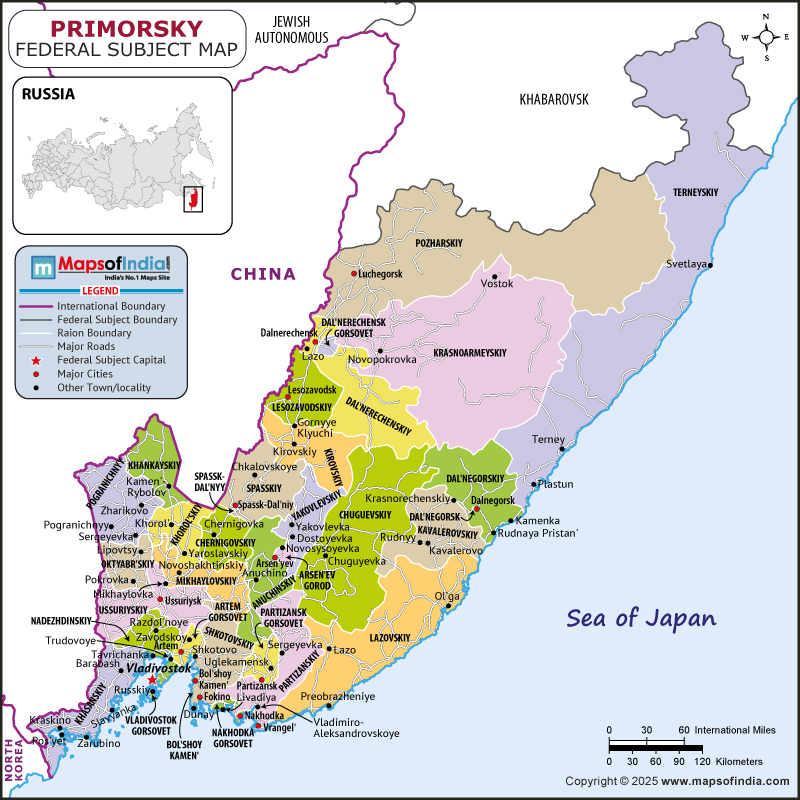



Primorsky Krai is located at the southeast end of Russia, along its coastline facing the Pacific Ocean, where Peter the Great Gulf meets the Sea of Japan. With an area of 164,673 square kilometres, this maritime area creates the connection between continental Asia and the Pacific rim and represents the significant connection between Moscow and Tokyo. It has its administrative headquarters at Vladivostok, which sits on a peninsula that overlooks Golden Horn Bay and flanks the eastern end of the Trans-Siberian Railway, which is an engineering marvel that makes a 9,289-kilometre journey across Eurasia.
History
Social history Human settlement in Primorsky Krai can be dated back at least 30,000 years when Palaeolithic hunters and fishers ranged along riverbanks and coastal terraces. Stone tools, shell middens and cave paintings have been found through archaeological excavations along the Ussuri and Amur river basins, testifying to advanced submarine and riverine adaptations. These tribes created the cultural substrate on which successive Northeast Asian polities such as Goguryeo, Balhae, Khitan Liao and Jurchen Jin would base their taunt claims or fought over each other in the power games of the region, and years transpired.
The Qing Dynasty nominally controlled the Amur basin, including territory to be incorporated into the Primorsky Krai during the 17th century, but was unwilling to develop or settle the hostile fringe. Cossacks and Russian explorers occasionally travelled to the east, exploring rivers and establishing trade connections with the locals. A Sino-Russian border along the Stanovoy Range was officially established by the 1689 Treaty of Nerchinsk, and the region that remained south and formally remained under Qing suzerainty. Nonetheless, when the Qing empire was threatened both internally and externally, Russia seized the opportunity in the middle of the 19th century.
A series of lop-sided agreements, in 1858 the Aigun Treaty and the Convention of Peking in 1860, gave Russia everything to the east of the Amur and Ussury rivers, obtaining a Pacific outlet, as well as providing Moscow with new ice-free ports. The fortified military outpost that was known as Vladivostok was established the same year by military engineers, and it was the foundation for the preparation of civilian settlement. A rush of Russian peasants, traders and political dissidents came in and cleared lands to farm and built sawmills among the trees. By 1903, the Trans-Siberian Railway had progressed to reach Vladivostok, which turned the distant outpost into a prosperous port town, and the Pacific left its footprint on Russia.
During the upheavals of the early 20th century, the Primorye region was washed through by convulsions and clashes of forces resulting in both World War I and the Russian Revolution and the subsequent Civil War. The fleeting Far Eastern Republic nominally existed between 1920 and 1922, giving in to Soviet power. During the rule of Stalin, the area experienced unfathomable industrialisation: it grew plenty with shipyards, pulp and paper mills, ports and military bases, but during the period 1937-38, around 200,000 of the ethnic Koreans and Chinese who were deported by security services. Primorsky Krai took the current administrative form in 1938.
At the end of World War II Soviet Pacific Fleet was headquartered in Vladivostok, and the city area served as a closed military district during the Cold War. Limited access reduced tourism but led to investment in the naval infrastructure and military-related urban amenity. The fall of the Soviet Union in 1991 signalled the breakdown of the economy: industries collapsed, cargo results in the ports declined, and the population fled away in the direction of west.
Culture
The culture of Primorsky Krai is a varied fabric of Slavic, Tungusic, Korean and Chinese tapestry formed under the influence of centuries-long exchange on the Russian frontier. Theatres, concert halls and galleries are situated in Uglovaya and Svetlanskaya streets in Vladivostok, where the State Opera and Ballet Theatre performs not only the classics of Russia, but also bold experiments.
In September, Pacific Meridian International Film Festival attracts filmmakers and film enthusiasts of East Asia and Russia to showcase regional documentaries, art movies and cross-border co-production. There are maritime festivals that reflect navies tradition and the seafood market that livens up the summers, and during winters, there are community commemorations of the Orthodox Christmas and the Lunar New Year tours that happen simultaneously.
Off the city limelight, aboriginal Udege, Nanai, and Oroch populations observe traditional arts referencing the spirits of the forest and gods of the river. Woodcarvers in the remote villages of the Bikin River carve ritual drums and totemic poles, beadworkers adorn animal and botanical patterns on reindeer-hide clothing. In addition to shamanic chants, stories and bartering of hand-crafted hilts, necklaces and carved figurines, blending utility and the liminality of sacred imagery, summer get-togethers include a celebration of harvesting that transforms awe of natural abundance into beauty of the golden rains.
Primeur cuisine mirrors maritime and woodland nucleus and Slavic and Korean influences. Markets in coastal cities are full of king crab legs, red salmon roe and sea cucumbers, incorporated into fleshy soups, grilled on skewers and filled with a filling of dumplings by local cooks. Restaurants feature mushrooms which are brought by inland foragers in the form of chanterelles, boletus and saffron milk caps that appear on pirogi and creamy sauces.
Pickles and hot stews typical of kimchi were brought by the Korean settlers, who also introduced spicy stews that are now part of the regular menu along with borscht flavoured with area fish. In tea houses overlooking the harbours of Vladivostok, tea is brewed with pine-needle and lime-flower infusions as a reminder of local adoration of botanicals to be found in the forest.
Language
Primorsky Krai is a multiethnic region in which the prevailing nationality is Russian, which is the language of government, educational establishments and press, uniting all the different nations by the cultural attachment to the rest of the country. The standard Russian, learned at school and practised on television, guarantees mutual incompatibility throughout the Russian Federation, despite the features of the local speech characterised by the elements of the Far Eastern dialects. They find that their residents will crisply pronounce unstressed vowels with respect, the phenomenon of ostensible okanye and adapt Manchu, Korean or Japanese words to what is called local flora, fauna or local dishes.
Under the Russian canopy, endangered Tungusic languages mumble survival. Udege survive with fewer than 200 native speakers, mostly of older generations of villages of the Bikin and Samarga rivers. An alphabet based on the Cyrillic one was introduced in the 1930s and allowed assembling not only folk-tale collections but also recordings of shamanic chants, which are vital in preserving culture. Adjacent there is the Nanai language, with a few hundred speakers, which also has complex vowel harmony and epic songs about river spirits and epic hunts. The Oroch people who speak the language (fewer than a hundred people) celebrate and tell stories in the native language each year, in spite of the steady move towards Russian to gain economic advantage.
Geography
Geography Primorsky Krai reveals itself in the dramatic contrasts of the forested ridges of Sikhote-Alin mountains on the one hand and the reflecting Lake Khanka in the west on the other hand, and the low coastal strips and the wind-swept islands. Approximately eighty per cent of the area is under the cover of temperate mixed forests, mainly consisting of Korean pine, Manchurian fir and broadleafs like elm and linden that make an abundance of biodiversity. SikhoteAlin Range swings southwest to northeast with mountains such as Mount Anik rising 1,933 meters high and supporting essential habitats of Amur tigers, leopards and Asiatic bears.
The Khanka Lowlands are an extensive alluvial plain in the West of the region with Lake Khanka as its focus, the largest freshwater lake in Russia (more than 4,000 square kilometres). Its shallow shores are bordered by endless reed beds, riparian forests and rice paddies that provide habitat to migratory birds, white-naped cranes, herons and swans using the East Asian-Australasian Flyway. Its waters are used to grow carp and lotus root, and its waters are used by small villages alongside its waters being taken care of with a joint administration with Heilongjiang province in China, which has led to cross-border conservation of wetlands and fish stocks.
The maritime fringe of Primorye has more than 1,350 kilometres of coastline along the Sea of Japan with the great bays of Peter the Great Gulf and Usuri Bay. The rocky cliffs become sandy spits, and tiny and secret coves and islands appear along the coastline like Russky Island, Popov Island, Askold and other islands. The Golden Horn Bay serves as the site of the headquarters of the Pacific Fleet, but along the coast, there are fishing villages collecting the scallops, squid and sea cucumbers. Plankton-rich upwellings and currents provide a supply of plankton that support wild fisheries and the growing aquaculture industry.
The climate of Primorye is a humid continental climate with a monsoonal tinge. Winter is windy and cold with a continental climate and an average of -8 °C along the coast, with -18 °C inland and a stable snow pack between 70 centimetres in depth. Melting of spring thaws is unequal, and there are late frosts well into May. The summers are balmy and wet, with two-thirds of the 700-850 millimetres of rain falling between the months of June and August and brought by maritime air masses. On a few occasions, the typhoons, which come violently smashing the coast, bring about the rain.
Quick Facts
| Official Name | Primorsky Krai |
| Population | 1,845,165 (As of 2021) |
| Area | 164,673 km² |
| Language | Russian |
| Religion | Christianity |
FAQs
Q1: What does the name “Primorsky Krai” literally mean?
The name literally means “Maritime Territory,” reflecting its coastal location on the Sea of Japan.
Q2: Which UNESCO World Heritage Site is located in Primorsky Krai?
The Sikhote-Alin Biosphere Reserve, renowned for its ancient temperate forests and endangered Amur tigers, is a UNESCO World Heritage Site.
Q3: What special economic status was granted to Vladivostok in 2015?
Vladivostok was designated a free port for 70 years to boost international trade and investment.
Q4: What world-record-holding bridge spans Russky Island in Vladivostok?
The Russky Bridge boasts the longest cable-stayed span by cable length in the world at 1,104 meters.
Last Updated on: April 15, 2026

