


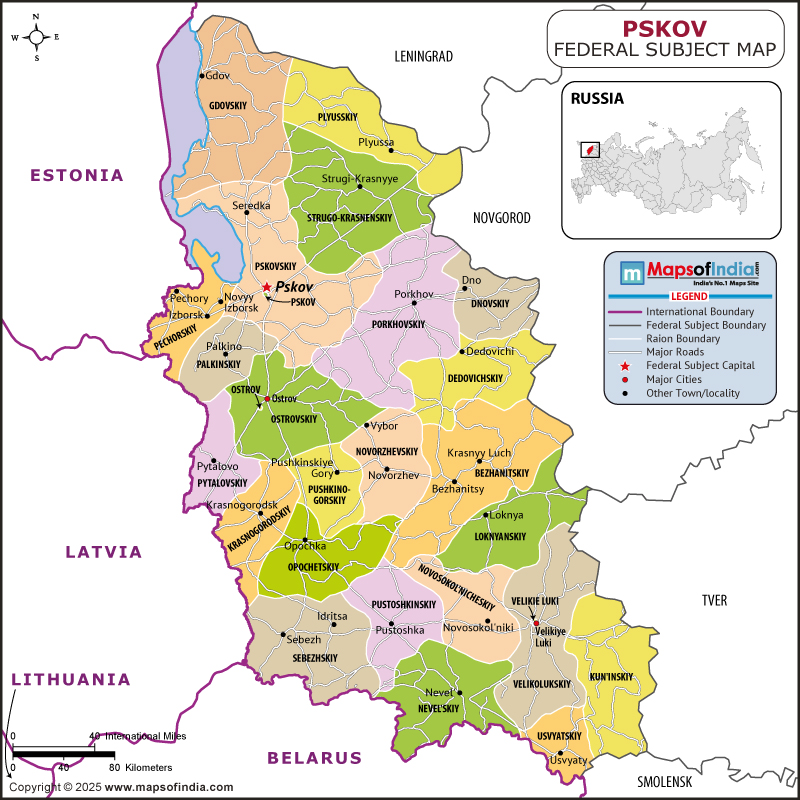



Pskov is located In northwestern Russia near the borders of Estonia, Latvia and Belarus. It is one of Russia’s oldest cities and has a rich and storied history which dates back over a millennium. The city’s name originally spelled Pleskov is thought to derive from the phrase purling waters. It reflects the location along the velikaya river.
History
It was historically referred to in English as Plescow and the present day name Pskov first appeared in records in 903 when it was mentioned in connection with the marriage of Kievan Prince Igor to a local woman Olga who later became St. Olga of Kiev. This date is often celebrated as the city's founding year with grand festivities marking its 1100th anniversary in 2003.
The earliest known ruler of the region was Sudislav the youngest son of Vladimir the Great. After being imprisoned by his brother Yaroslavl Sudislav was freed only after Yaroslavl’s death. During the 12th and the 13th century Pskov was politically aligned with the Novgorod Republic. In 1241 the city fell to the Teutonic Knights but it was swiftly recaptured by Alexander Nevsky in a campaign later immortalized in Sergei Einstein’s 1838 film Alexander Nevsky.
To secure their independence from the Teutonic Knights the Pskovians invited Lithuanian Prince Daumantas to rule in 1266. A convert to orthodoxy he fortified the city and led successful campaigns against the Knights defeating them at Rakvere and expanding the influence of the region into Estonia. His legacy endures in Pskov’s Kremlin where his remains and sword are preserved and the citadel’s core still bears the name Dovmont’s town.
Throughout the 14th century the political status of Pskov shifted. In 1341 it acknowledged the over lordship of the grand duchy of Lithuania but by 1347 it had realigned with Novgorod. The following year it became the capital of an independent Republic. Pskov Republic, though normally subordinate to Novgorod, functioned as a sovereign state with its merchants playing an important role in trade with the Hanseatic league.
Novgorod formally recognized the independence of Pskov in 1348. The city later developed its own legal code and the charter which influenced Russia’s unified legal system in 1497 was developed.
Trade was important to the prosperity of the region. The German merchants had been active in the city since the 13th century and by the 16th century the Hanseatic league maintained the trading post there. Despite interruptions from war with Livonian order Poland Lithuania and Sweden commerce persisted until the 17th century which Swedish merchants eventually dominated.
Pskov's strategic importance made it a frequent target of sieges. Its formidable Kremlin which had 26 sieges in the 15th century alone protected by multiple stone walls. The city became a center of Russian culture known for its icon painting and architectural innovations.
However in 1510 it was annexed by the grand duchy of Moscow. The Moscovites authorities exiled 300 noble families and resettled merchants and military personnel in the city. At the time it was among Russia’s largest urban centers with over 6500 households and a population exceeding 30,000.
The city's resilience was tested again during the Livonian war. In 1581 a 50,000 strong Polish Lithuanian army led by king Stephen Bathory besieged Pskov. Despite numerous assaults the defenders, mostly civilians, held firm even repairing breaches in the wall. Bathory’s secretary famously compared Pskov to Paris in size and grandeur. The war along with families and epidemics devastated the region, reducing its population fivefold by the 1580s.
Pskov faced another major siege in 1615 this time by the Swedes. The successful defense led to the Treaty of Stolbovo which secured Russia’s northwestern borders. However the military significance of Pskov waned after Peter the Great’s victories in the Great Northern War.
This pushed Russia’s frontiers westward. The city declined economically though it became the administrative center of Pskov governorate in 1777. By 1897 the population was technically diverse with Russians constituting 80% followed by Jews Germans Latvians and Estonians.
During World War I it served as the headquarters of Russia’s northern Front. It was here on March 15 that Tsar Nicholas II abdicated aboard the imperial train. After the Bolshevik revolution German forces occupied the city following the Treaty of Brest-Litovsk.
In 1990 during the Estonian war of independence it was briefly controlled by White Russian commander Stanislaw Bulak Balachowicz who promoted democratic governance and cultural revival before the Red Army reclaimed the area.
Under Soviet rule Pskov underwent significant modernization though many historic buildings including churches were demolished. During World War II the city suffered extensive damage under German occupation. Nazi forced labor camp was established for Jewish prisoners and Soviet bombings in 1944 caused further devastation. Post war recovery was slow and the region struggled to regain its former prominence.
Culture
Pskov has a rich and distinctive cultural heritage shaped by the strategic location, historical significance and enduring traditions. It is located near the border of Estonia and Latvia and has served as cultural crossroads between east and west. This has led to the blending of slavic Baltic and Scandinavian influences into a unique regional identity.
Pskov culture is deeply rooted in the medieval past.
The city was a powerful independent Republic in the 13th and 15th century known for its democratic governance and military prowess. The iconic Pskov Kremlin and the Trinity cathedral are architectural testament to this era.
They showcase the city’s role as a spiritual and political center. The architecture with its austere stone churches and fortress like building reflect both Byzantine and local styles which emphasize functionality and resilience.
Pskov is renowned for its school of icon painting which flourished from the 14th to 16th century. These icons are characterized by their expressive faces, earthy tones and spiritual depth. The city also contributed to the development of Russian fresco art in which many churches dawned with vivid biblical scenes. Folk art traditions including embroidery, wood carving and ceramics remain vibrant. It often features motives inspired by nature and orthodox symbolism.
The cultural life of people involved a strong literary tradition. The city is associated with Alexander Pushkin who is Russia’s greatest poet First off he spent time near by at his family’s estate in Mikhailovskoye.
His legacy is celebrated through museums and literary arts. Pskov also has a thriving theatre scene with the Pskov drama theatre offering performances which range from classical Russian plays to contemporary works.
Traditional music includes folk songs and dances performed with instruments like gusli and balalaika. The city hosts various cultural festivals which celebrate medieval history with reenactments, crafts and music. Orthodox religious celebrations especially Easter and Christmas are marked by procession, choral singing and communal feast.
The culture is deeply spiritual shaved by orthodox Christianity and a reverence for nature. Pilgrimages to nearby monasteries are common. The surrounding landscape, river forests and lakes play an important role in local folklore and seasonal traditions.
Language
Pskov is a predominantly Russian speaking city. The official and the most widely spoken language is Russian which is used in government education media and daily life. The local dialect of Russian spoken in the region has some unique phonetic and lexical features which is influenced by the regions of historical interaction with the neighboring cultures.
Pskov Dialect is part of the Nathan Russian dialect group. It includes archaic words and pronunciation which differ slightly from standard Russian. These linguistic traits reflect the city's medieval heritage and relative geographical isolation in earlier centuries as while the younger generation increasingly speak Russian older residents may still use dialectical expressions and informal settings.
Because of the region’s proximity to the Baltic states there are some historical and cultural influences from Estonian and Latvian. However these languages are not commonly spoken today.
In earlier centuries trade and migration brought multilingualism to the region but modern usage is limited to small communities or academic context.
In religious settings especially within the Orthodox Church churches slavonic is used during liturgical services. Though not spoken in conversations it plays an important role in religious and cultural life, especially in historic churches and monasteries the language finds pretty useful.
In educational institutions English is taught as a second language particularly as in school and universities. Other foreign languages such as German and French may also be studied though these are less commonly spoken.
Geography
Pskov is located In northwestern Russia near the borders of Estonia, Latvia and Belarus. The strategic location praised it within the east European plain characterized by gently rolling terrain, fertile soil and abundant rivers and lakes. The city lies on the velikaya river which flows into lake Pskov Anyone actually connects to lake Peipus. This forms part of the natural boundary between Russia and Estonia.
The geography of the region is marked by a mix of forest, wetland and agricultural lands. It is rich in natural beauty with pine and Birch forests, meadows and freshwater bodies which support diverse wildlife. Lake Peipus is one of the largest lakes in Europe. It is a prominent feature which offers fishing, boating and ecological significance to the region. The terrain is mostly flat with occasional low hills making it suitable for farming and settlement.
Pskov has a humid continental climate which is typical of much of western Russia. This means cold winters and mild to warm summers with distinct seasonal changes. Winter lasts from December to February. The temperature during the season drops below freezing and averages around -8°C. Snowfall is common and the landscape is typically covered in snow.
The spring season lasts from March to May and the temperature gradually rises during this. Snow melts which led to increased river flow and blooming vegetation. The summer season lasts from June to August. It is warm and pleasant with average high around 22°C and some rainfall is moderate and the region becomes lush and green. Autumn season lasts from September to November with cooler temperature returns with colorful foliage and increased rainfall.
Quick Facts
| Official Name | Pskov |
| Location | West Russia |
| Population | 599084 |
| Area | 55399 sq. km |
| Languages | Russian |
FAQs
Q1: What is the climate of Pskov?
Pskov has a humid continental climate which is typical of much of western Russia. This means cold winters and mild to warm summers with distinct seasonal changes.
Q2: Which languages are spoken in Pskov?
Russian is the primary language spoken in Pskov.
Last Updated on: June 22, 2026

