


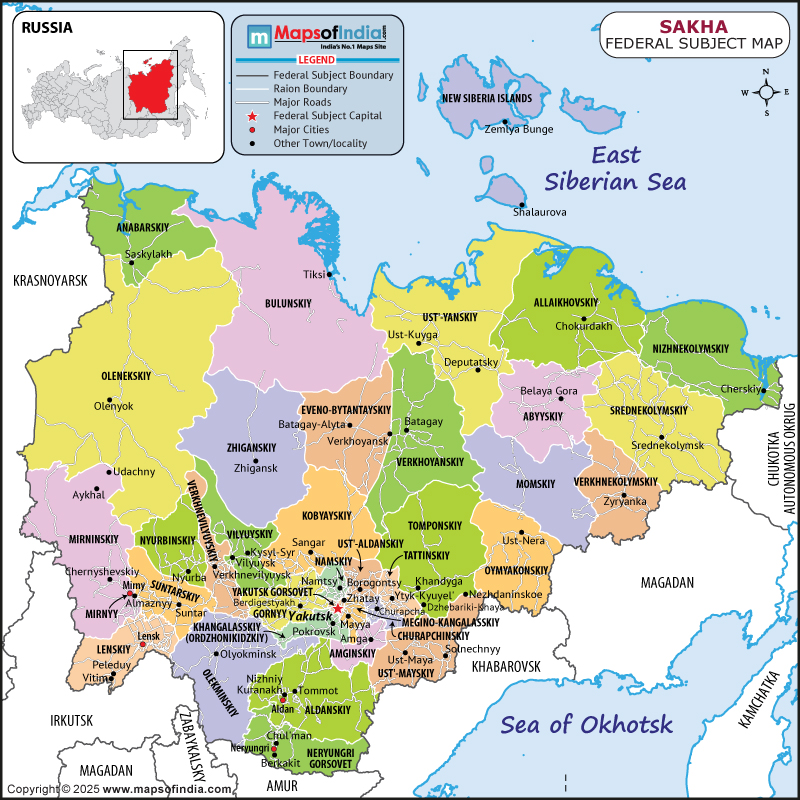



Sakha is officially known as the Republic of Sakha. It is the largest region in Russia by land area and lies in the Russian Far East. Sakha is bordered by the arctic ocean. Even though the region is small in size it has a relatively small population of one million people. Yakutsk is the capital of Sakha and is recognised as the coldest major city in the world.
Evenks and Yukaghir are the indigenous groups who have inhabited the region for centuries. They practiced hunting and reindeer herding. The Turkic sakha people migrated to the region between the 9th and 16th centuries. They brought central Asian pastoral traditions with them.
Russian colonization began in the 1600s. During this the locals were made to pay tribute in furs. There was a dramatic drop in the native population. However the Yakuts eventually expanded their territory across northern and eastern areas.
Sakha played an important role in the Russian civil war. It became the Yakut Autonomous Soviet Socialist Republic in 1922 under Soviet Rule. This led to the arrival of many Russian and Ukrainians. In 1990 it was renamed as Yakutskaya-Sakha Soviet Socialist Republic, and then became the Republic of Sakha (Yakutia) in 1991 as part of the Russian Federation.
History
The Sakha Republic occupies a vast area in northeastern Siberia and has a history shaped by migration conquest and resilience in one of the world’s most challenging environments.
The earliest known inhabitants were Tungusic and paleo Siberian groups such as Evenks and Yukaghir who practised hunting gathering and reindeer hurting. The Sakha people arrived between the 6th and 10th century. They migrated northward from the South as Turkic speaking pastoralists. This migration led to the blending of Turkic migrants and indigenous Siberian populations.
By the early 17th century the Sakha were organised into clan base society. It was governed by councils of elders and nobles known as toyons. The legendary Dygyn and early 17th century leader forged a powerful chiefdom by uniting various clans. At this time the Sakha lived primarily as a pastoralist. They herded cattle and horses hunting, fishing and trading with neighbouring groups.
The Russian conquest of shakha began in 1632 when Cossacks seeking Siberian firs as tribute established a fort at Yakutsk. They quickly made it the hub of Russian power and expansion further East.
The initial Russian arrival devastated the Sakha population which may have decreased by as much as 70% between 1640 and 1670 because of diseases like smallpox and has tribute demands. Fierce resistance erupted in a series of an uprising but after their separation the Sakha submitted to Russian rule and the region became integrated into the Russian Empire as Yakutsk province in 1638.
By the late 18th and the 19th century Russian administration became more deeply and trenched. agriculture previously unknown was introduced by settlers who grew wheat, oats and potatoes along river valleys especially the Lena.
Fur trade sparked a local cash economy and brought further outside influence. Shakha's remoteness made it a notorious destination for political exile including revolutionaries and religious dissenters. Nevertheless the Sakha people retained their language and many traditional customs into the late imperial period with shamanism a cultural influence indirectly until Soviet time.
The early 20th century saw the rise of Sakha intelligentsia and political consciousness. This was catalyzed by exposure to Russian political ideas and contact with revolutionaries. The Yakut union formed during the 1905 revolution criticized Russian colonial policy in advocating for local representation. They achieved a Sakha delegate in the first Duma before being suppressed.
During the Russian civil war Yakutia was the final battleground. After the Bolshevik victory the territory was proclaimed the Yakut autonomous Soviet socialist Republic in 1922 though it remained restive for years.
Early Soviet policy initially promoted indigenous languages and culture under korenizatsiya. This led to a brief flowering of Sakha literature and an expanded education system that eradicated illiteracy. These policies however gave way to harsh centralisation, collectivization and the great shakha intellectuals and leaders were executed on charges of nationalism.
Soviet industrialization profoundly altered Sakha's economic and demographic landscape. The discovery of diamond gold and other minerals in the 20th century led to a major influx of Russian and Ukrainians. This shifted the region's ethnic balance especially in urban and industrial centers.
The region's mineral wealth, particularly diamonds, became important to Soviet and post Soviet economies but the environmental cost was severe. For example, pollution from mining caused the Vilyuy basin to be declared an elemental disaster area in 1992.
Despite economic modernization most sakha people in the countryside continued traditional livelihood based on herding, hunting and fishing.
The collapse of the Soviet Union in 1991 ushered in dramatic change. The Yakut ASSR became the Sakha Republic, a federal subject of the Russian Federation. It had significant autonomy confirmed by Moscow in 1992. The periods saw resurgence of Sakha national and cultural activism with demands for greater source of self management and the legal organization of indigenous land rights.
The Republic government wanted to buffer the economic shock of transition to a market economy privatizing state enterprises and fostering traditional land use. New political institutions including a locally elected parliament and president were established.
Since the 2000 centralization under Russian federal reforms have curtailed some of Sakha's autonomy.
The region was integrated into a far eastern federal district and subject to increased oversight. Economic development remains heavily dependent on extractive industries which have diamond gold uranium and fossil fuels as mainstays. Wages in Sakha generally surpass Russian averages but most profits from mining flow to companies outside the region. This leaves many indigenous communities under-resourced.
Culture
The culture of Sakha Republic is rich and rooted in indigenous traditions. They are known for their resilience and adaptation to the extreme climate evident in their distinct clothing diet, spiritual belief, festivals, craft and oral tradition.
Spirituality and belief systems have traditionally centered on shamanism, nature worship and reverence for ancestral spirit. Major life events such as birth marriage, house building and funerals were historically guided by shamanic rights with ritual sacrifices and prayers to the spirits and deities of the land and sky.
Despite the challenges of colonization, Sovietization and resource extraction, the Sakha people have preserved their distinct cultural identity. It is anchored in that language's oral tradition and a deep connection to the land.
Shamanic and clan based tradition survived well into the 20th century and continued to inform cultural revivals in the post Soviet era. Today the Sakha republic is a vibrant multiethnic region which is known for its harsh beauty, natural wealth and enduring spirit of its indigenous people.
Language
The Sakha Republic is characterized by remarkable Linguistic diversity which is influenced by its history, geography and ethnic composition. The two official languages are Russian and Sakha, both of which play an important role in public life administration, education and media. In practice almost all ethnic Sakha people speak Sakha as their mother tongue and are most fluent in Russian.
Sakha is a member of Turkic language family specially the northeastern common Turkic branch and is the most widely spoken native language among the indigenous groups in the region.
The development of the language has been influenced by centuries of relative geographical isolation. This has led to significant divergence in some other turkic languages and the presence of unique features including a high proportion of Mongolic and tungusic loan words as well as more recent Russian borrowing.
The language serves as lingua franca among indigenous people and retains a vibrant role in everyday communication, art literature and local governance. Notably the use and documentation of language in official settings is protected by law and legal documents can be prepared in either Russian or Sakha. There is an ongoing effort to maintain and revitalize Sakha amidst growing Russian influence.
Geography
Sakha is Russia’s largest federal subject and one of the world’s largest country subdivisions. It is situated in far northeastern Siberia and stretches from the central Siberian plateau in the West to the Kolyma lowland in the east and from the Arctic coastline in the north down to Stanovoy mountain in the south. Over 40% of Sakha lies above the Arctic Circle and the territory also includes the new Siberian island in the Arctic sea.
The landscape is a mix of mountain ranges, plateaus, vast river valleys and lowlands. The highest point is peak pobeda and the region contains 393 named mountains. Major rivers like the Lena, Yana, Indigirka and the Kolyma flow northward to the Arctic Ocean and there are over 8,00,000 lakes which makes the region rich in water resources.
The climate in the region is extremely harsh and continental. Winters are long and bitterly cold. The temperature goes below -60°C in some places. Summers are mild but brief. Precipitation is low and permafrost underlies almost the entire territory.
Vegetation follows climatic zones from Arctic tundra in the north to vast taiga forest in the South. About ¾ of the region is forested. The region is an exceptionally pure natural environment and supports diverse flora and fauna adapted to the extreme cold.
Quick Facts
| Official Name | Sakha Republic |
| Location | Russia Far East |
| Population | 995686 |
| Area | 308523 sq. km |
| Language | Russian and Sakha |
FAQs
Q1: What is the capital of Sakha?
The capital of Sakha is Yakutsk. It is known as the coldest major city in the world.
Q2: What is the climate of Sakha?
Sakha experiences extreme winters with temperatures below −35°C. It has warm summers because of hypercontinental tendencies.
Q3: What are the coldest places in Sakha?
Verkhoyansk and Oymyakon are among the coldest places in Sakha which lie in the Northern Hemisphere.
Q4: What are the main natural resources found in Sakha?
Sakha is rich in diamonds, gold, coal, and other minerals.
Q5: Which languages are spoken in Sakha?
Russian and Sakha (Yakut) are the main languages spoken in the Sakha Republic.
Last Updated on: April 15, 2026

