


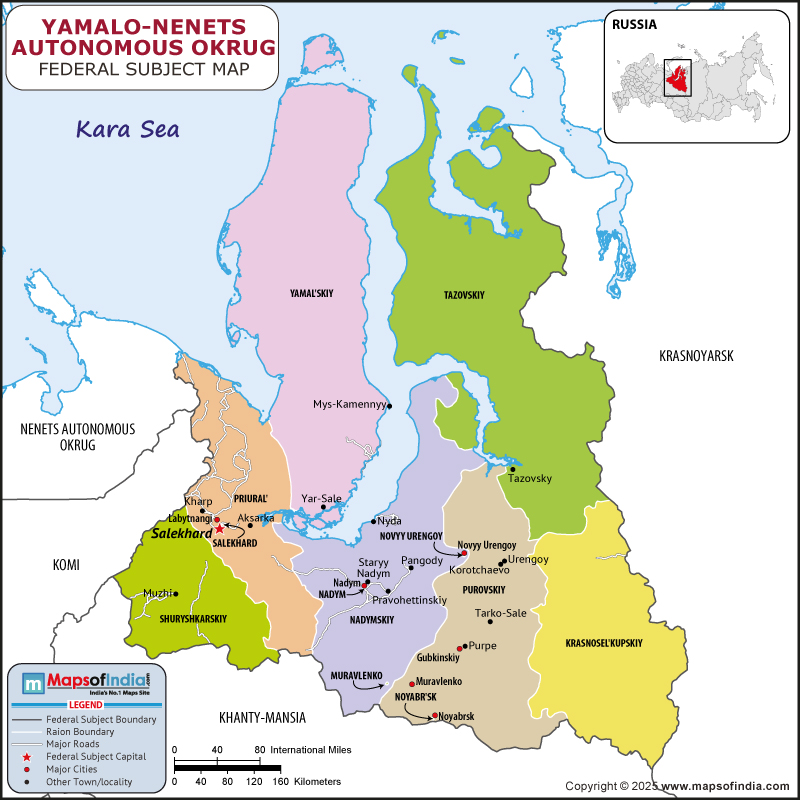



Yamalo-Nenets Autonomous Okrug - a federal subject of Russia, situated in the North of Western Siberia, with more than a half of its territory being beyond the Arctic Circle. Nor takes care of about 769,000 square kilometres; it is located in Tyumen Oblast of the Urals Federal District. Salekhard is the administrative centre; it is the only city in the world directly located in the Arctic Circle. This area was founded in the year 1930 to assist indigenous communities including Nenets and Khanty. Key centres of the energy industry are the major towns, such as Novy Urengoy and Noyabrsk. Traditional activities such as reindeer herding and fishing are also essential to the people because of their incapacitation to abandon practices such as industrialization. The region is not only strategic in the arctic development of Russia but also its economy.
History
Natives like the Nenets and Khanty have lived in the area today called Yamalo-Nenets Autonomous Okrug for thousands of years. They were traditional nomadic reindeer herders, hunters and fishers of the very harsh Arctic environment. The first contact was with Russia and its merchants arrived in the Ob River region in the 12th century. Towards the latter part of the 16th century, the Russian state started having increased control of the area. The fortress of Obdorsk was established in 1595 at Poluy River mouth, later transformed to the town of Salekhard.
In imperial times the area was a distant northern outpost but the focus of fur trade and arctic exploration. The reorganization of Northern territories had been initiated by the Soviet government by the beginning of the 20th century. The Yamal ( Nenets ) National Okrug was created within Ural Oblast in December 1930 specializing in administering the affairs of natives. Its administrative capital was the town of Salekhard established in 1938.
The Soviet policies of collectivization were really effective throughout the 1930s and 1940s. Family ways of life and paths to the traditional religion were shattered with rearrangement of reindeer herding, hunting, and fishing into communal farms. There was resistance among the native people which was clamped down upon. The nomadic itineraries of many Nenets were restricted and many of them were forced to settle. The results of such changes caused terrible losses in social and cultural aspects on the sides of the native peoples.
The discovery of huge fields of natural gas started in the 1950s and 1960s, when huge geological surveys started taking place. The Urengoy, Yamburg, and Medvezhye fields were among the biggest. Such findings changed the economic significance of the region. Development of infrastructure: gas pipelines, roads, and new towns, including Novy Urengoy, Nadym and Noyabrsk increased rapidly to serve the energy business. Yamalo-Nenets started as a world energy facility as Medvezhye field started gas production in 1972. The okrug gained autonomous status in 1977. After the dissolution of the Soviet Union in 1991, it became part of the Russian Federation while remaining administratively tied to Tyumen Oblast.
Culture
Their food revolves around the resources in the tundra so reindeer and fish are the staple foods of their diet. Stroganina is one of the most recognizable meals that are made and comprise thin slices of raw and frozen fish such as muksun, nelma or whitefish, which are commonly served with salty, peppery or berry sauces. Reindeer meat is essential and is used in most of the foods, including ya soup, a rich broth prepared using reindeer meat, blood and organs and salamat, a protrude food that is prepared with reindeer meat. Nyan are the traditional breads, which differ across the region, as some groups of people still prepare dough on sticks, and others prepare flat loaves. Additional sources are shangas (open-faced rye flour pie), pancakes using reindeer blood, and wild berries which have been preserved which include cloudberries and cranberries. Such foods can be considered as not only convenient sources of food, but also carry some cultural value connected with land and seasonal availability.
Dressing in the area is a source of survival in very cold circumstances as well as the identity of the culture. The most common, among the recognizable clothes, is the malitsa, a hooded fur shirt, to be worn with the fur inward to provide insulation. Men have longer militias whereas women put on the yagushka or pany, two coats embroidered and edged with fox fur. In extreme cold the outer clothes are of the sovik or panitsa, the fur turned outward, and frequently crowned with fox tails. Customary footwear is high fur footwear with fabric insoles and is made in reindeer hide, and further wearing insoles consisting of grass to facilitate warm and versatile clothes. Children also are dressed in specially suited malitsas and boots made with soft buckskin to withstand the cold of the Arctic.
Festivals are significant events where culture is displayed and community is integrated. The newly created Nyan Fest in Salekhard is a festival of arctic food, traditional garments, music and dance. This children's festival includes cooking and crafting workshops, the competitions, such as stroganina cooking, and the sport played in traditional clothes.
Language
Nenets language is the key component of cultural identity of indigenous Nenets people who inhabit Yamalo-Nenets Autonomous Okrug. It is part of the Uralic language group and more precisely to the Samoyedic segment, which has close relations with other languages spoken by the people of northern Siberia. The two greatest dialects of the language are Tundra Nenets and Forest Nenets, the two major Nenets groups of people. Tundra Nenets is more broadly used, and it can be said that it is the standard form that is used in educational and media work, whereas Forest Nenets has a smaller number of speakers and is in more jeopardy of extinction.
Although nowadays Nenets is largely a written language, it is also a verbal culture with a lot of folklore, songs, and oral epics being transmitted through generations. Recent decades saw the attempts to create the written form of the language with the help of the Cyrillic alphabet, which now allows the language to be taught in school and passed to the written literature. These efforts are to regenerate the language which is under strain of Russian that is widely spoken in the region and country.
Nonetheless, Nenets language is described as a vulnerable one despite such efforts. The process of urbanization, education, and economic activity causes a number of younger Nenets individuals to learn Russian as a native language instead of their ancestral language, with fluency in the latter declining.
Geography
Yamala-Nenets Autonomous Okrug (YaNAO) is a huge and prosperous territory of the Russian north where the West Siberian Plain is the place (this region constitutes a bigger part of it). The West Siberian petroleum basin is the largest hydrocarbon (petroleum and natural gas) basin with an area of approximately 2.2 million km and is also the largest oil and gas producing region in Russia. This has created not only a geographical but important economic region to the country.
The Okrug is situated in the northern corner of West Siberian Plain, and it spreads on the broad territory of the Arctic and northern tundra and boreal forest (taiga). It also has extreme climatic conditions where during winter it has a long tough climate and during summer a short but cool climate. Permafrost conditions occur in the landscape which affects both the natural and human life.
On the one hand is the West, where the Polar Urals grow, which marks the natural boundary of the European part of Russia. Mount Payer is the highest point of the okrug, as of the entire system of the Ural mountains. These mountains represent the difference of the lowlands that cover most of Okrug.
It is arctic tundra and taiga, wide peninsulas that include the Yamal Peninsula, Taz Peninsula and the Gyda Peninsula (which includes the Yavay Peninsula and Mamonta Peninsula). These peninsulas extend to the Kara Sea and are very vital in the Russian plans of voyaging in the Arctic and shipping.
Water bodies are a major part of YaNAO geography. The okrug has almost 300,000 lakes, among the most significant ones are Pyakuto, Chyortovo, Neito, Yambuto, Yarroto and Nembuto. Besides the lakes, the Ob river runs its way through Yamalo-Nenets Autonomous Okrug to the Kara Sea through the Gulf of Ob that defines the geography of the Okrug (as well as the two sub-bays of it: the Taz Estuary and Khalmyer Bay). Ob River forms a significant area of transportation and ecological flow in the area.
Off the coast of the okrug are a number of islands to the west and east, the largest of which are the Torasovey Island, Bolotnyy Island, Litke Island, Sharapovy Koshki Islands, Bely Island, Shokalsky Island, Petsovyye Islands, Proklyatyye Islands, Oleny Island and Vilkitsky Island. Wildlife And these arctic islands are significant and are occasionally used as observatory points against climate and environmental research.
Quick Facts
| Administrative center | Yamalo- Nenets |
| Capital | Salekhard |
| Population | 510,490 |
| Area | 769,250 km2 |
| Governor | Dmitry Artyukhov |
FAQs
Q1: What does the Nenets traditional food consist of?
Reindeer meat and fish largely make their diet. Raw and frozen fish is traditionally consumed by them and reindeer products are main sources of their nutrition.
Q2: What are the traditional clothes of Nenets people?
The garments used in Nenets are mostly deerskins and reindeer fur as well and may be worn to enable them to resist the extreme arctic climate.
Q3: What do people do economically?
Fishing and Reindeer herding are prevalent among the local indigenous communities.
Last Updated on: April 15, 2026

