


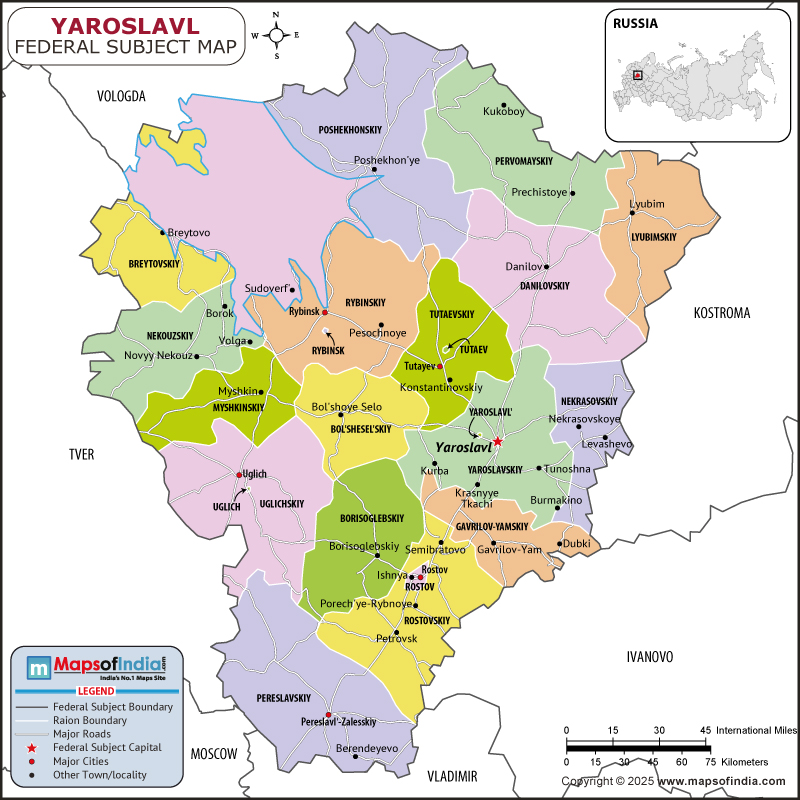



Yaroslavl, built in 1010 by Prince Yaroslav the Wise, is located at the meeting point of the Volga and Kotorosl rivers, 250 km Northeast of Moscow. It was one of the most ancient cities of Russia and it was located on the medieval trade routes that linked the north with Moscow, Novgorod and others. Its historic centre, famous for its early XVII century churches painted in bright frescoes, is a World Heritage site of UNESCO. The 18th-century radial city design of Catherine the Great incorporated neoclassical boulevard development alongside existing monuments, earning the city the nickname "Florence of the Russian North." This was followed by industrial and cultural growth, which came to Russia in the 1750s with the establishment of the first professional theatre.
History
The city was established in 1010 by Prince Yaroslav the Wise, at the merge of the Volga and Kotorosl river on a high bank where he is said to have slain a bear in order to claim the land. The very name of it and its bear-and-axe coat of arms recalls that founding myth.
It remained a small fortified town in the territories of Rostov-Suzdal till the 12th century and since the inception of its monasteries, such as Petropavlovsk and Spaso-Preobrazhensky, it expanded slowly. By 1218, it had its own capital state, but it was never completely absorbed by growing Moscow until 1463.
The city survived a lot of adversities: it was pillaged by the Mongols in 1238, after which it was invaded in 1257, and in the early 1300s. They were supplemented by epidemics, fires, but restoration was stable. After every setback, institutions like the Spaso-Preobrazhensky Cathedral built in the early 13th century, were restored or even reconstructed again.
Its position became important as a trading point along the Volga between Moscow and western and eastern markets by the 16th and 17th centuries. It emerged as a center of crafts, particularly of linen work, pottery and leatherwork, as well as distinctive architecture. A great number (over 60) of stone churches were constructed, most of them richly decorated with brilliant frescoes. The Church of Elijah the Prophet, constructed between 1647-1650 is cited to be one of the best manifestations of artistic and architectural heritage of this city.
The city acted as the temporary capital of the Russian state during the Time of Troubles, April 1612 - June 1612. This is where Minin and Pozharsky formed the army of volunteers which later on freed Moscow. Mikhail Romanov, the future Tsar, also lived in the city where he made his first royal decree in 1613.
Major change came in the 18th century. Due to the diminishing significance of the river trade the city headed into the industry. Its industrial era dates back to 1722 with the establishment of the Great Manufactory, a big textile factory. Here Feodor Volkov founded the first professional public theatre in 1750. In 1763 Catherine the Great commissioned a neoclassical redesign of the city. The outcome was the harmonious mixture of old churches and new boulevards that had refined and European appearance and which is why the city gained the reputation of the so-called Florentine of Russian North.
The 19th century was a period of thriving industry. Factories started appearing in dozens, and families of merchants gained rise. In 1895, a huge strike by thousands of textile labourers broke out at the Great Manufactory, causing the imperial government to take notice, and leading to later labour reforms.
It was in the Soviet stage that the pace of industrialization was increasing. It was where the first dump truck and trolleybus in the USSR still was manufactured during the 1920s and 1930s. The world's first synthetic rubber tire plant was on this territory in 1932. It was the leading industrial center of the Soviet Union in the middle of the 20th century.
Culture
Conventional celebrations are key to the local community. Among the most recognizable ones is already a long-established jazz festival called Jazz over the Volga, which invites international jazz musicians to play on open-air stages and historical halls. During the summer season, Dobrofest, a large rock music festival that is organized in an airfield located outside the city attracts rock music fans across Russia. Such family friendly activities as the international film festival called within the Family as well as folklore events held across the region celebrate the world of cinema, the arts and crafts and rural life.
During these festivals traditional dress can be seen with women wearing the highly embroidered sarafans and kokoshnik headdresses whilst men can be seen wearing the belted shirts and high boots. Folk groups often use costumes, balalaikas and accordions.
Local food is rich and well rooted in local farming culture. Foods are stews, fish caught on the Volga and baked products such as kulebyaka (stuffed pie). Pastila is a widely known sweet dish, a long history of which is based on fruit. Pancakes (blini) In the pre lent festival of Maslenitsa, pancakes are produced in abundance and distributed in celebrations throughout the town squares with festivities involving dancing,, and effigy-burning.
Language
In Yaroslavl the main language is the Russian one and it is an official and dominant language in all spheres of everyday life, education, government, media, and commerce. The ideas within the local people is that they speak Russell unthinkingly, however, their accent and dialectical input mirrors the location of the city which is central within the territory of Russia (especially the state of upper Volga).
Even though the dialect used in the Yaroslavl region falls within the Northern Russian group, it has a mix of the northern and the central Russian linguistic patterns. Such northern dialects were historically characterized as particularly conservative in maintaining older phonetic characteristics, among them was the pronunciation of unstressed o as a clear [o], as opposed to the southern dialects which normally reduced it to [a] or a schwa. Some of these differences have however decreased over the years particularly in cities influenced by the standardized Russian in schools and mass media.
There are communities (the older residents and resident villages), which still apply variations of local dialect words, archaic language, and regional phonetics in informal speech. As an example, it can sometimes be different in the degree of stress, intonation or pronunciation of some consonants and vowels. These are however well understood by the speakers of standard Russian language and do not often aggravate communication.
Other foreign languages are also instructed in general education in addition to Russian although dexterity in English is a characteristic of the youth and other school going students, as well as workers in the tourism or international business sectors. In tourist regions, some English translations might be limited in the form of signs on the streets, information found in public places and descriptions in the museum but the rest of day-to-day conversation is usually in the Russian language.
Geography
Yaroslavl Oblast has temperate continental climate, the number of the relatively determined seasons is four and the main part of the precipitation is characterized by showers perhaps during the warm half of the year. The winters are snowy and cold and the summers are very warm. January is by far the coldest month with average temperature averaging around −8.2 Celsius (17.2 Fahrenheit) while July is by far the warmest month with the average temperature at +18.9 C (66.0 F).
There used to be practically dense fir, pine forest on the former territory. Once most of it had been harvested, now a significant share of land is covered with the second-growth birch-and-aspen forests and crop lands. Flood swamps occupy large spaces too.
Large animals have been greatly diminished in numbers, but yet.are a few bears, wolves, foxes, moose and wild boars. There are many wild birds inhabiting and breeding in the oblast. The most common birds there in the settlement are pigeons, jackdaws, hooded crows, rooks, house sparrows, and great tits.
The oblast borders Vologda Oblast to the north, Kostroma Oblast and Ivanovo Oblast on the east, Vladimir Oblast on the south and Moscow Oblast and Tver Oblast on the west.
Yaroslavl Oblast is irrigated by the Volga River: large dams and hydroelectric plants were constructed at Uglich and Rybinsk. One of the largest reservoirs of Europe is the Rybinsk Reservoir that was filled between 1941 and 1947. After being filled the old town of Mologa and various hundreds of villages were submerged. In reference to this project, some 150 thousand people in Yaroslavl, Vologda and Kalinin (currently Tver) oblasts were forced to be displaced.
Only a few types of mineral resources are available (construction materials, i.e., sand, gravel, clay, and peat). Mineral water springs and wells exist too.
Quick Facts
| Oblast | Yaroslavl |
| Country | Russia |
| Population | 1,209,811 |
| Area | 36,177 km2 |
| Official Language | Russian |
| Governor | Mikhail Yevrayev |
FAQs
Q1: What are the well-known things in Yaroslavl?
It is a city retaining a well-preserved historical city center, beautiful 17 th -century churches and is regarded as one of Russia's Golden Ring of ancient cities.
Q2: What is the best time to go?
Mild weather conditions that are experienced during moderate and later spring of the year and early fall; (May to September) are pleasant to the sightseeing activities.
Q3: Is Yaroslavl the UNESCO World Heritage Site?
This is so, its city center is a historically designated UNESCO heritage world site which was declared in 2005.
Q4: How old the city is?
This is one of the earliest cities to have been established in Russia in 1010.
Last Updated on: June 22, 2026

