


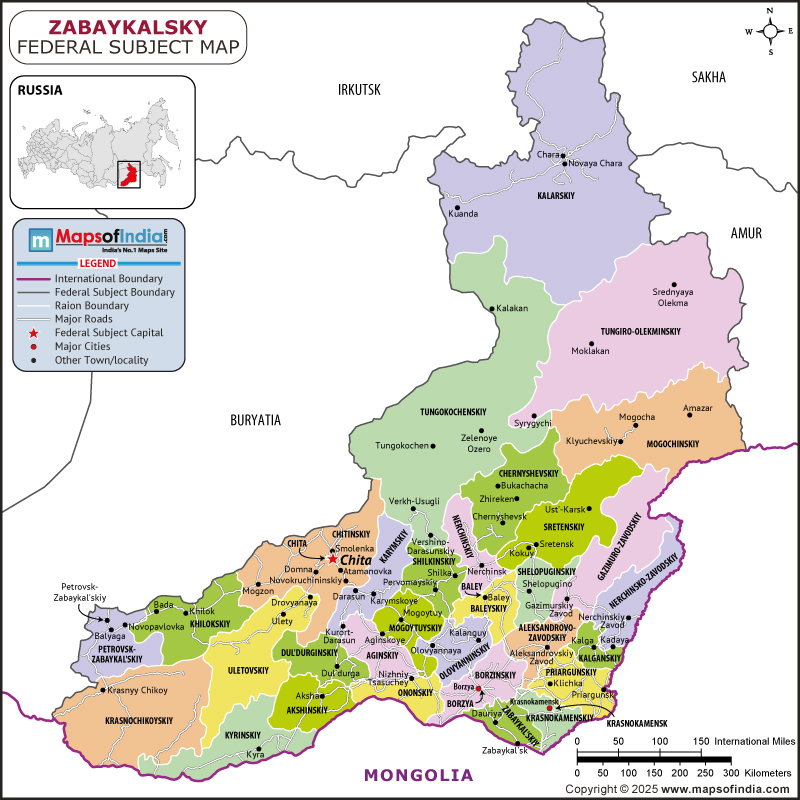



Located along the east of the Siberian region, occupying 431,892 square kilometres along the western side of Lake Baikal and the southern side of both the Mongolian and Chinese borders, Zabaykalsky krai is separated into 5 regions. This vast expanse lies at the south-east corner of the Far Eastern Federal District of Russia; the territories are in the tract of ancient overland routes that connected Central Asia with Manchuria. Although the size of Germany, it supports a population of slightly over one million people, hence giving it a population density of around 2.5 individuals per square kilometre. Huge stretches of forests of taiga forests, alpine meadows, as well as the stepping fields are prevalent, which are scattered with mountain ranges and occasional farming valleys.
History
Archaeological findings in Zabaykalsky Krai testify to the human presence there at least 35,000 years ago. Palaeolithic hunter-gatherer camps are shown by stone tools and hearths in the area of the Chikoy River, and also around Chita. In later millennia, Transbaikalia was successively crossed and inhabited by waves of nomadic steppe peoples, who left burial mounds and rock art in their wake, the Xiongnu, the Xianbei, the Rouran and the Gokturks among them. In 1612, the area east of Lake Baikal, until the 17th century, the Daurs, who were a Mongolic-speaking tribe, lending their name to Dauria, the historic name of this land of the border.
The Russian conquest of Transbaikalia in the name was started seriously in the middle of the XVII century when the Cossack detachments led by Yerofey Khabarov and Onufriy Stepanov explored the routes of the rivers, built fortified posts (ostrogs) at Nerchinsk in 1654 and Chita in 1653. These forts founded fur-trading routes and established overland connections with Qing China. The Sino-Russian border of the range of Argun and Stanovaya was established by the Treaty of Nerchinsk in 1689, the negotiation of which was the work of voivode of Siberia Fyodor Golovin, and initiated the period of controlled commerce, but also of periodic confrontations with the Manchu armies.
Zabaykalsky was gradually colonised in the 18th and 19th centuries with economic diversification. Old Believer exiles in flight against religious persecution worked in silver and lead mines east of Nerchinsk, and Decembrist exiles, also of political tincture, owing to the events of 1825, were sent to Chita, where they too stimulated the local intellectual life. It was used by Mongolian caravans, and, by the turn of the century, Russian riverboats, to reach into the region, connecting it with Irkutsk, Yakutsk and Manchuria.
The construction of the Trans-Siberian Railway in 1891-1916 had changed Zabaykalsky from a remote backwater to a strategic crossroads. Along the track mushroomed stations and workshops, and urban development stimulated in Chita and brought into existence new logging and mining camps. During Soviet rule, the 1930s collectivisations reoriented the Buryat herding people, with forced labour camps, including Japanese POW camps after World War Two, booming the forestry and mining industries. Militarisation on the two rivers (Ussuri and Argun) and the erection of garrisons as a result of the 1969 Sino-Soviet border conflicts continued to function until the end of the Cold War.
Economic shrinkage was induced by the fall of the USSR in 1991: numerous industrial plants were shut down, unemployment grew precariously, and there occurred a heightened out-migration. Having assessed the necessity of administrative reform and investment, the local authorities offered to unify Chita Oblast with the Agin-Buryat Autonomous Okrug. A referendum on the unity of Chita and the Okrug, held in March 2007, united 90.29 per cent of the people of Chita and 94.26 per cent of the people of the Okrug, resulting in the official formation of Zabaykalsky Krai on 1 March 2008. The said merger was to ensure easy governance, more budgetary capability, and a renewed identity of this frontier region.
Culture
Zabaykalsky Krai is a colourful tapestry of Russian, Buryat and Evenk and other native threads. The Trans-Baikal Drama Theatre in Chita performs classical Russian plays as well as modern ones written by local playwrights, and the Decembrist Church Museum is a reminder of the exiles during the 19th century who started Siberian salons where liberal ideas became established. The Trans-Baikal International Film Festival takes place each year and has attracted filmmakers throughout Asia to an event featuring themes of frontier life, environmental change and cross-cultural communication.
Rural districts have their own local festivals that include embroidered Buryat deel robes, wooden distaffs with carved elements and housewares with silver inlaid metalwork. Sagaalgan, or Buryat New Year's, family members celebrate by having a multi-generational feast of buuz (steamed dumplings), noodle soups, and dairy products such as aaruul (dried cottage cheese). Christmas and Easter in the Russian Orthodox societies are liturgies held at midnight in wooden chapels, where iconographers follow centuries-anchored methods of painting holy images on linden and birch-bark panels.
Evenk cultural associations encourage reindeer herding displays, conventional archery competitions and shamanism rituals made over to appeal to ethno-tourists. They instruct the tourists about the possibility of distinguishing taiga medical plants, arrange a small game snare, and carve a canoe of birch bark. Open-air markets in the border towns like Krasnokamensk express the tea blends imported from China; Mongolian airag (fermented mare milk) and steamy tea are sold and bought by a vendor having to operate three languages in a transaction.
Buddhist datsans (temples) have also been established in Chita, Tsugol and Aga since the late 1990s, and are renewing practices that had been repressed during Stalin's rule, Lamaism. Black-robed monks pray each day, and laity rotate stupas and donate barley flour and marmot fat offerings. Orthodox bell towers are ringing over the krai again in concert with temple gongs and are setting a special spiritual soundtrack that resonates with the historical status of the country as a junction point of Eurasian philosophies.
Language
The official state language in Zabaykalsky Krai is the Russian language, which prevails in government activities, education and mass communications. Russian is the language of all official documents, the work of legislative bodies of the Krai Parliament, and primary schools, as a policy of the federal government and as the vehicle of communication among the people inhabiting the Krai, who are diverse in terms of ethnicity.
In the Agin-Buryat Okrug, Buryat is a co-official language and is a compulsory school subject. Buryat grammar, history, and literature are taught in textbooks in bilingual programs at the same time as the Russian language, whereas both languages appear on public signage and in the cultural centres. A newspaper published in Buryat. In Buryat, local radio stations broadcast daily news programs, and from time to time, theatrical productions are performed in the Mongolic dialects, maintaining oral epics like the Geser cycle.
Geography
The topography of Zabaykalsky Krai is located in the territories between the 50 and 58 degrees north latitude and 111 and 124 degrees east longitude, linking three international boundaries and four major territories of Russia. On the south, it has 998 km of frontier on the Inner Mongolia Autonomous Region and Heilongjiang Province of China, and 868 kilometres on Dornod, Khentii, and Selenge aimags of Mongolia. The krai borders Irkutsk Oblast, the Republic of Buryatia, Amur Oblast, and the Sakha Republic within the krai, making it a crossroad of sharp relief and ecosystem diversity.
It is the meeting point of three major watersheds. Selenga River drains to the north into Lake Baikal and further through the Yenisei River to the Arctic Ocean. Eastwards Onon, Argun, and Shilka rivers combine to form the Amur, which, after delimiting Russian, Chinese and Mongolian lands, drains to the Pacific. To the northwest, the Chikoy is fed by its tributaries, which flow into the Lena basin. More than half the krai is covered with the forests of Siberian larch, spruce, pine and mixed broadleaf trees, and the deciduous forests of birch and aspen growing in protected valleys. Above 2,000 meters, there is alpine tundra where the mosses and lichens are endemic.
Life is characterised by climatic extremes. Northern highlands can register temperatures of below -40 in the winters, and in the sheltered southern valleys, temperatures over +25 during the summer. Precipitation is 250250 millimetres annually, with most of it occurring in the form of rainfall between June and September, crisp, cool autumn and bright, sunny winters. These climatic conditions determine growing seasons, water supplies and burning regimes in forested areas.
Zabaykalsky has a number of areas that are preserved to preserve its diversity. There is also Alkhanay National Park, which enjoys the legacy of a sacred mountain according to the Buryat Buddhist religion, and carries some endangered species of flora like Siberian larch subspecies Larix gmelinii var. olgensis. The steppe wetlands form the UNESCO Biosphere Reserve - the Daursky Nature Reserve important to migratory waterfowl. Sokhondinsky Biosphere Reserve stretches between taiga and steppe, maintaining Siberian musk deer and Amur tigers on the eastern fringes of their habitat. Chikoi National Park not only integrates biodiversity protection with archaeological reserves, but it is also home to the stone-age camps and petroglyphs, which testify to deep roots that humans have in Transbaikalia.
Quick Facts
| Official Name | Zabaykalsky Krai |
| Population | 1,004,125 (As of 2021) |
| Area | 431,892 km² |
| Language | Russian |
| Religion | Christianity |
FAQs
Q1: What unique wildlife species are endemic to Zabaykalsky Krai?
The Transbaikalian Siberian musk deer is found almost nowhere else on Earth.
Q2: Which annual festival showcases the region’s cultural heritage?
The Chita City Festival in July highlights Buryat and Russian traditions through performances, crafts, and cuisine.
Q3: What notable geological landmark draws nature enthusiasts?
Alkhanai Mountain, revered by local shamans, features striking volcanic rock formations and sacred springs.
Q4: How does permafrost shape everyday life in the region?
Seasonal thawing of discontinuous permafrost causes ground instability that demands specialised building techniques.
Last Updated on: April 01, 2026

