

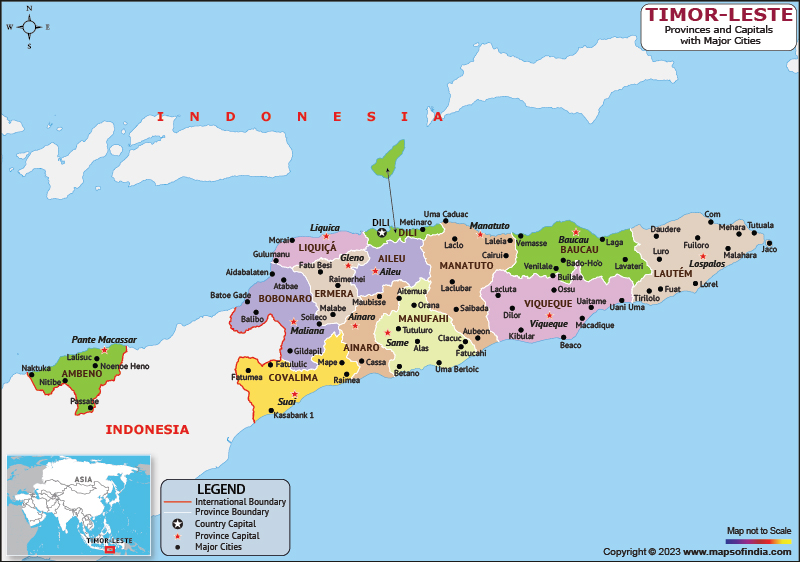



Timor-Leste, also known as East Timor, is a small island nation located in Southeast Asia. It is the newest country in Asia, gaining its independence from Indonesia in 2002. Despite its small size, Timor-Leste has a rich cultural heritage and stunning natural beauty.
History
Timor-Leste has a complex history, shaped by its position as a strategic trading post between Southeast Asia and Australia. The Portuguese colonized Timor-Leste in the 16th century, and the island was later occupied by Japan during World War II.
After the war, Indonesia claimed Timor-Leste as part of its territory, leading to a period of violent conflict and resistance. Timor-Leste gained its independence in 2002 after a long struggle for self-determination, making it the first new sovereign state of the 21st century.
Culture
Timor-Leste has a unique and diverse culture, with influences from Portuguese, Indonesian, and traditional Timorese customs. The country is known for its vibrant music, dance, and art, with traditional instruments such as the ukulele and the gong used in performances.
The Timorese have a deep connection to their land and the environment, with traditional agriculture and fishing practices still an essential part of daily life. The country is also home to a rich tradition of oral storytelling and poetry.
Language
The official languages of Timor-Leste are Tetum and Portuguese, with Indonesian and English also widely spoken. Tetum is the most widely spoken language in the country, with over 40% of the population using it as their first language.
Geography
Timor-Leste is a small island nation located in Southeast Asia, covering an area of approximately 15,000 km². The country is situated on the eastern half of the island of Timor, with the remaining western portion belonging to Indonesia.
Timor-Leste is known for its stunning natural beauty, including rugged mountain ranges, dense rainforests, and pristine beaches. The country is also home to several protected areas, including Nino Konis Santana National Park and Jaco Island.
| Official Name | Democratic Republic of Timor-Leste |
| Capital | Dili |
| Area | 14,874 km2 |
| Population | 1340513 |
| Language | Portugal, Tetum |
| Religion | Christianity |
| Largest Metro | Liquica, Gleno |
FAQs
1. What is Timor-Leste famous for?
Timor-Leste is known for its beautiful beaches, coral reefs, rugged mountains, Portuguese and Southeast Asian heritage, and diverse marine life. Its capital, Dili, is also a popular starting point for exploring the country.
2. What is the capital of Timor-Leste?
The capital of Timor-Leste is Dili. Located on the northern coast, Dili is the country’s largest city and its main political, economic and cultural center.
3. Where is Timor-Leste located?
Timor-Leste is located in Southeast Asia, occupying the eastern part of the island of Timor along with the Oecusse exclave. It also includes the islands of Atauro and Jaco and shares a land border with Indonesia.
4. What language is spoken in Timor-Leste?
Tetum and Portuguese are the official languages of Timor-Leste. Indonesian and English are also used, while numerous indigenous languages are spoken across the country.
5. What currency is used in Timor-Leste?
The official currency of Timor-Leste is the United States dollar (USD). US dollar banknotes and coins are widely used for everyday transactions.
6. What are the best places to visit in Timor-Leste?
Popular places include Dili, Atauro Island, Jaco Island, Mount Ramelau, Cristo Rei and the Com coastline. Visitors can explore beaches, mountains, diving sites, traditional communities and historical landmarks.
7. Why is Timor-Leste important in Southeast Asia?
Timor-Leste is notable as one of Southeast Asia’s youngest countries, having restored its independence in 2002. Its location between Indonesia and Australia gives it important geographical and cultural links within the region.
Last Updated on: September 15, 2026

