

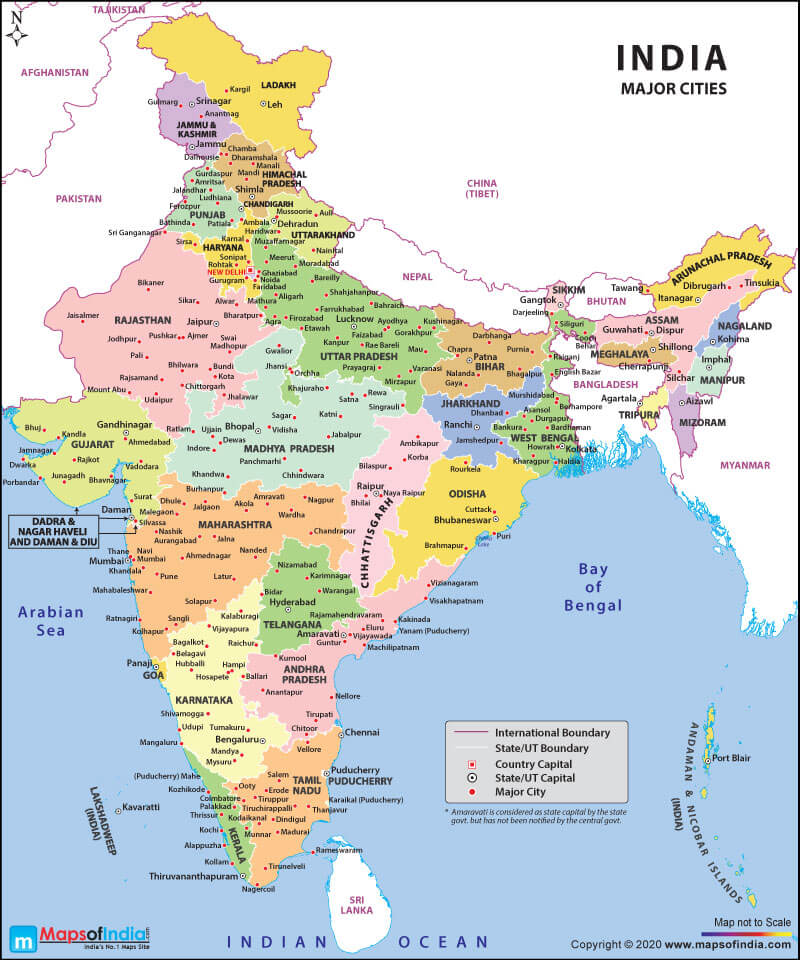



India is one of the oldest civilizations in the world with a kaleidoscopic variety and rich cultural heritage. It is a wonder and an example of a wholesome democratic existence in the world. It covers an area of 32,87,263 sq. km (1,269,346 sq mi), extending from the snow-covered Himalayan heights to the tropical rain forests of the south. As the 7th largest country in the world, India stands apart from the rest of Asia, marked off as it is by mountains and the sea, which give the country a distinct geographical entity. Bounded by the Great Himalayas in the north, it stretches southwards and at the Tropic of Cancer, tapers off into the Indian Ocean between the Bay of Bengal on the east and the Arabian Sea on the west. It has a land frontier of about 15,200 km. The total length of the coastline of the mainland, Lakshadweep Islands and Andaman & Nicobar Islands is 7,516.6 km. Today, India is not only a rich source of art and cultural diversity to enjoy and learn from but also it is excelling in various other domains such as science, businesses and even space technology.
The Republic of India is a country in South Asia. It has a population of more than 1.2 billion and is ranked the second most populous country after China. Post the abrogation of Article 370 in 2019, India has 28 states and 8 union territories.
Cities are classified into several categories based on their population
- 50,00,000 - above: Megacity
- 10,000,00-4999999: Metropolis
- 500,000-999999: Sub Metropolis
- 100,000-499999: Big Town
- 40,000-999999: Small Town
- 10,000-3,9999: Big Village
- 5000-9999: Small Village
- 4999- Below: Hamlet
List of major cities in different states of India:
| State | Capital | Major Cities |
|---|---|---|
| Andhra Pradesh | Hyderabad (De jure - 2 June 2024) Amaravati (proposed) | Visakhapatnam, Vijayawada, Guntur, Nellore and Tirupati |
| Arunachal Pradesh | Itanagar | Tawang, Bhismaknagar, Pasighat, Ziro and Bomdila |
| Assam | Dispur | Guwahati, Tezpur, Dibrugarh, Silchar and North Lakhimpur |
| Bihar | Patna | Gaya, Biharsharif, Darbhanga and Bhagalpur |
| Chhattisgarh | Raipur | Bilaspur, Korba, Durg-Bhilainagar, Raigarh and Rajnandgaon |
| Goa | Panaji | Vasco-da-Gama, Ponda, Margao, Mapusa and Goa Velha |
| Gujarat | Gandhinagar | Ahmedabad, Surat, Rajkot, Junagadh and Vadodara |
| Haryana | Chandigarh (Shared with Punjab) | Faridabad, Gurgaon, Sonipat, Panipat and Ambala |
| Himachal Pradesh | Shimla | Dharamshala, Mandi, Solan, Bilaspur and Chamba |
| Jharkhand | Ranchi | Bokaro Steel City, Jamshedpur, Deoghar, Hazaribagh and Dhanbad |
| Karnataka | Bengaluru | Mysore, Davangere, Mangalore, Hubli-Dharwad and Belgaum |
| Kerala | Thiruvananthapuram | Kochi, Kozhikode, Thrissur and Malappuram |
| Madhya Pradesh | Bhopal | Indore, Gwalior, Jabalpur, Ujjain and Sagar |
| Maharashtra | Mumbai | Pune, Nagpur, Nashik, Aurangabad and Solapur |
| Manipur | Imphal | Bishnupur, Ukhrul, Tamenglong, Chandel and Senapati |
| Meghalaya | Shillong | Cherrapunji, Tura, Jowai, Baghmara and Nongpoh |
| Mizoram | Aizawl | Lunglei, Serchhip, Champhai, Tuipang and Mamit |
| Nagaland | Kohima | Tuensang, Zunheboto, Mokokchung, Kiphire Sadar and Phek |
| Odisha | Bhubaneswar | Rourkela, Cuttack, Brahmapur, Puri and Sambalpur |
| Punjab | Chandigarh (Shared with Haryana) | Amritsar, Jalandhar, Ludhiana, Patiala and Kapurthala |
| Rajasthan | Jaipur | Bikaner, Jaisalmer, Jodhpur, Udaipur and Ajmer |
| Sikkim | Gangtok | Namchi, Gyalshing, Mangan and Rabdentse |
| Tamil Nadu | Chennai | Tiruchirappalli, Madurai, Erode, Vellore and Coimbatore |
| Telangana | Hyderabad (Shared with Andhra Pradesh) | Warangal, Nizamabad, Karimnagar, Adilabad and Khammam |
| Tripura | Agartala | Amarpur, Kumarghat, Udaipur, Gakulnagar and Kunjaban |
| Uttar Pradesh | Lucknow | Noida, Varanasi, Allahabad, Agra and Kanpur |
| Uttarakhand | Dehradun | Haridwar, Roorkee, Rishikesh, Kashipur and Haldwani |
| West Bengal | Kolkata | Darjeeling, Siliguri, Asansol, Howrah and Durgapur |
| Union Territories | Capital |
|---|---|
| Andaman and Nicobar Islands | Port Blair |
| Chandigarh | Chandigarh |
| Dadra and Nagar Haveli and Daman and Diu | Daman |
| Lakshadweep | Kavaratti |
| NCT of Delhi | New Delhi |
| Puducherry | Puducherry |
| Jammu and Kashmir | Srinagar (Summer) and Jammu (Winter) |
| Ladakh | Leh |
Last Updated on: April 17, 2026