

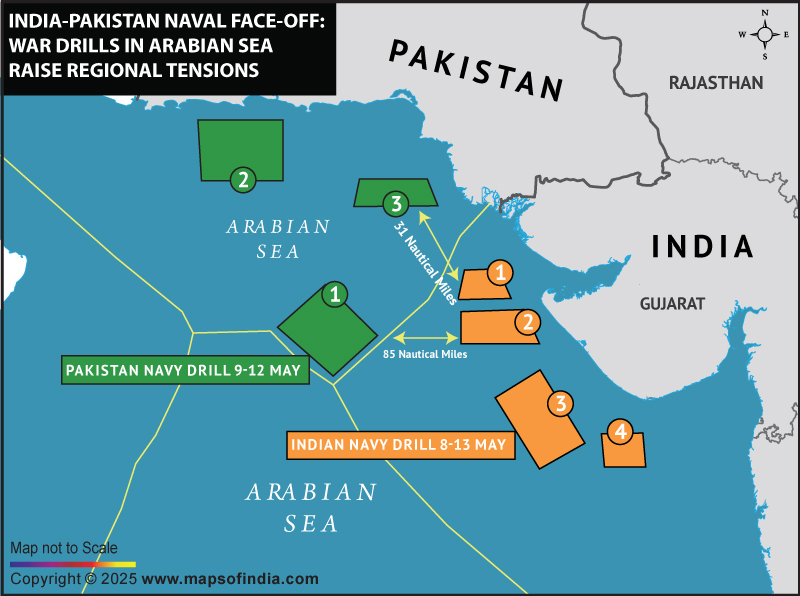



A significant naval face-off between India and Pakistan in the Arabian Sea from May 8 to May 13, 2025, has smartly escalated service forces in South Asia. Characterised by bold war drills, sonar shadowing, and near-collisions, the fight affected plane carriers, submarines, missile frigates, and maritime patrol aeroplanes from both nations, starting international panic over the case of conflict spilling into international waters.
Although no bullets were fired, security critics say the passion of the five-day meeting images Cold War-style brinkmanship and emphasises the fragility of deterrence instruments in the explosive region.
Backdrop of Rising Hostilities
The naval drills occurred in the immediate aftermath of the Lahore blast on May 8, which killed over 30 Pakistani military personnel. Pakistan unofficially blamed India for orchestrating the attack, a claim New Delhi has categorically denied. In response, Pakistan launched what it called a “strategic readiness exercise” in the northern Arabian Sea—directly adjacent to Indian maritime patrol zones.
India swiftly countered with its own naval deployments under Operation Varuna Alert, activating frontline warships from the Western Naval Command and placing maritime strike squadrons on standby in Goa, Porbandar, and Mumbai.
"Within hours of Pakistan’s first surface fleet movement, we had full-spectrum monitoring and escalation readiness in place," a senior Indian Navy official told this reporter. “The timing and composition of their fleet movement suggested more than routine drills.”
Composition of the Forces
Both navies brought significant assets into the theatre:
Indian Navy Deployed:
- INS Vikramaditya – India’s flagship aircraft carrier, escorted by destroyers INS Kochi and INS Chennai.
- INS Kalvari and INS Vagir – Scorpène-class stealth submarines conducting undersea surveillance.
- P-8I Poseidon – Long-range maritime reconnaissance aircraft operating from INS Hansa, Goa.
- Sea King helicopters and Harpoon-armed fast attack craft for ASW (anti-submarine warfare) operations.
- PNS Zulfiquar and PNS Khaibar – Type-21 and F-22P frigates armed with cruise missiles.
- PNS Moawin – Logistic support ship aiding extended drills.
- Agosta 90B submarines, including PNS Hamza, with air-independent propulsion.
- JF-17B Thunder and maritime patrol aircraft coordinated with the Pakistan Maritime Security Agency (PMSA).
Near-Collision Incident: May 10
The most dangerous moment occurred late on May 10 when Indian destroyer INS Kochi intercepted an unexpected bearing from PNS Khaibar, which reportedly deviated from the pre-notified navigation corridor. The two vessels closed to within 2.3 nautical miles before both sides veered away following multiple alert signals.
Sources in India’s Naval Headquarters in New Delhi described the event as a “deliberate provocation.” However, Pakistan Navy officials insisted it was a “miscommunication due to sonar jamming caused by multiple vessels operating in proximity.”
Satellite imagery released by U.S.-based defense think tank StratNav confirmed heightened vessel activity during the time period, with heat signatures showing high-speed maneuvers, particularly on May 10 and 11.
Airpower Interplay: Skirmishes in the Sky
While the core drills remained sea-bound, maritime air operations added an aerial layer to the standoff.
On May 9 and May 11, Indian P-8I aircraft detected radar lock-ons from Pakistani JF-17B fighters patrolling from the Makran coast. In response, Indian Naval Command scrambled MiG-29K fighters from INS Vikramaditya twice for high-altitude deterrence patrols.
“No missile launches occurred, but the level of alertness was extremely high. Cockpit videos show that weapons systems were armed,” revealed a senior pilot stationed in Goa.
Pakistani sources claim Indian aircraft “breached near the edge of its declared Exclusive Economic Zone (EEZ),” though Indian officials deny any such incursion.
Submarine Shadow Games
Beneath the surface, a more secretive dimension unfolded.
Both countries deployed advanced diesel-electric submarines in overlapping patrol arcs. INS Vagir, operating under radio silence, reportedly shadowed PNS Hamza for 12 hours from May 10 to 11 without detection. Indian Navy sources described it as a "silent dominance exercise" meant to underscore India's sonar and stealth edge.
Pakistan, meanwhile, claims to have tracked Indian Kalvari-class submarines using passive sonar arrays and deployed anti-submarine drones for observation—though these claims remain unverified.
A classified Indian Navy dispatch, reviewed by this reporter, warned that “any sudden power-up of sonar or launch tubes would be construed as escalation”—a tense indication of how close the confrontation came to active engagement.
Civil Maritime Disruptions and Commercial Impact
The war drills affected civilian maritime traffic across major shipping lanes in the northern Arabian Sea.
On May 9, the Mumbai Port Authority issued a maritime security advisory to oil tankers and cargo vessels, advising course deviations to avoid the conflict zone. Pakistani ports, including Karachi and Gwadar, also saw brief halts in outbound movement on May 10 and 11.
Maritime insurers briefly raised premiums on vessels operating within 250 nautical miles of the Indian and Pakistani coastlines. According to Lloyd's of London, at least 14 vessels reported delays or detours over the course of the five-day escalation.
“This level of regional instability raises immediate concerns for energy transport routes from the Gulf,” said Admiral (Retd.) Peter Ainsworth, now a consultant with the International Maritime Organization.
Global Response and Diplomatic Calls for Restraint
As news of the naval brinkmanship spread, international leaders issued urgent calls for calm.
- The United Nations Security Council held an emergency closed-door meeting on May 12, urging both nations to avoid miscalculations.
- U.S. Secretary of State, in a call to counterparts in Delhi and Islamabad, emphasized the “unacceptable risk of maritime escalation in a nuclearised region.”
- France and the UK issued joint statements praising Indian restraint but urging immediate de-escalation talks.
- China, while maintaining neutrality, called for "mutual respect of sovereign maritime rights."
India's Stance: Strategic Assertion
In a press briefing on May 13, Indian Defence Minister Rajnath Singh stated:
“India’s naval actions were proportionate, defensive, and clearly intended to safeguard our maritime interests. We will never allow hostile posturing near our shores to go unanswered.”
India has since extended Operation Varuna Alert for another seven days, citing ongoing vigilance. Additional maritime patrol sorties have been launched over the Gulf of Kutch and off the Lakshadweep coast.
A special Parliamentary Committee on Defence met in New Delhi on May 14 to review long-term implications of the face-off and consider bolstering India’s forward naval bases.
Pakistan's Reaction: “Maritime Sovereignty Respected”
Pakistan’s Chief of Naval Staff Admiral Naveed Ashraf, addressing media in Karachi, emphasized that Pakistan’s drills were within legal bounds.
“The Pakistan Navy operated entirely within our internationally recognized EEZ. The presence of foreign warships so close to our waters required tactical preparedness. We acted with restraint and readiness.”
He also warned that any future incursion would be “met with decisive maritime action.”
Pakistan's Foreign Office further accused India of "media manipulation" and attempting to "internationalize a controlled exercise for political mileage."
Public Sentiment and Media Narratives
In India, public sentiment has largely backed the Navy's posture, with national news channels airing dramatic visuals of INS Vikramaditya’s aircraft launches and P-8I flyovers. Hashtags like #ArabianWatch and #NavyOnGuard trended on X (formerly Twitter).
Pakistani media outlets, on the other hand, portrayed the incident as a “show of deterrence,” praising the professionalism of the Pakistan Navy and urging India to “end warmongering in all theatres.”
In both countries, retired admirals and strategic commentators were featured in near-continuous television panels, offering divergent narratives on who escalated first and how future engagements might unfold.
Regional Security Implications
The five-day stalemate has reignited debate over the demand for robust marine deconfliction protocols between India and Pakistan.
Unlike airspace near the Line of Control, which includes pre-defined no-fly zones and hotline policies, the Arabian Sea lacks unambiguous naval career arrangements beyond general adherence to international maritime law.
Unlike land conflicts, where landscape limits exposure, the sea is wide open. Without standing rules of employment or real-time military exchange, the risk of accident or misunderstanding is dangerously high,” warned ocean strategist Dr. Urvashi Singh of the Centre for Naval Security Studies.
The Road Ahead
Though active confrontation has ceased for now, military sources in both countries confirm that surveillance operations are continuing at a high pace. Indian satellite reconnaissance over Karachi Port and Gwadar has intensified, while Pakistan has increased patrols near Sir Creek—a disputed estuarine region often seen as a flashpoint.
There are also increasing calls within Indian strategic circles to expedite the third aircraft transportation project and improve joint naval drills with social countries, including QUAD partners (U.S., Australia, and Japan).
Pakistan, too, is considering enhancing Chinese support for its maritime forces, including the possible purchase of additional Type 054a frigates and advanced anti-ship rockets under the CPEC protection umbrella.
Conclusion: A Perilous Dance in Open Waters
The naval face-off between India and Pakistan in the Arabian Sea was more than just a war drill—it was a carefully choreographed show of strength, resilience, and deterrence. Yet, its execution flirted dangerously with uncontrolled escalation. In an age where missiles can be launched in minutes and sonar shadows can be misinterpreted as threats, the importance of communication, restraint, and maritime diplomacy cannot be overstated.
As navies withdraw and ports resume normalcy, the scars of the stand-off remain etched in sonar records, radar logs, and the minds of commanders who came close to the edge—underwater and above it.
Last Updated on : April 17, 2026
